


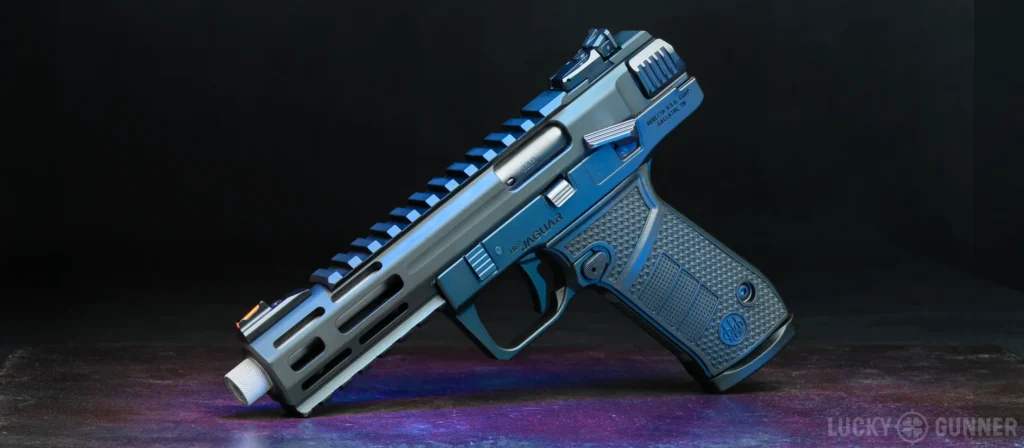
The new Beretta B22 Jaguar Tac Metal brings a fresh approach to the classic .22 plinker, with 15-round magazines, a removable barrel, and a design that seems to prioritize speed over pinpoint accuracy. But how well does it actually shoot? In this installment of Project Rimfire, we’re putting the B22 through our usual accuracy and reliability testing to see what Beretta’s newest rimfire pistol has to offer.
Details are in the video below, or keep scrolling to read the full transcript.
Hey everybody, I am Chris Baker from Lucky Gunner and today we are looking at the new Beretta B22 Jaguar Tac Metal. It’s a .22 pistol that, according to Beretta, is “built to train, built to last, and built like nothing else in its class.” Hey, that rhymes! But is it true? Let’s find out.
Beretta B22 Jaguar: A New Kind of Classic .22 Plinker
That’s right, Project Rimfire is back. This is the series where I have been reviewing an unreasonable number of handguns chambered for .22 Long Rifle. So far, I have covered pocket pistols, medium frame revolvers, and training pistols. Now we’re moving on to the category I’m calling “classic plinkers.”
These are pistols like the Ruger Mark IV, Browning Buckmark, and Smith & Wesson Victory. You might call them target .22s, traditional .22s, or something else. The industry hasn’t settled on a term for these so I’m going with “classic plinkers.”
Now, I have to at least give a shout-out to the original Beretta Jaguar. That was the Model 71, which was nothing like the B22. Beretta made that one from 1958 to 1985. It was a very cool compact .22 that had a lot more in common with today’s training-style pistols.
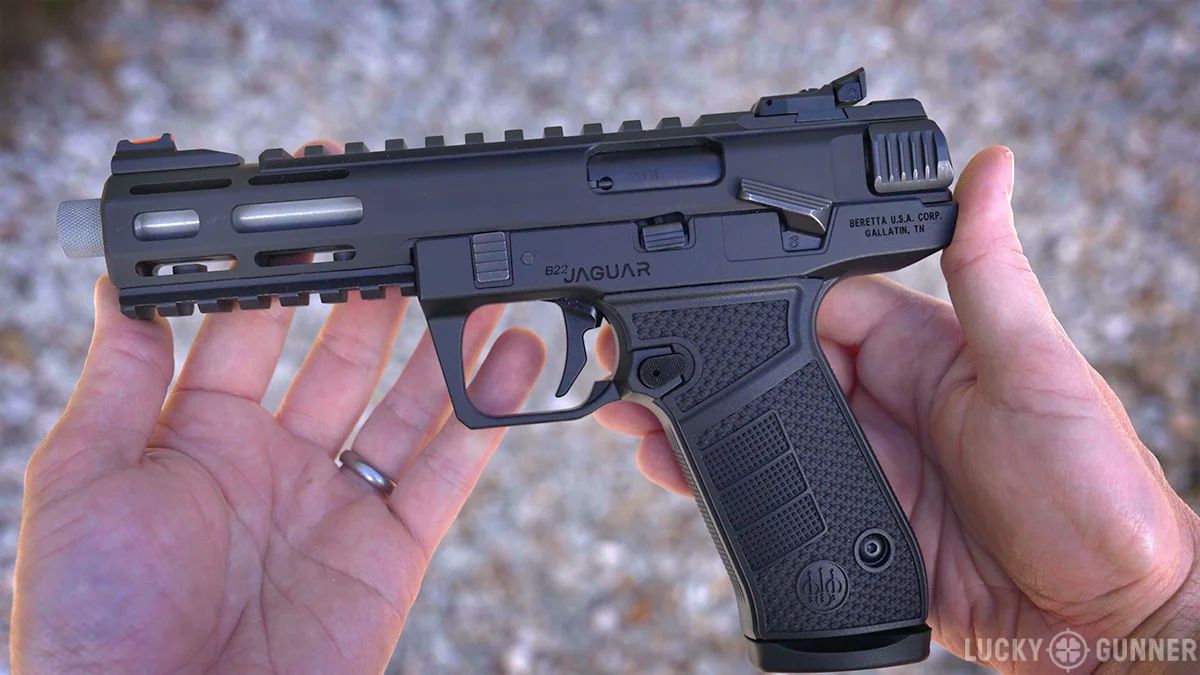
The new B22 Jaguar instead follows the classic plinker format: it’s got a fixed barrel and a fixed sight base. The only thing that moves when you fire is the bolt back here. Unlike the trainer pistols, it’s not trying to mimic the look and feel of a centerfire gun. When you look at this, you immediately know it’s a .22.
Pistols in this category have often been considered the do-everything .22s, but the designs often prioritize accuracy and shootability. We’ll see how the B22 performs in those areas in just a minute.
Beretta B22 Jaguar Features and Design
Beretta is calling this variant the Tac Metal, I think to distinguish it from the competition version that’s coming out later. But like the name implies, it’s all metal construction — aluminum grip frame and upper receiver with a steel barrel and bolt. It’s 32 ounces empty, 36 loaded. I was surprised how heavy it felt when I first picked it up. But it’s actually pretty well balanced. It’s not front-heavy like some of the bull-barrel target pistols.
Threaded barrel is standard. The front sight is a red fiber optic with an adjustable rear. It’s compatible with Ruger Mark IV sights, so there are plenty of aftermarket options already available if you want to swap those out. Or if you want to just throw an optic on it, the top picatinny rail is machined right into the upper receiver. We’ve got M-LOK slots on either side of the barrel. I have no idea what you would put there, but you can attach stuff if you want. There’s another pic rail on the bottom, but this one is removable and underneath there’s another pair of M-LOK slots.
The manual safety is ambidextrous. I’m not the biggest 1911 fan, but I do believe Grandpa Browning nailed it in terms of finding the ideal location for a manual safety. The B22 safety is in a similar position but it’s just a little higher relative to the tang. The mag release is reversible for left or right handed use. The ejection port is open on both sides and it can be set up for left-hand ejection. The only non-lefty friendly control is the bolt catch, which is only on the left side.
The B22 comes with two 15-round mags. Or 10 rounders if you’re in a ban state. That’s a big selling point for this gun. All the other classic plinker style pistols are limited to single stack 10 round mags. Extra mags are a bit steep at 69 bucks a piece.
Trigger, Reliability, and Break-In
Like most 22 autos, the Beretta is single action with an internal hammer. The trigger is not quite a flat-faced design but it’s close. You get a little bit of pre-travel and then it breaks right at three pounds. It felt a little heavier when I first got it, but there was noticeable improvement after firing a couple hundred rounds.
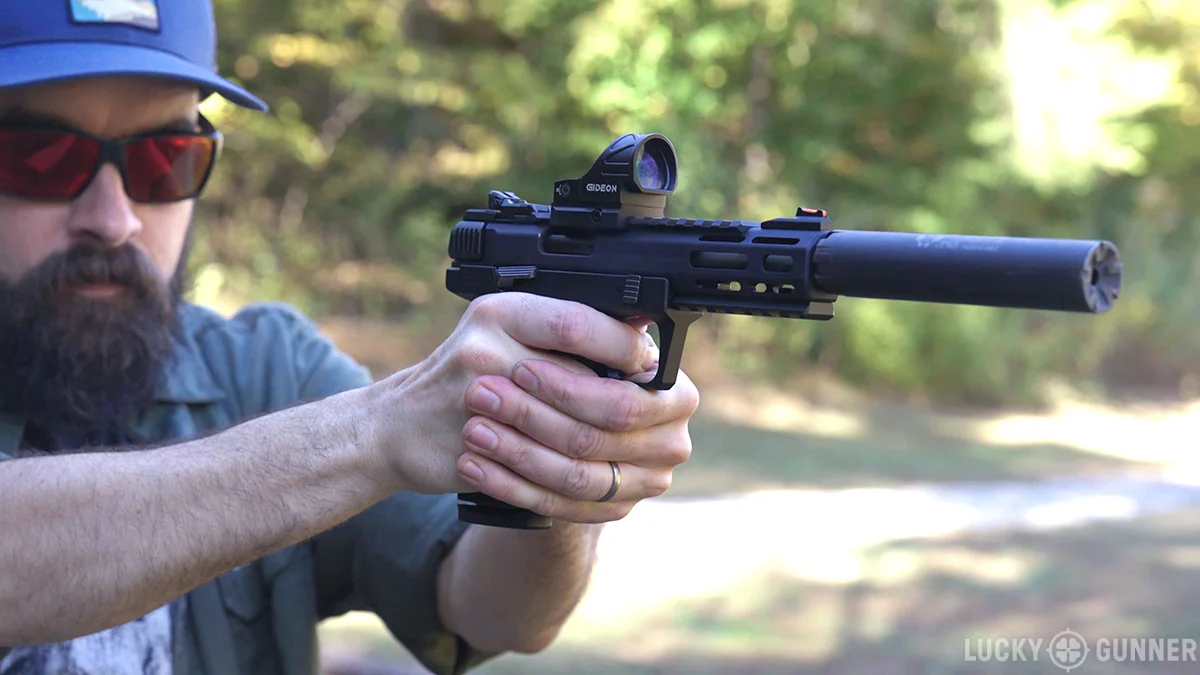
Reliability also improved after a short break-in period. I was getting failures to feed with CCI Mini-Mags when it was brand new. So I shot 50 rounds of CCI Standard Velocity, which it ran fine. That must have loosened things up a little because Mini-Mags worked fine after that. I’ve now got about 600 rounds through it with no failures. That’s a mix of suppressed and unsuppressed.
I did have an issue for a while where using the bolt catch to close the bolt would not work about half the time. The bolt wouldn’t have enough energy to fully chamber the round and I would have to slingshot it. But that issue also seems to have gone away after shooting it a bit more.
Disassembly and Removable Barrel
Field stripping the B22 is pretty straightforward. It’s not as simple as a Mark IV, but nothing is, really. The unique thing Beretta has done here is to make the barrel removable without any special tools. It’s just a few extra steps outlined in the manual. That’s really nice for deep cleaning, and it opens the door for aftermarket barrels and other modifications.
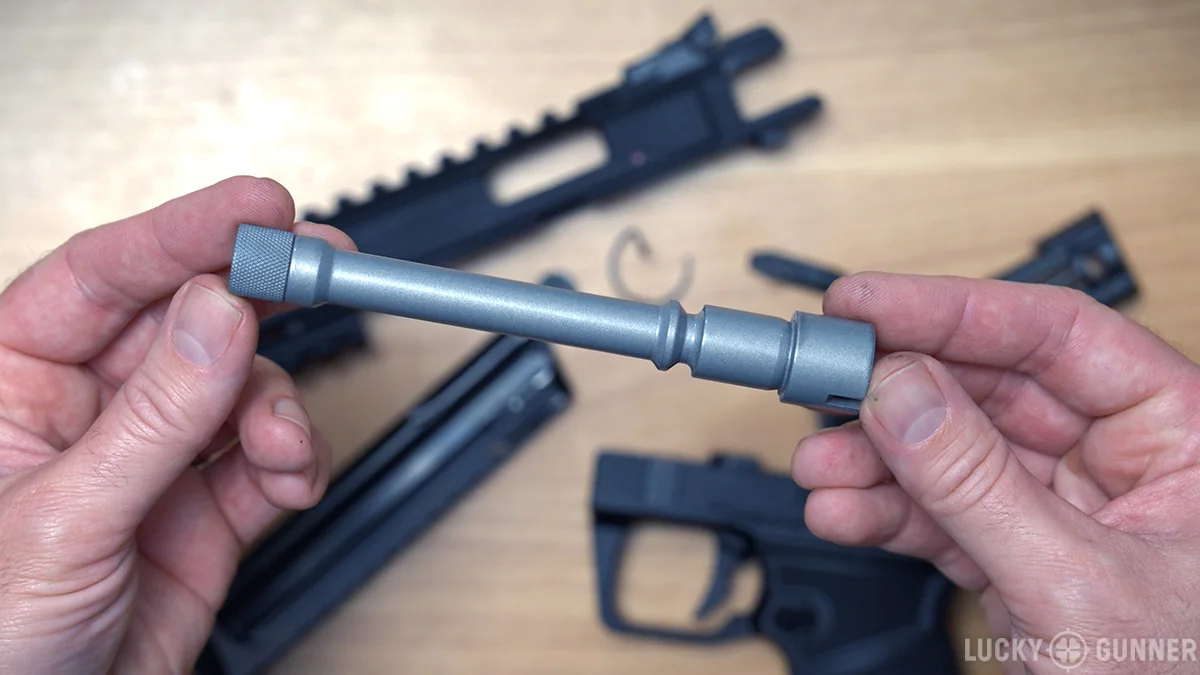
With most of these plinker style guns, the barrel and upper receiver are either impossible or very difficult to separate. Now that, of course, raises the question of whether having a removable barrel is a detriment to accuracy. There’s only one way to find out.
Beretta B22 Jaguar Accuracy Testing
As always, I fired two 5-round groups from a bench rest at 25 yards – this time, with four different ammo types.
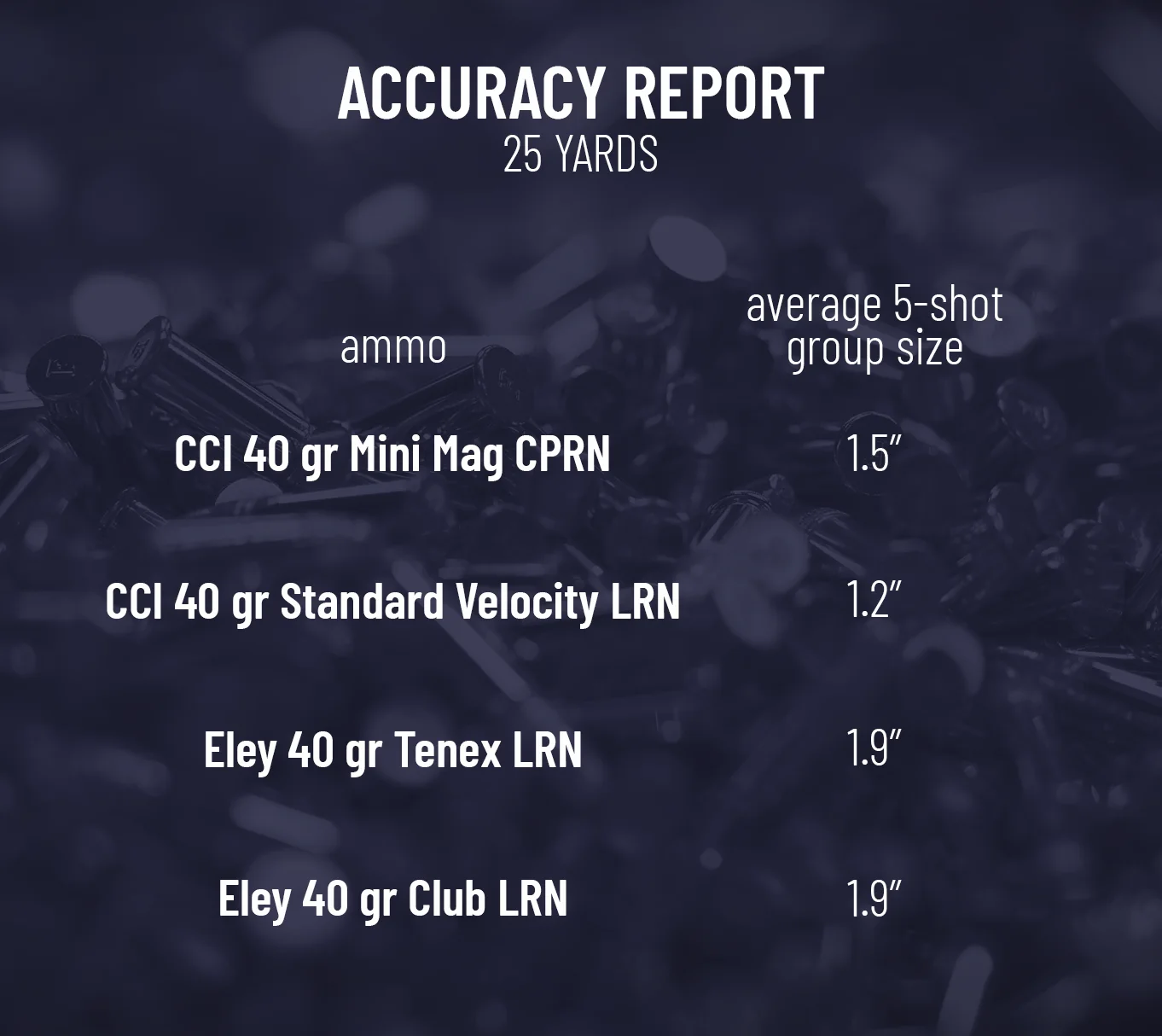
It grouped best with CCI Standard Velocity with a 1.2-inch average. The overall average was 1.6 inches.
Compared to the other guns we’ve tested so far in Project Rimfire, this is pretty good. However, generally speaking, the classic plinker semi-autos tend to be among the most accurate .22 handguns (outside of the purpose-built bullseye competition pistols). I would expect a gun like the B22 to shoot circles around these revolvers and trainer-style pistols.
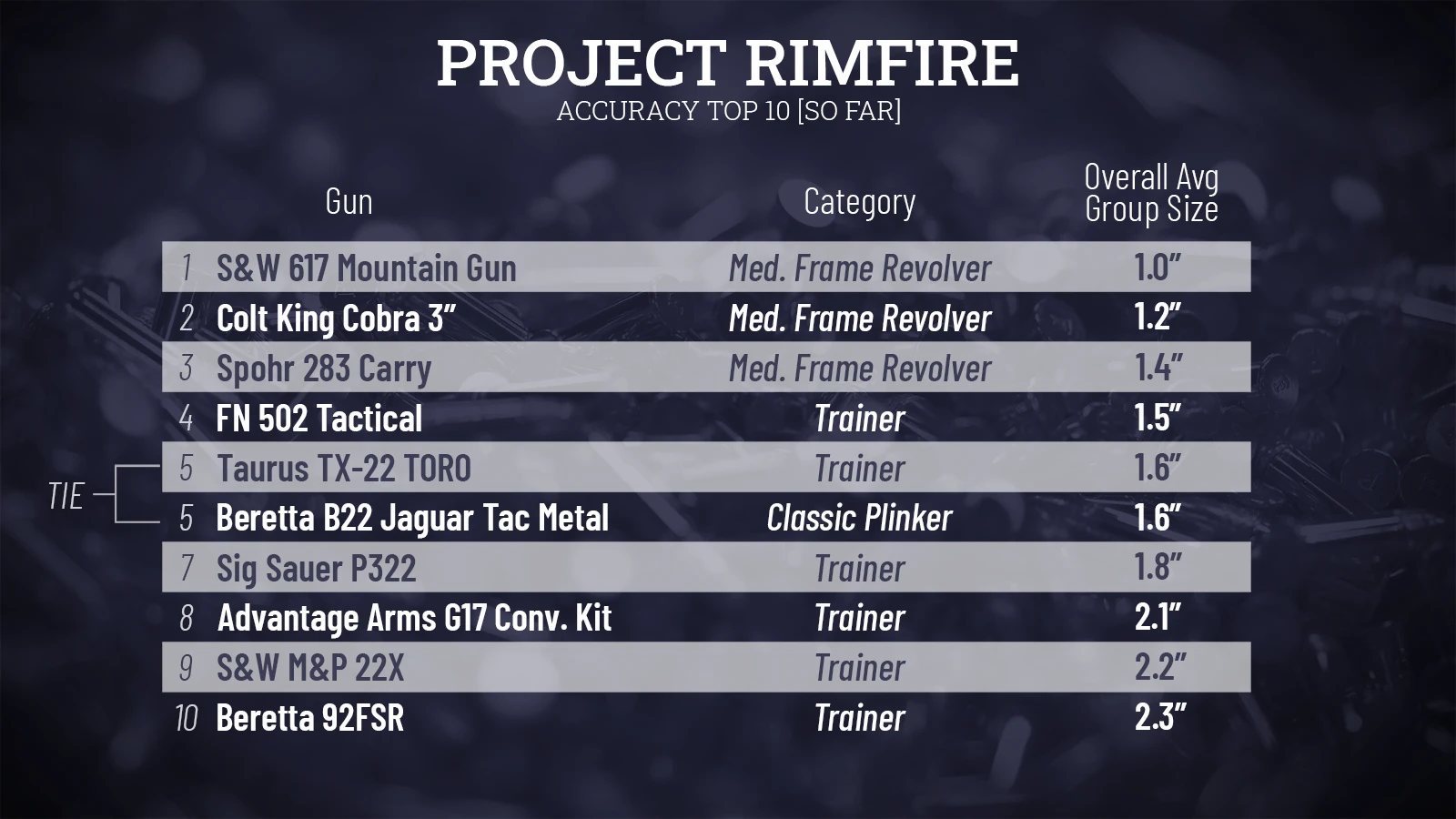
If the B22’s accuracy is less than amazing, it’s probably because that was never Beretta’s goal for this pistol. Like I mentioned, Beretta is coming out with a competition variant of the B22 soon. But it’s basically the Tac Metal with a few TandemKross parts bolted on. It has the same barrel and same internals. And it’s explicitly designed for steel challenge – a shooting sport that’s a lot more about speed than shooting tiny groups.
Built for Speed: Is the B22 Jaguar Worth It?
And the B22 really does seem ideal for that kind of shooting. I can’t point to any one reason why. The trigger is good but not amazing. There’s not a lot of muzzle rise. The grip is… well, grippy, with texture on every surface. It all comes together to form a package that’s just begging you to shoot fast because the gun’s not going to move.
MSRP for the Tac Metal version is $749. Now, I know you have questions: Is this a good value compared to other classic plinkers? How would it perform in a head to head test of speed or accuracy? Should you get a perm? Well, my friends, answering these questions is exactly what Project Rimfire is for. But you’ll have to wait until next time to find out. Our classic plinker comparison video is coming soon. Make sure you are subscribed so you don’t miss it. I’ll see you then.