


Which ammunition calibers are gaining popularity, and which ones are falling out of favor? We dug into 15 years of Lucky Gunner sales data to see how Americans’ ammo-buying habits have changed over time. Some of the results were predictable, but a few surprised us, especially the overwhelming dominance of a handful of cartridges and the remarkable rise of some relative newcomers.
Details are in the video below, or keep scrolling to read the transcript.
Hey everybody, Chris Baker here from Lucky Gunner. This is a round of 6.5 Creedmoor. Just 15 years ago, you’d have had a hard time finding this for sale anywhere. It was a boutique round for a small group of long range enthusiasts. Today, it’s one of the top five best-selling rifle cartridges in the country. That kind of disruption does not happen very often in this industry. And it occurred to me, there are probably some other unexpected trends hiding in the numbers our company has collected over the last decade and a half. So I went digging, and today, we’re going to look at what I found. Some of it may not surprise you. I’m pretty sure some of it will.
The Top Ten Best Selling Cartridges
So let’s get right to it. We’ll start with our all-time top ten calibers in terms of number of rounds sold.
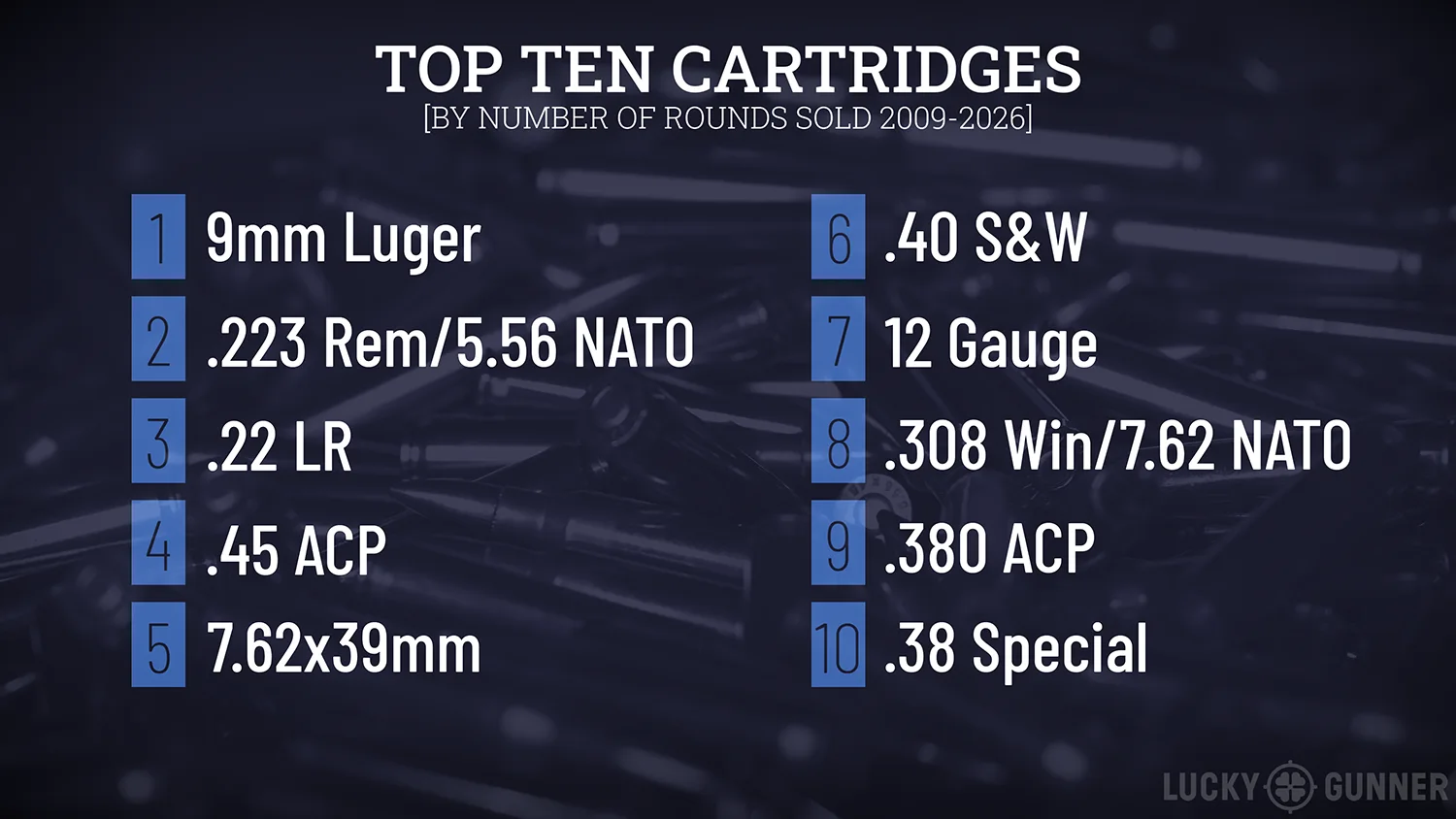
At the top we’ve got 9mm followed by .223/5.56 combined, and rounding out the podium is the mighty .22 LR. And then we’ve got the rest of the usual suspects. I don’t know about you, but that looks pretty much like I expected. But how about if I break this down by percentage of total rounds sold?
Just Three Calibers Dominate Ammo Sales
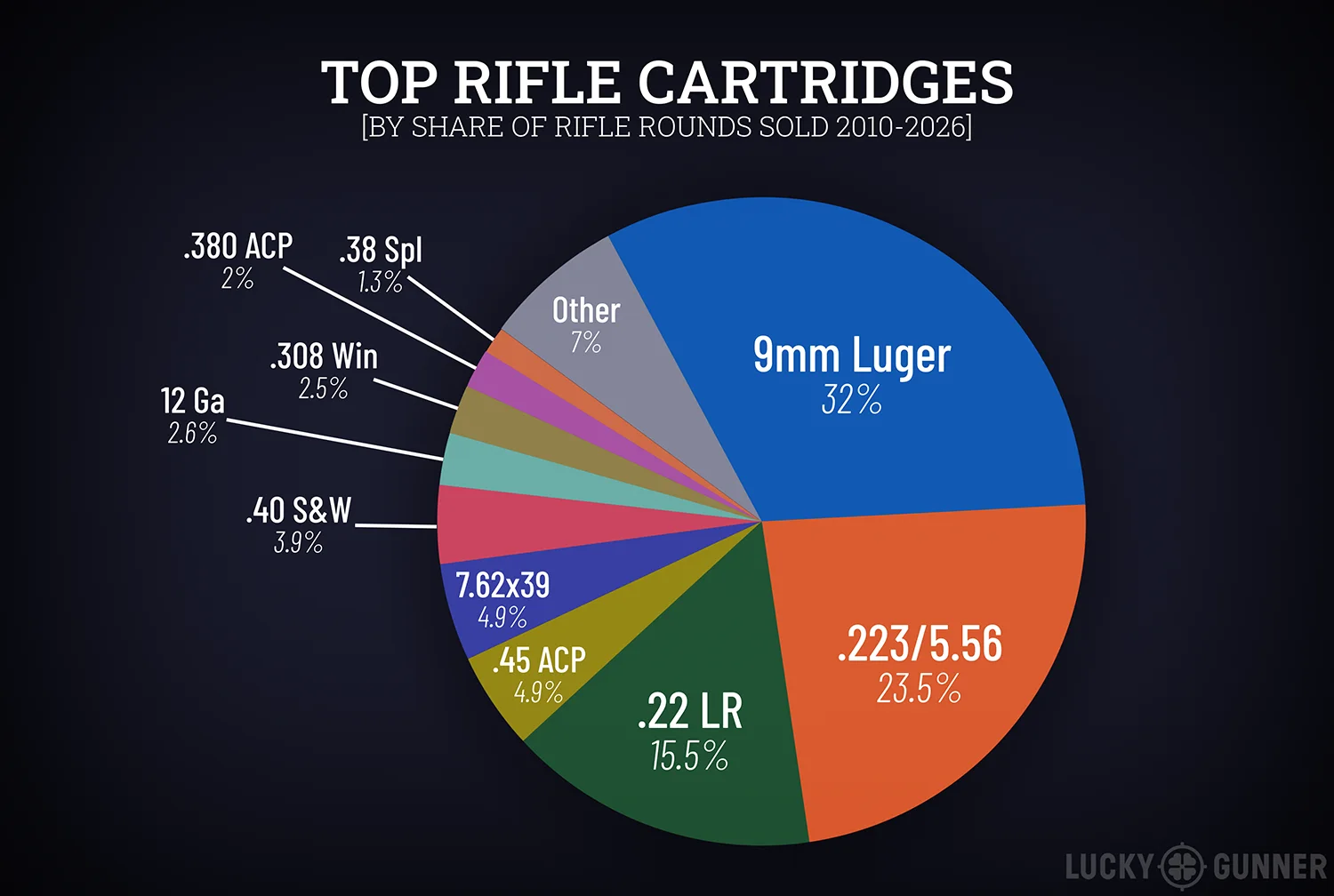
Now we’ve got something to talk about.
The top three calibers account for 71% of all rounds sold. The top 10 combined make up 93%. No individual cartridge lower than the top ten has more than a 1% share.
Sales Don’t Tell the Whole Story
Now, before we start jumping to any crazy conclusions, let’s talk about a couple of caveats.
First, this is just one online company’s data. It’s not a perfect analog for overall countrywide ammo sales.
Second caveat, we’re looking at the number of rounds sold, but that’s not the only way to gauge the popularity of a cartridge. For example, a round could be incredibly popular with hunters, but hunters tend to go through a fraction of the ammo that competition or recreational shooters do. Modest sales numbers don’t necessarily mean nobody likes it.
Having said that, let’s break these numbers down by category and look at how they’ve changed over time. I think that will give us some better clues about what our fellow shooters have been up to.
How Pistol Caliber Popularity Has Changed Since 2010
Let’s do pistol rounds first.
In 2010, the first full year we were in business, the top five pistol calibers were 9mm, .45 ACP, .40 S&W, .380 ACP, and .38 Special. We have the same top five today, except .380 and .40 have switched places.
The Rise of 9mm
But now let’s look at the percentage of overall pistol sales because that has changed a lot.
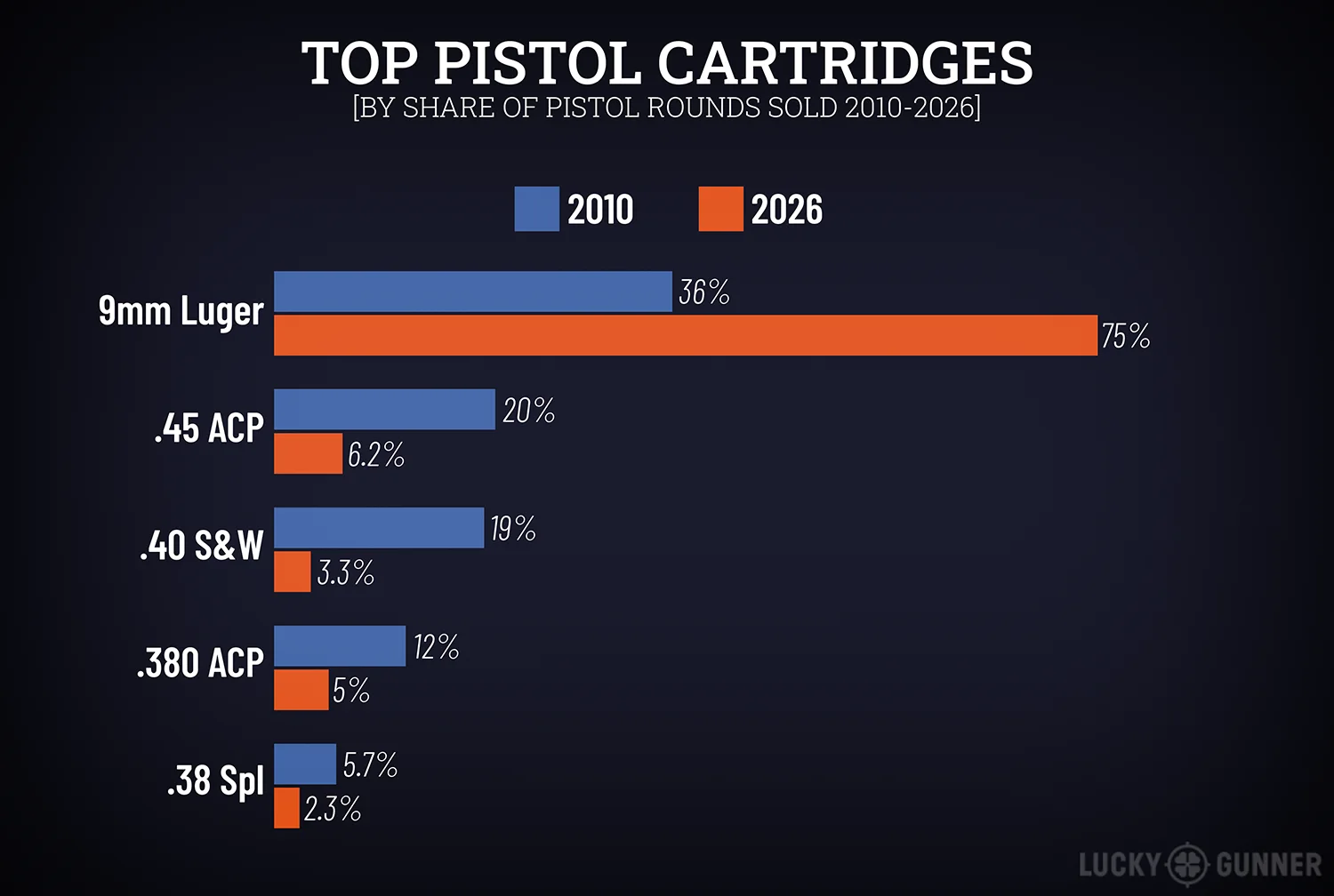
Things were much more spread out in 2010, but now 9mm has almost completely taken over. It grew from 36% to 75%. Combined, .45 and .40 were at 39% and now they’re less than 10%. But the overall share of the top five together has remained between 92 to 95%. The other 50 or so pistol calibers we’ve carried make up the bottom 5%.
Now let’s break it down by year. 9mm steadily rose for a decade and then plateaued around 2021.
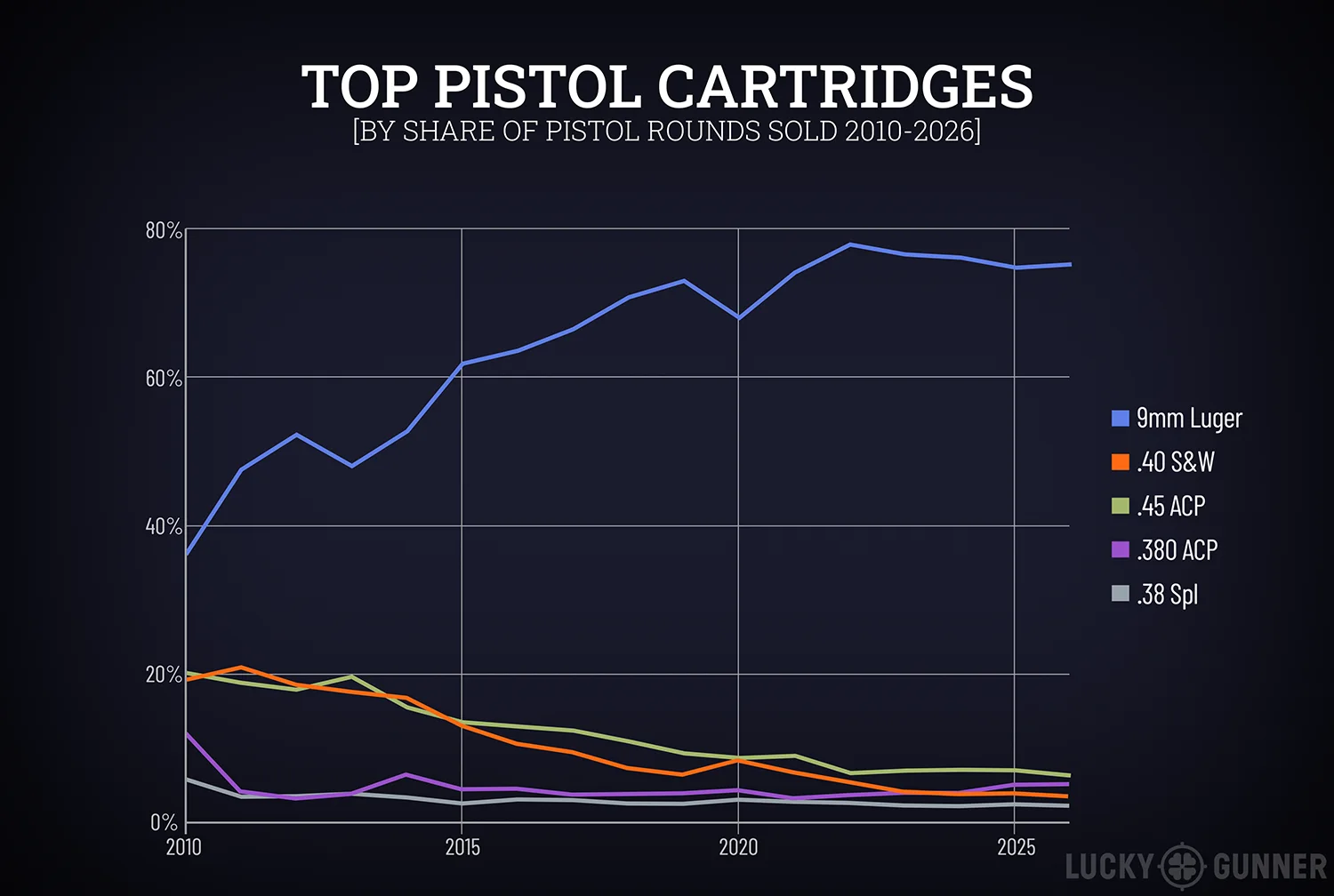
The dips we see here in 2013 and 2020 are when we had big spikes in overall ammo sales. When 9mm is hard to get, people start buying other calibers so the share of 9mm goes down.
.38 Special and .380 have been pretty steady since about 2011, while .40 and .45 have gradually had their share gobbled up by 9mm.
Now, you probably didn’t need to see these numbers to guess that 9mm is the most popular pistol cartridge. But I was surprised to see just how dominant it is and how quickly that change happened.
I’d be really curious to see when this trend actually started because my guess is that it goes back way before our company was around — probably back to the 90s — and what we’re seeing now is just the tail end of it.
The Most Popular Rifle Calibers: 2010 vs. Today
Okay, moving on to rifle ammo: today’s top ten versus 2010.
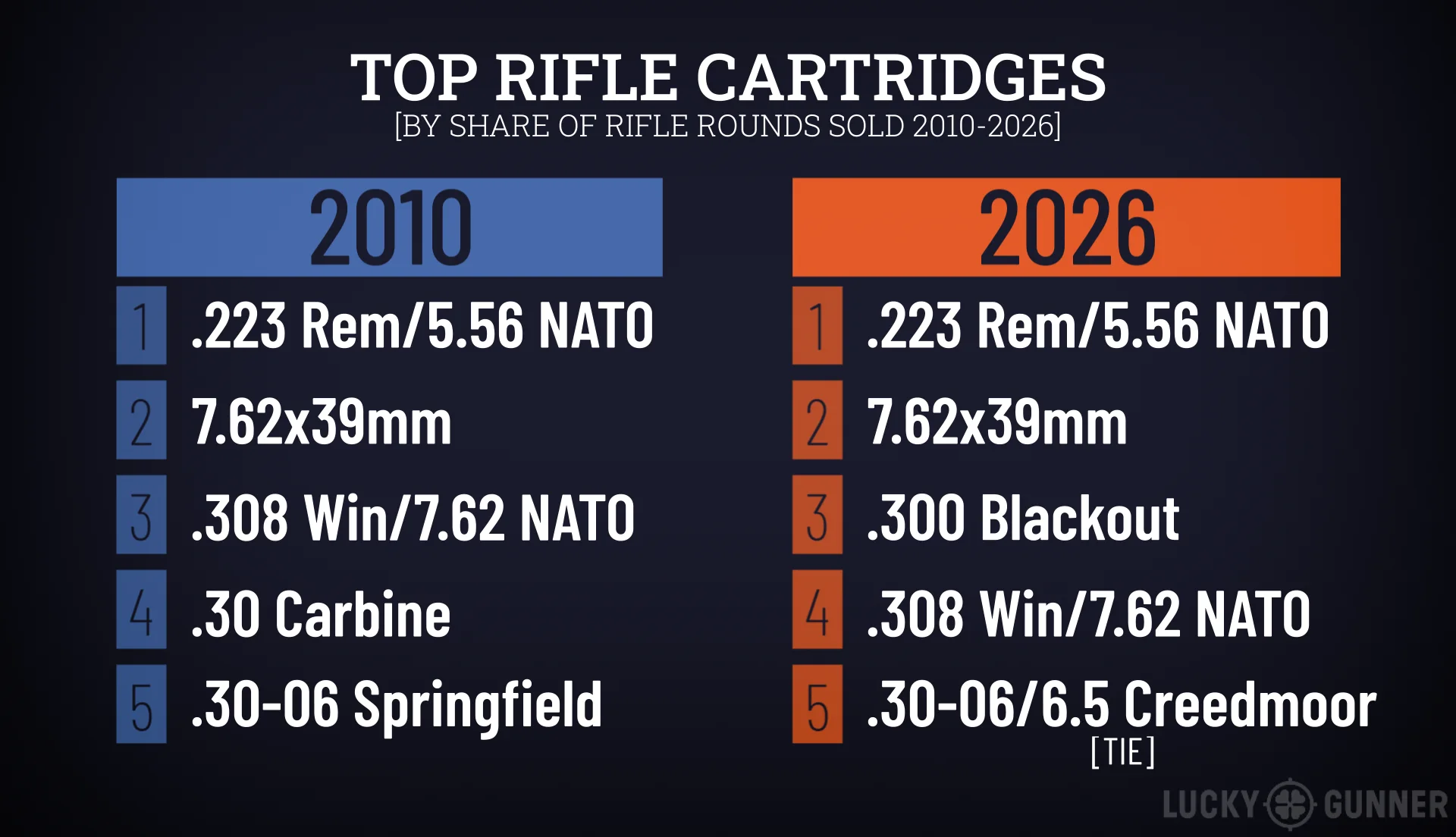
We’ve got 5.56 and 7.62×39 holding the leading spots. .308 goes from third to fourth. .30 Carbine got bumped in favor of .300 Blackout. And 6.5 Creedmoor is now tied with .30-06 at fifth place. 300 Blackout and 6.5 Creedmoor were both brand new cartridges in 2010. We didn’t even stock them until around 2012. So to go from nothing to the top five is really impressive. More on that in a minute. Let’s look at the percentage breakdown over time.
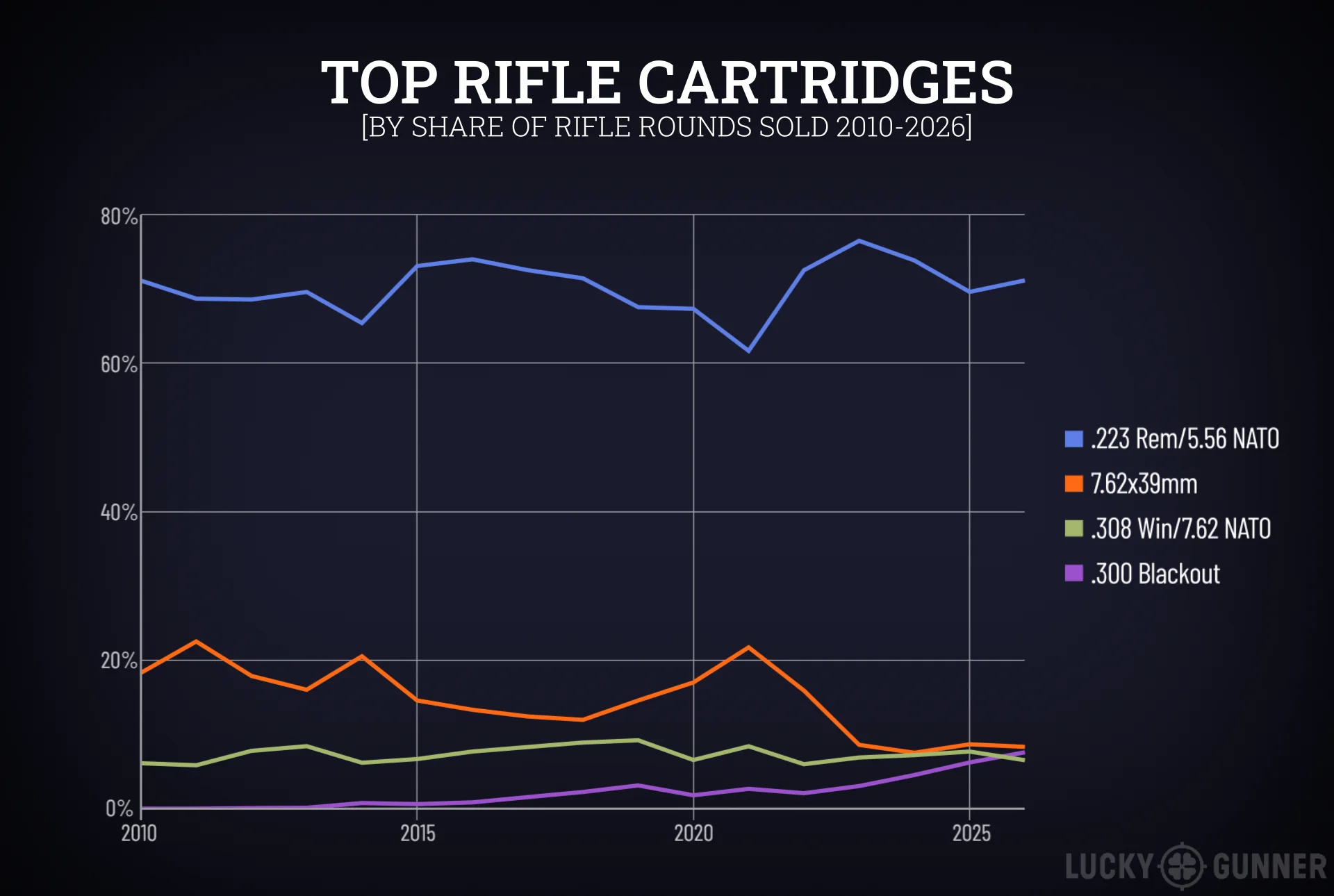
This is nothing like what we saw with the pistol ammo. 5.56 is clearly dominant, but it’s been that way the whole time. It’s hovered between roughly 65-75%. I only bothered putting the top four on the graph here because everything else is hardly visible relative to 5.56. But let’s zoom in on each one of these for a second.
Rifle Cartridge Breakdown
7.62×39 has held second place, but it’s less than half of what it used to be. The big drop off there happens after 2021. That’s when the import restrictions hit that affected the Russian steel cased ammo. There are still plenty of sources for that cartridge, it’s just not the cheap option it used to be.
.308 has been holding steady at around 6-9%. Even though it was surpassed by .300 Blackout this year, it’s still just as popular as ever. Same with .30-06. It has not changed a whole lot over the last 15 years. A good chunk of that comes from loads made for the M1 Garand and I can hear the approving call of a bald eagle every time a box leaves the warehouse.
You guys know I love the M1 Carbine, but even I was a little surprised to see .30 Carbine on this list. There’s basically just one gun that fires it. Apparently, it does really well whenever there is cheap military surplus available like we had in 2010 and 2020. Sadly, I do not know when or if we’ll see more surplus .30 Carbine, but it’s still fairly popular. Today it’s our #8 rifle cartridge.
How .300 Blackout and 6.5 Creedmoor Became Best-Sellers
For me, the biggest surprises are .300 Blackout and 6.5 Creedmoor. I did not expect to see either of them in the top 5. They have some similar advantages that I think put them there. Both are very good at the specific roles they were designed for. They both came out with a lot of industry support behind them. And they were both kind of in the right place at the right time in terms of what shooters were looking for.
But the case of 6.5 Creedmoor is extra unique because of its popularity relative to its cost. It’s more affordable than it used to be but the cheap stuff is still close to a buck a round. The decent target loads are double that. People just really like shooting this cartridge and they’re willing to pay for it.
It’s accounted for roughly 1.5% of our rifle ammo sales the last three years, which might not sound like a lot. But look at it this way: we’ve had about 140 different rifle cartridges in stock at some point this year. We’ve sold more rounds of 6.5 Creedmoor than the bottom 124 cartridges combined.
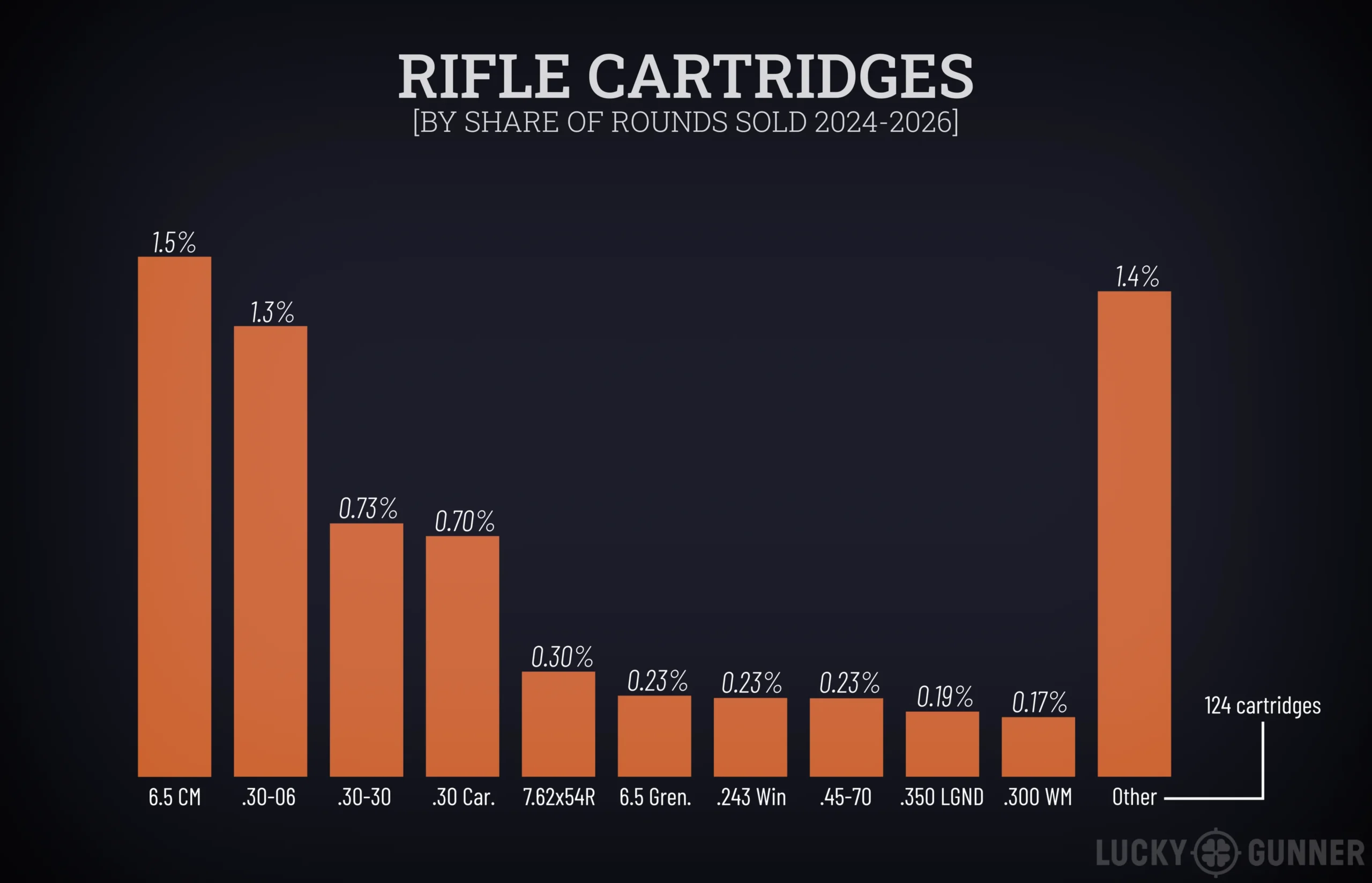
Now, if you’re a fan of one of these more obscure cartridges, there’s another way of looking at this. It doesn’t take much to keep a cartridge alive. Demand has to get ridiculously low before all the major ammo makers completely stop making a cartridge. It might not always be easy to find or affordable, but the industry will oftentimes keep supporting a cartridge for a very small but enthusiastic customer base.
Okay, I’ve had enough of staring at spreadsheets for now. But I might revisit it in the future if you guys are interested in more. Before I go, there is one cartridge we’ve sold just 100 rounds of in the last 15 years. And that was spread out over three years. It’s our worst performing cartridge ever. I’m curious if anyone can guess what it is. Let me know in the comments. First person to get it right gets a… I don’t know, a virtual high five. Alright, see you next time.