


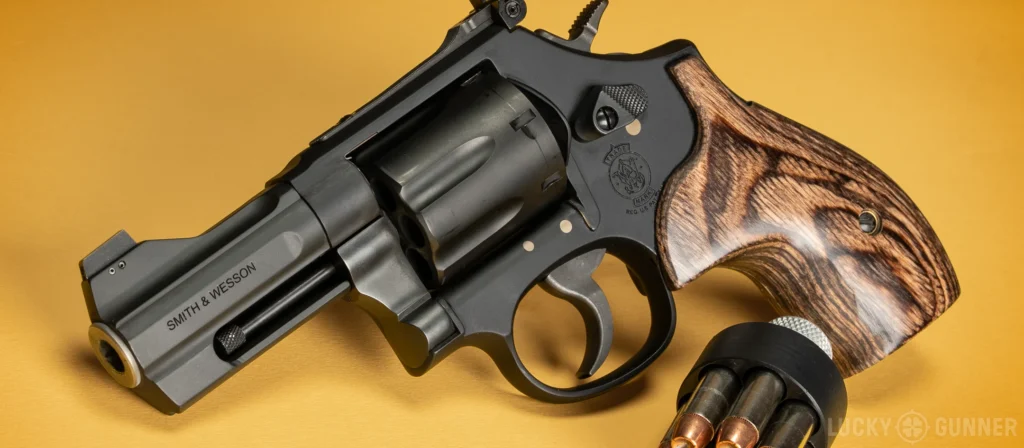
About a year ago, I did a video lamenting the lack of new revolvers with modern or innovative features. This year, Smith & Wesson has taken a step toward alleviating that gap with the new Night Guard revolvers.
But are they any good? In this review, I’m covering the (tragic and brief) history of the original Night Guards and how the new ones are different. And, of course, we’ll look at accuracy and recoil impressions with .38 Special and .357 Magnum loads, and how S&W’s quality control issues factor into the picture.
Details are in the video below, or keep scrolling for the full transcript.
Hey everybody, I’m Chris Baker from Lucky Gunner and today I’m going to talk about the new Smith & Wesson Model 386 Night Guard – a lightweight 7-shot .357 Magnum.
What Is the S&W 386 Night Guard?
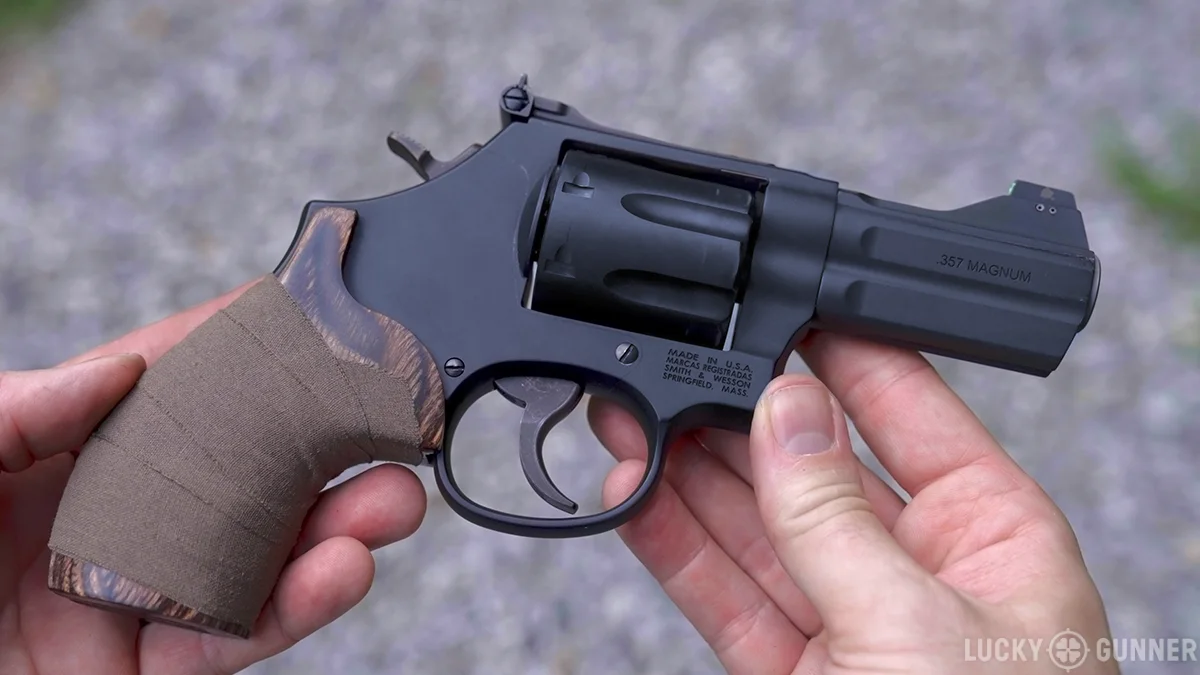
“Lightweight” here is not just a marketing term, it is the main appeal of this revolver. It has the same dimensions as the all-steel 686 L-frame, but the frame is an aluminum/scandium alloy. The cylinder and the barrel here inside this sleeve are steel, but the lighter frame alone makes a huge difference. It weighs about 24 ounces empty, 27 and a half loaded. That is 12 ounces less than the 686, or about the same as a loaded Glock 48.
The 386 was released earlier this year as a Lipsey’s distributor exclusive alongside the 396 Night Guard – that one is a 5-shot .44 Special L-frame.
The Original Night Guards: A Brief History
This is the second go-around for the Night Guards. The first attempt was back in 2008. They were called Night Guards because they all had tritium nights sights in the front, which was a pretty novel concept back then. They made eight different versions in seven calibers and three frame sizes – without a doubt some of the coolest carry revolvers Smith ever made. Sadly, the whole line was discontinued just a few years later and most of their other medium and large lightweight revolvers didn’t last much longer.
The early 2000s marked a low point for revolver interest in general. And it didn’t help that the Night Guards launched with a high MSRP during a major economic recession. And releasing eight different models at once was probably a mistake. It was confusing, and there was no obvious default choice for customers to gravitate toward.
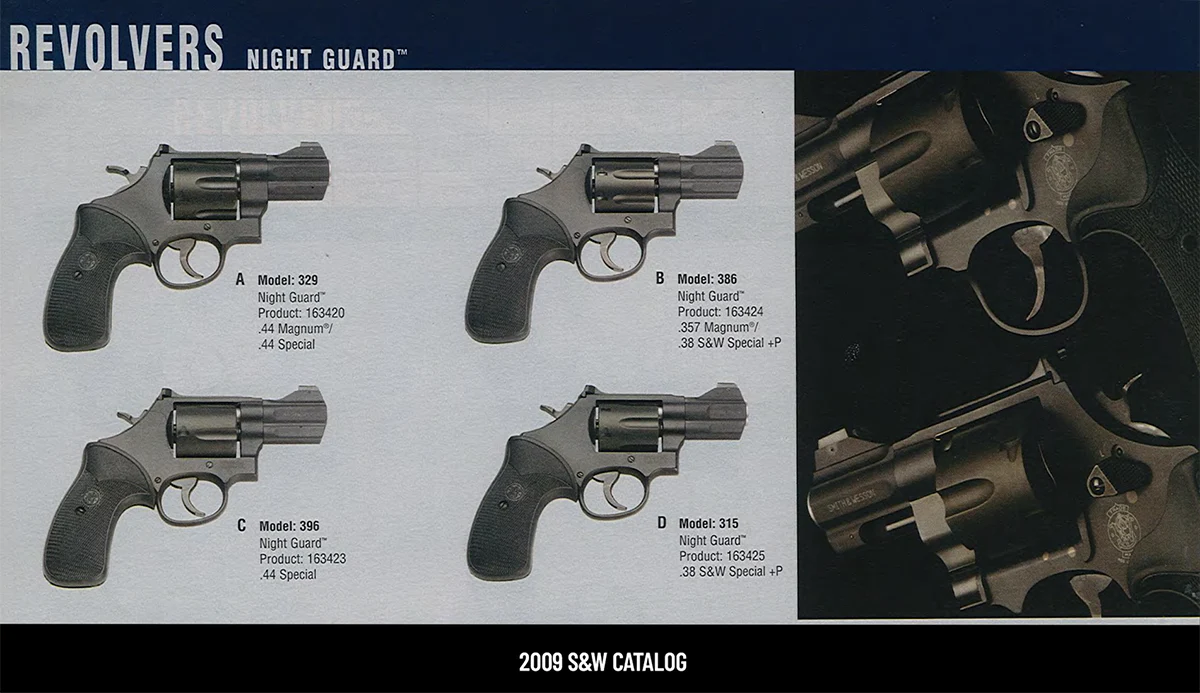
Unfortunately, the lesson Smith & Wesson seemed to learn was that the market does not want lightweight medium-frame revolvers. But with some encouragement from Lipsey’s, they have finally warmed up to the idea again. And they did not just regurgitate the old Night Guards, they made several changes, and I would say most of them are improvements.
What’s Changed Since 2008
First, we have no internal lock – a huge plus. At the front here there’s a fantastic XS night sight. It’s a tritium vial with a bright fluorescent green ring. The old Night Guard sight had a white ring and a rounded profile that made it harder to get a clean sight picture.
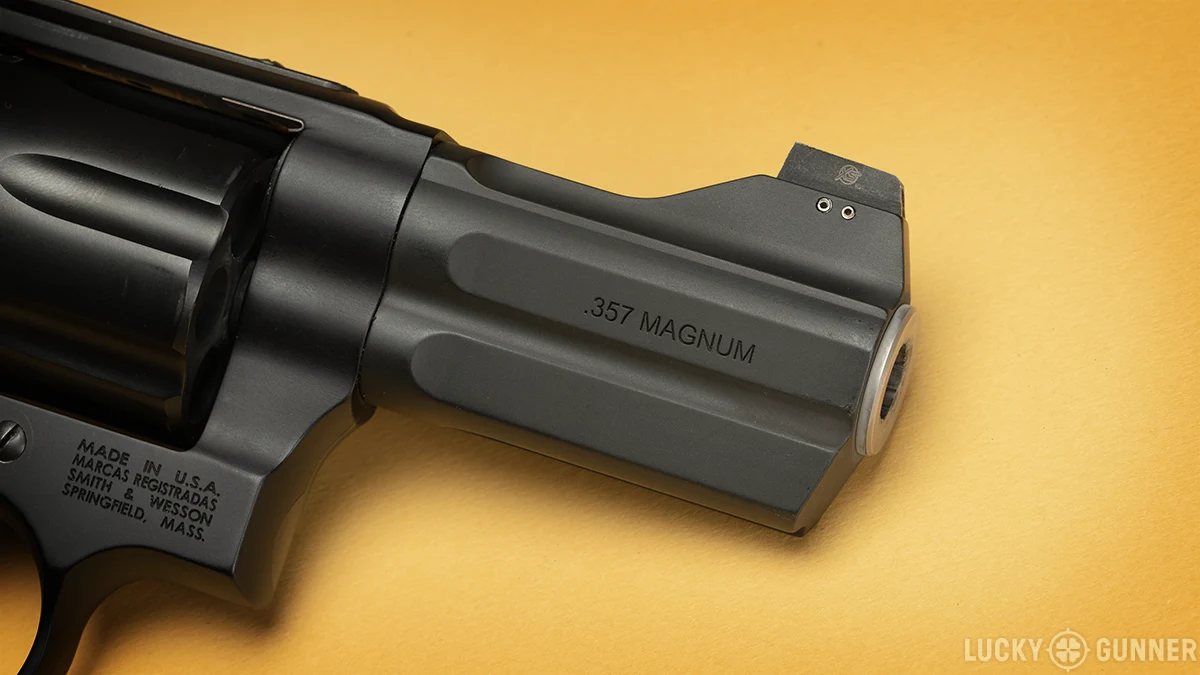
They went with a 3-inch barrel instead of two and a half. You get a little more velocity with 3 inches and it also leaves room for a full-length ejector rod so you don’t have to worry about those empty cases getting stuck.
The original Night Guards came with a fixed, snag-resistant rear sight. That solves one problem, but it creates a new one. With .38 and .357, your point of impact can shift several inches between different loads, even at fairly close range. So for the new Night Guards, I think they made the right call by going with the standard Smith & Wesson adjustable rear sight.
I was happy to see that the rear sight blade has a deeper notch than a lot of the other recent-production Smiths. I can actually see the entire front sight ring through the notch.
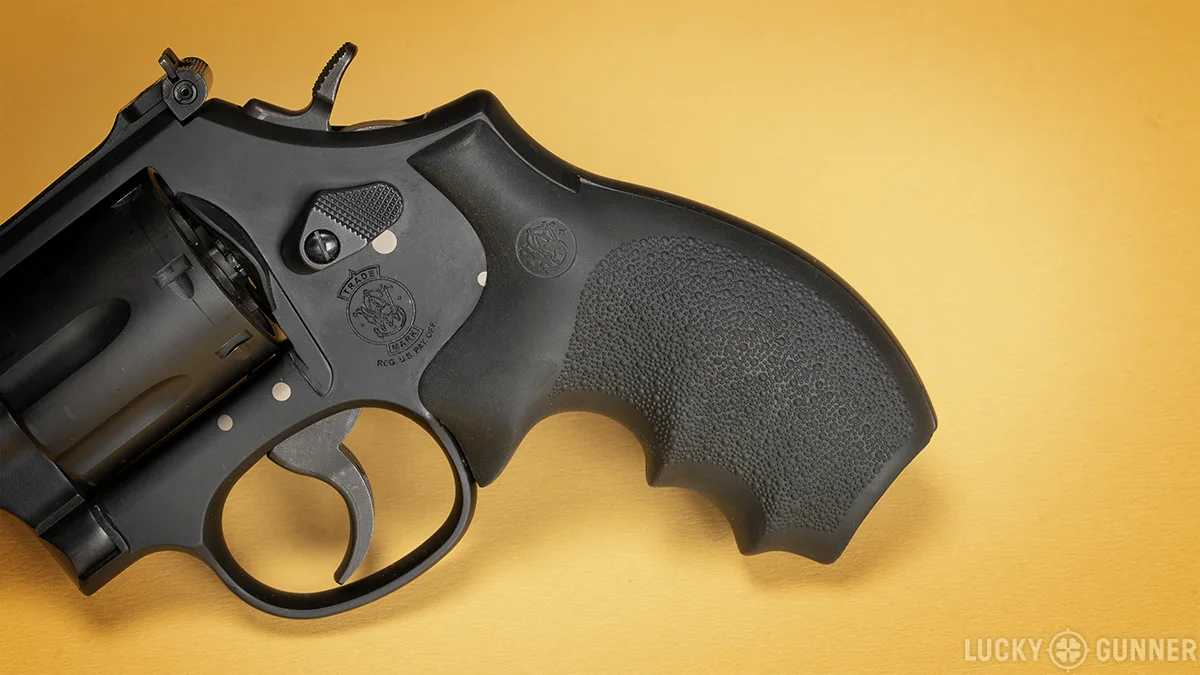
For the grips, they’re shipping with Hogues. They’re… fine. Like factory Glock sights or the photo of the fake family that comes with picture frames, the Hogues are just placeholders until you add your grips of choice. I went with a set of Altamont boot grips, which are only good if you’re willing to work on them a little bit. I sanded down all the sharp edges and Dremeled off the completely unnecessary finger groove. Then I added a little grip tape for some extra traction in the sweaty weather we’re having.
So in terms of design and configuration, this is all looking pretty good so far. How about the execution?
Accuracy Testing
Let’s start with accuracy. I shot 5-round groups from a bench rest at 25 yards with a Holosun red dot sight mounted. I tried four different loads – two .38s and two .357s. Average group size was about 2 inches with Black Hills wadcutters and Hornady XTPs. Three inches with the Gold Dot Magnum load, but then it opened up to six inches with the .38 Gold Dot.
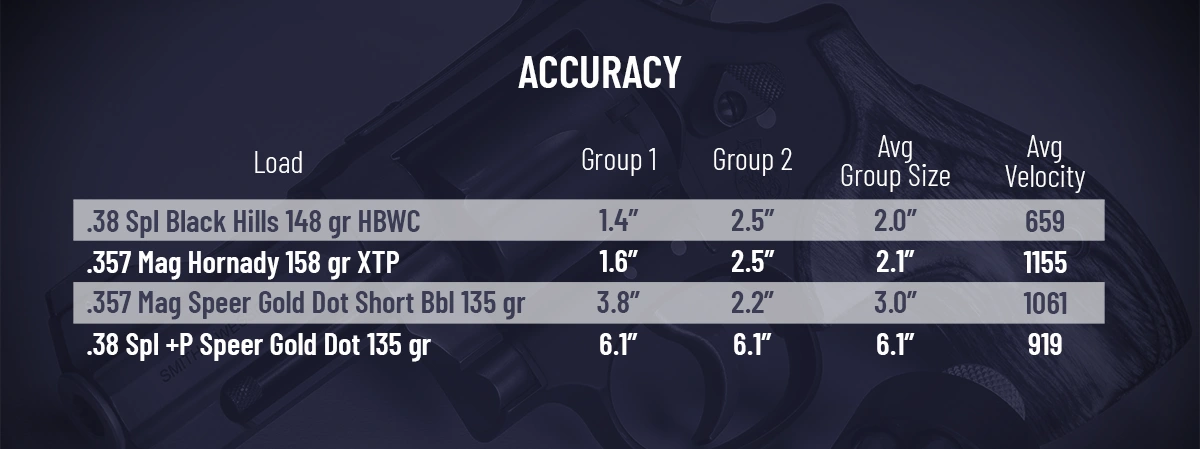
So the 386 is certainly capable of respectable accuracy, but I wouldn’t take it for granted. It can vary quite a bit depending on the load.
Recoil and Trigger
People are always curious about recoil with the lightweight guns, especially with magnum loads. Shooting magnums out of a lightweight J-frame is a miserable experience. Out of a steel frame 686, it’s usually not bad. In terms of weight, the 386 is about midway in between those two extremes and the recoil is spread out over the larger surface area of a full size grip frame. With the grips I was using, which are optimized more for carry than for the range, I don’t mind shooting a few cylinders of the light to moderate magnum loads. After that, it’s not fun, but it’s nothing like a magnum J-frame, or even a magnum LCR.
About 90% of the ammo I’ve put through this thing has been standard pressure .38 Specials. Those are no problem at all.
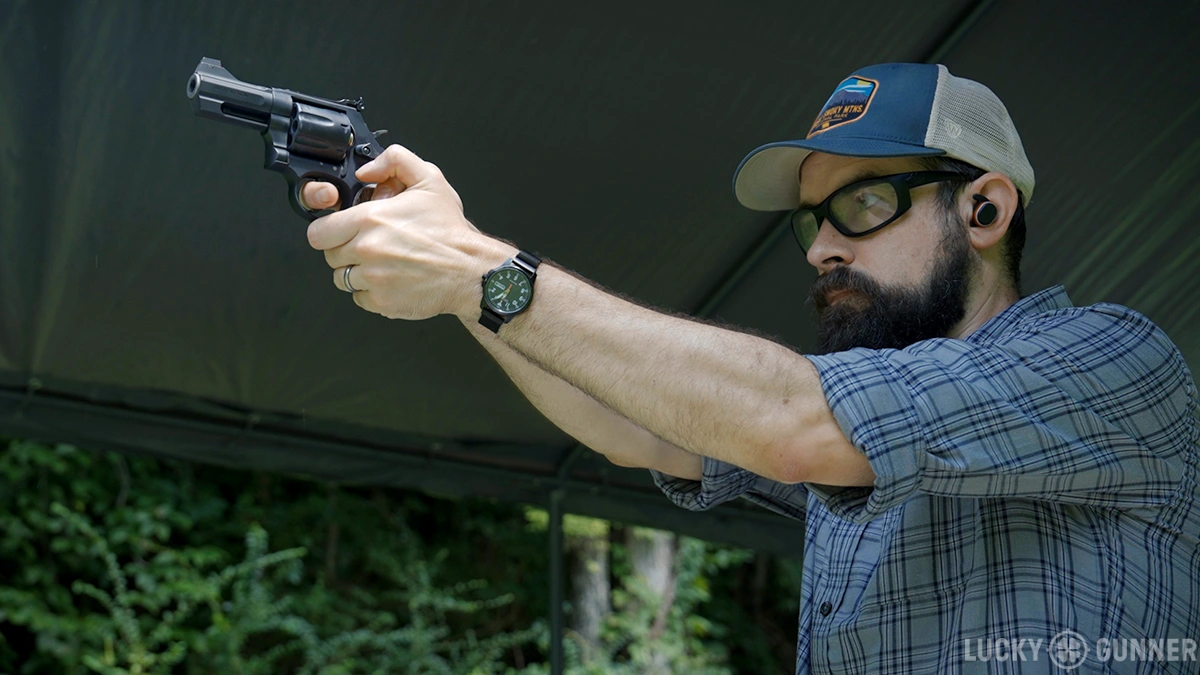
The double action trigger is about as good as it gets for an out-of-the-box Smith & Wesson action. I measured it at about 10 and a half pounds. It started out reasonably smooth and gets a little smoother over time. With Smith revolvers, there is a very fine line between a nice trigger and one that gives you light primer strikes. I have not had any light strikes with this one. But most of the ammo I had on hand for this review was Federal, Speer, and Hornady, which all tend to have primers on the softer side anyway.
The single action trigger is 4 pounds. But I don’t really use that except when I’m shooting groups for accuracy tests so… I have no opinion beyond that. A revolver like this is a perfect candidate for a bobbed hammer and DAO conversion.
Would I Carry It?
But even then, I probably would not actually carry a 386 Night Guard myself. We have an old 386 Sc/S which is basically a 2008 Night Guard with different sights. It’s been in the company collection for years and I’ve never really warmed up to it.
An L-frame is just more bulk than I want to conceal on a daily basis, no matter how light it is. And it’s not enjoyable enough to shoot for me to take it out to the range just for fun over a steel frame gun. I feel the same way about the new 386, despite the improvements. I would maybe carry it in a small chest bag for a hike in the mountains, but it’s not really my thing for everyday carry.
That said, I’m still glad they’re making this and the 396 because, for one thing, a lot of you don’t think L-Frames are too big at all. And you will carry them and enjoy them because they’re cool guns. And I’m also glad they’re making these because if the L-frames do well, hopefully they will make some K-frame Night Guards, which is something I really would like to see. I’m just happy that Smith is willing to make some revolvers that are different and interesting. Like the Ultimate Carry J-frames and the Mountain Guns (which we also have Lipsey’s to thank for, by the way).
The QC Question
But, as most of you probably know, Smith has struggled lately when it comes to quality control. For what it’s worth, this Night Guard has been problem-free. I know a few other Night Guard owners who are satisfied with theirs. But I also know of at least two others that had to go back for repairs. One of them actually had to be replaced for a frame that was out of spec. So clearly, Smith still has some issues to work out. And that’s a real shame because it’s not like you can get anything remotely like a Night Guard from Ruger, Colt, or Taurus. A 24-ounce seven shot .357 Magnum is exclusively Smith & Wesson territory.
I’m hopeful they will turn it around soon. But only time will tell. In the meantime, just understand before you buy one of these that there might have to be a little back and forth before they get it right. Let us know about your experience with the new Night Guards, good or bad, in the comments. Whether you’re taking a chance on a new one or you’re sticking with an old one, just be sure to get the ammo from us with lightning fast shipping at Lucky Gunner.