LuckyGunner.com has a live inventory system that removes any out-of-stock items from our website the moment the last unit is ordered. If you see it, we have it in stock and ready to ship.
Fast Shipping
$100 Guarantee
We guarantee the products shown on our site are in-stock. If we make a mistake and an item in your order is out of stock, we will give you a $100 store credit.
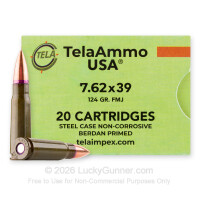
Steel-cased ammunition, predominantly manufactured in Russia, China, and Eastern European countries, offers significant cost savings over brass—typically 30-40% less per round. Modern steel cases use protective coatings (lacquer, polymer, or zinc plating) to prevent rust, but corrosion resistance remains inferior to brass. Steel's main drawback is its poor elasticity: unlike brass, steel doesn't expand to fully seal the chamber (relying instead on its stiffness), and it doesn't contract as cleanly for extraction. This can cause increased extractor wear over tens of thousands of rounds, though the effect is often overstated for casual shooters. Steel cases cannot be reloaded due to their material properties. While some shooters avoid steel-cased ammo in premium firearms, many AR-15 and AK owners use it extensively for affordable training. The magnetic steel body means many indoor ranges prohibit steel-cased ammunition.
Not significantly for most shooters. Steel cases may cause slightly more extractor wear over very high round counts (50,000+) compared to brass. The lacquer/polymer coating, not bare steel, contacts the chamber. For training and plinking, steel-cased ammo is perfectly acceptable in most firearms.
Why do indoor ranges often ban steel-cased ammo?
Three reasons: (1) Steel-cased ammo often has bi-metal (copper-washed steel) bullets that can spark on steel backstops, creating fire risk, (2) The magnetic bullets can damage certain backstop designs, and (3) Ranges that sell scrap brass don't want steel cases mixed in. The restriction is usually about the bullets, not just the cases.
You may be interested in these steel-cased ammo products: