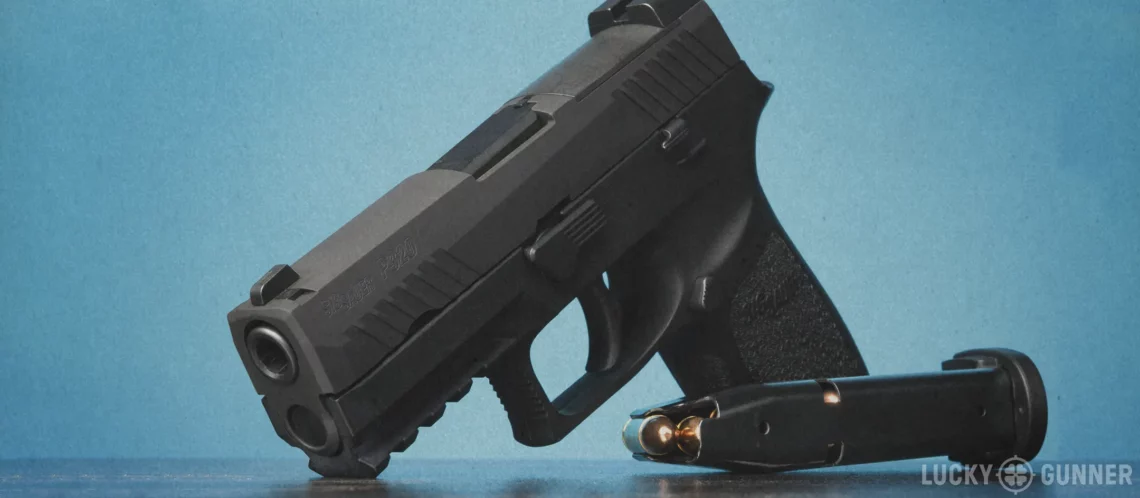

The SIG P320 has been at the center of controversy over reports of uncommanded discharges. But this debate isn’t just about one pistol, it raises bigger questions about how we think about handgun design. We’re taking a closer look at the P320 issue and what it means for striker-fired pistols and carry guns in general.
Details are in the video below, or keep scrolling to read the full transcript.
Hey everybody, I’m Chris Baker from Lucky Gunner and today we’re going to talk about the Sig P320. I had not been planning to wade into this minefield of a topic. But a lot of people have been asking for my take, so here we are.
In case you haven’t been following the story, we’re in the middle of a long, drawn-out controversy with the P320. At this point, there are numerous reports of uncommanded discharges with multiple injuries and even deaths being attributed to mechanical flaws in the gun. But so far, there is no definitive explanation for what, if anything, is actually wrong with the P320. Sig has vehemently denied any wrongdoing, claiming it’s all user error.
Is the P320 a safe gun to carry? I have no idea and I’m not going to guess. While everyone argues about whether the P320 is defective, we’re missing some bigger questions about modern pistol design philosophy. I have to wonder if there would even be a P320 controversy if it weren’t for the industry’s pursuit of increasingly lighter and shorter triggers in striker-fired pistols.
Levels of Safety
Every handgun design is a compromise between safe to use and easy to use. We all want both and we’re going to have different opinions on where the ideal place on that spectrum is. And that’s okay. But in all the debate about the P320, I’ve noticed a lot of people talking past each other. I think one thing that might help is for us to be more precise in the terminology we use.
Is the P320 safe? Are striker-fired guns in general safe? These are really vague questions that are hard to answer. So I’ve been thinking about it in terms of three different levels of safety. The first level is the gun’s inherent mechanical safety – does it only fire when you pull the trigger? Is it drop safe? Do the manual safeties function as intended? All of our gun handling practices are built on the assumption that guns do not fire unless the trigger is pulled. We pretty much all agree that guns should be safe at this level.
The second level is where there tends to be more disagreement. That’s the interface between us and the gun – the user controls. These are the safety features, both passive and active, that help us to handle it safely, help us avoid mistakes, and provide a margin of error for when we do. There are the obvious ones like manual thumb safeties, grip safeties, magazine disconnects, and loaded chamber indicators. But also design features like the weight of the trigger and its length of travel. Even the presence of a trigger guard falls under the second level of safety. These safety features all have pros and cons and there’s plenty of room for debate here.
The third level is the most subjective and that’s peace of mind. Do you trust the gun? Are you confident that it’s safe to carry? Are you confident in your ability to use it safely?
This is an area where I think we just need to cut each other a whole lot more slack. It’s like how everyone driving slower than me is a moron and everyone driving faster is a lunatic. Man, everybody just chill. If someone is carrying a specific gun that you don’t think is safe, that doesn’t necessarily mean they’re being unreasonable. On the other hand, you also shouldn’t feel bad if you can’t articulate why one gun makes you feel more comfortable than another in terms of safety.
The P320 Debate
People are debating the P320 issue like it’s a straightforward level one safety problem. But it’s anything but straightforward. There’s still a lot of uncertainty on this one. So in terms of what we should do in the meantime, that’s a much more squishy level three safety question.
Maybe there is nothing wrong with the Sig P320 and all of these videos and reports have some explanation that’s not the gun’s fault. But given the evidence, you can’t really blame anyone who feels uneasy about carrying a P320 right now. Until we get more information, it’s probably a good idea to err on the side of caution. At the same time, if I was a P320 owner who had fired thousands of rounds through these guns and carried one for years with no problems, I might have a hard time taking these reports at face value.
Also keep in mind that actual negligent discharges are fairly common. If one of those results in injury or property damage, blaming the gun that is already at the center of a big controversy might give someone an easy out. It looks like that might be what happened in the Air Force incident. Even if the P320 turns out to be problematic, people are going to take advantage of the situation, and not every report will be a legitimate uncommanded discharge.
Shifting Standards
One of the reasons I haven’t talked about the P320 issue so far is that I’m not really fond of striker fired pistols in general. That’s not a secret. You guys know I like revolvers and traditional double actions. But I’ve been especially apprehensive about the P320 even before all of the controversy started. I’ve kind of viewed it as the beginning of the trend in making striker-fired triggers lighter and shorter.
In the interest of cutting each other slack, I try not to harp on this too much. A lot of very smart people in this industry have a different take on it than I do. But let’s put the trigger thing in perspective.
If I took a Sig P226 – a traditional double-action pistol – and I cocked the hammer and told you to carry it like that, most experienced shooters would be somewhere between reluctant and horrified. This leaves very little margin for error.
Well, that’s essentially what you’re doing with a lot of striker fired pistols. This is a five pound single action trigger with a quarter inch length of travel – that’s roughly the same as a P320. The striker is under spring pressure – it’s almost fully tensioned, just like that cocked hammer. The trigger just releases the striker. The only difference is you can’t see it. The striker is hidden inside the slide, so most people don’t think about it.
I’m not saying that all striker-fired guns are inherently unsafe. I can’t prove that there are more unintentional discharges with striker-fired guns than any others. I just feel uneasy about them.
Now somebody’s going to point out that the Glock striker is only partially tensioned. The first part of the trigger stroke compresses the striker to full tension and then it releases when the trigger breaks. And this is supposedly safer than a striker that’s fully tensioned like the P320, M&P, the Walthers, and pretty much all the major striker-fired guns. But when I looked into this, I found out that even that partial tension the Glock starts out with is enough to ignite a primer if the internal safeties somehow failed. That’s not what makes Glocks safe.
The real difference of the Glocks is that on average, the triggers tend to be a couple of pounds heavier. The takeup or slack is also heavier, which I think makes it more likely that you’d notice unintentional pressure on the trigger sooner than with the P320.
What I do like about the P320 is that they eventually added the option of a manual thumb safety. That adds back a layer of safety that you’re missing with a light, short trigger. The P365 also has that option, and the M&Ps, and… not many others.
Imperfect Solutions
That said, I don’t believe manual safeties or double actions are the ultimate answer either. Both have downsides, especially on the training side of things. I don’t blame anyone for preferring the straightforward simplicity of the typical striker-fired design.
But I keep coming back to the idea that everything that’s going on inside the striker pistol is completely opaque to the user. I kind of wonder if this issue with the P320 – however it plays out – might lead more people to have a problem with that.
One thing I like about double actions is the peace of mind I get from the fact that their operation is visible and intuitive. You can look at a DA/SA pistol and immediately see whether the hammer is down. And you can pin the hammer when you’re holstering so it can’t move.
There’s no reason we couldn’t have something like this for our striker-fired pistols. We already have it with the aftermarket Striker Control Device for Glocks. You can see and feel what the striker is doing and you can block it with your thumb, just like a hammer. And now there’s a version that works with the CZ P10 as well. Maybe, with all the talk about uncommanded or unintentional discharges, more shooters will demand similar features.
So there you have it. Those are my thoughts on the P320. I still have more questions than answers. But I do think we’re witnessing something significant here. This moment is bigger than just one company’s QC issues. It’s forcing us to question assumptions about modern firearm design — and that’s a conversation worth having.


A safety feature that you don’t hear about too often with double action guns is that in double action mode, the hammer is forward; there’s no spring tension trying to pull it forward. If something should slip within the gun that normally would keep the hammer from going forward, no worries; the hammer is already forward. In other words, there is little to no chance of the gun accidentally going off if anything goes wrong. You would have to actually pull the trigger to get it to shoot; a simple light touch on the trigger wouldn’t do it, such as might happen with a striker-fired gun, that is, a gun that is in single action mode.