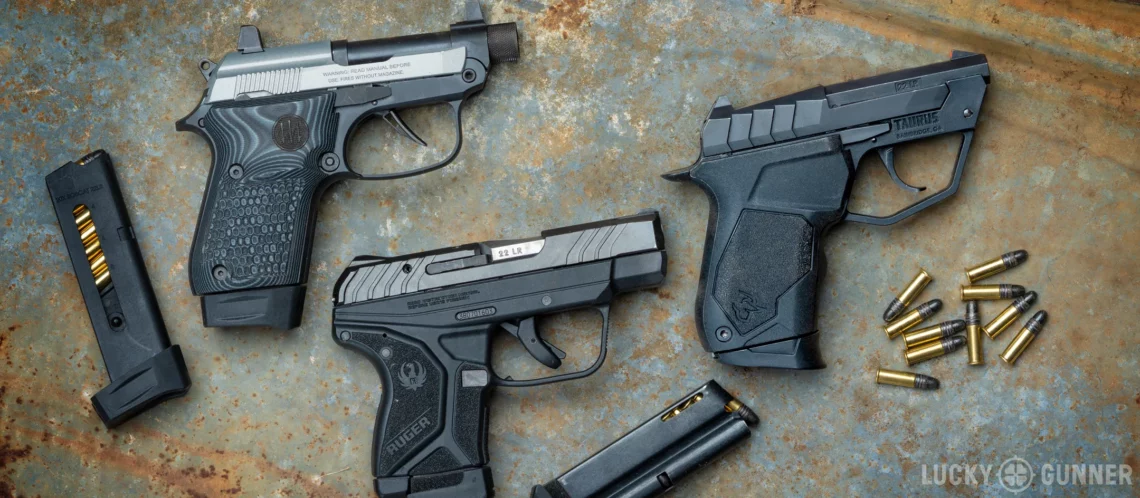

In this Project Rimfire category roundup, I’m comparing every .22LR pocket pistol currently in production. That’s right, all three of them! The Ruger LCP II, Taurus 22TUC, and Beretta 20X Bobcat. I ran all three through standardized accuracy, speed, and reliability testing to see which, if any, actually work.
Details are in the video below, or keep scrolling for the full transcript.
Hey everybody, I’m Chris Baker from Lucky Gunner and this is part four of Project Rimfire where I am reviewing an absurd number of .22 caliber handguns. This is our first category roundup video: a side-by-side comparison of pocket pistols.
As a reminder, for this project I’m only including guns in current production. The pocket pistol category is for the smallest class of semi-auto .22s – no derringers, single shot pistols, or revolvers.
This category has fewer entries than any other I’m planning to cover. There are really only three to choose from: the Ruger LCP II Lite Rack, the Taurus 22TUC, and the Beretta 20X Bobcat. I was originally planning to include the Beretta 21A Bobcat as well, but they ended production earlier this year.
The only other .22 pocket pistol in current production that I’m aware of is the Ounce Pistol – a very unusual folding bullpup semi-auto made by a small startup company called Third Bay. I wasn’t able to get one in time for this video, but I have ordered one, so hopefully I’ll be able to review it soon.
For now, let’s look at the more conventional options. I have done individual review videos for each of these three pistols – the Taurus and Beretta last month and the Ruger back in 2020. So I’m going to jump straight to our side by side comparison starting with physical dimensions.
Size Comparison
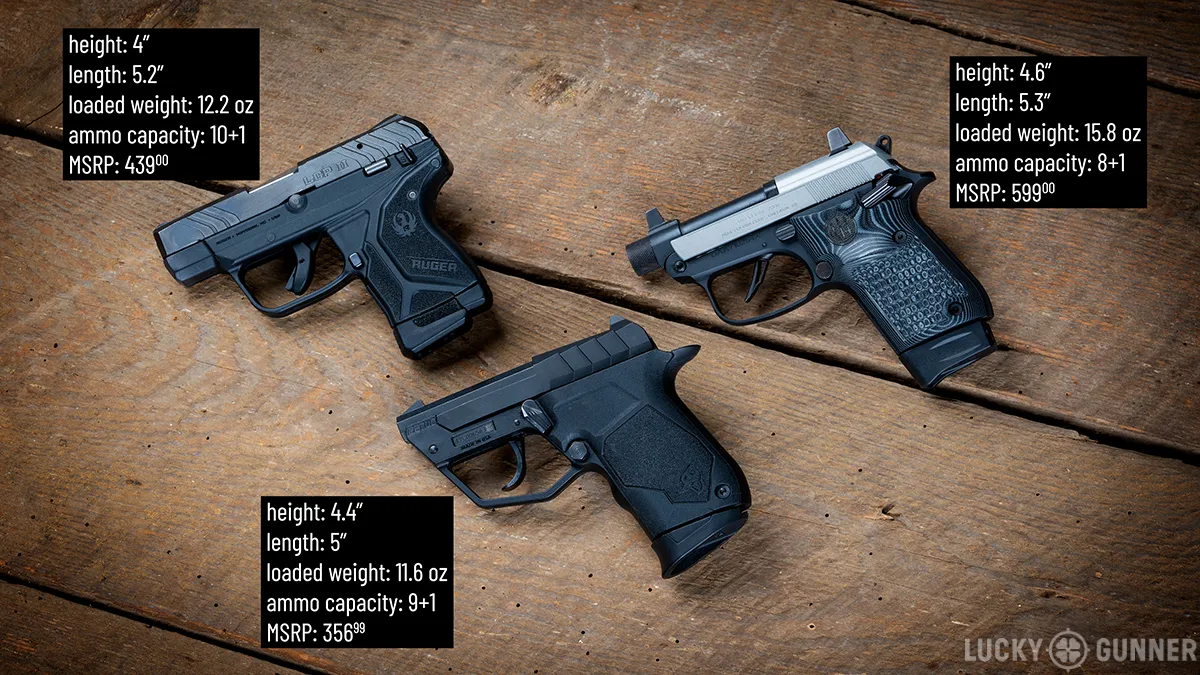
You don’t carry a .22 pocket pistol unless you’re looking for absolute minimal size and weight. There’s not much difference in height and length between these three. The Beretta 20X looks bigger, but there is a version with a shorter non-threaded barrel and standard height sights that’s more on par with these other two.
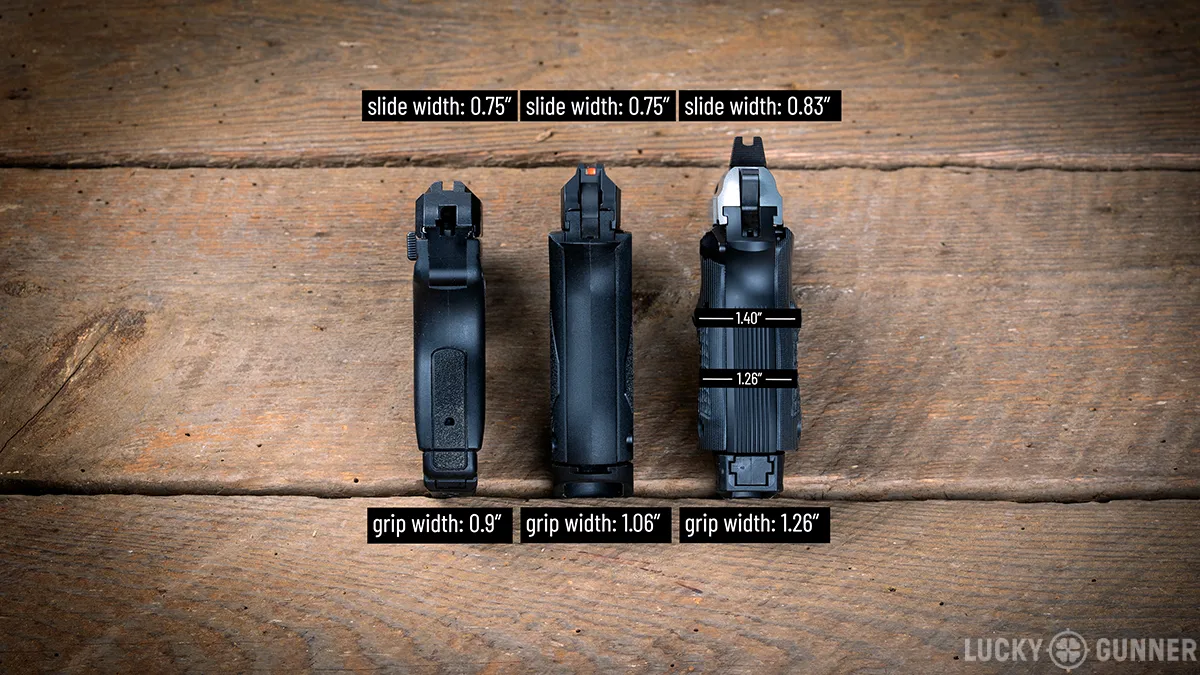
In terms of width, the Ruger is substantially slimmer. The Beretta and Taurus both have removable grip panels that add to their width.
These are all very lightweight guns, but the Beretta is noticeably heavier. Fully loaded, the Ruger and Taurus are around 12 ounces thanks to their polymer frames. The aluminum frame 20X is almost 16 ounces – a pretty big difference for this class of pistol.
Actions
Each of these guns has a different type of action. The Ruger is recoil operated, hammer fired, single action only with a non-ambi manual safety. The trigger has a lot of takeup and then a mushy break that measures just under 8 pounds.
The Beretta is a tip-up barrel, blowback operated, double action/single action with a manual safety. The double action trigger is a little over seven pounds, single action is about four and a half.
The Taurus is also blowback with a tip-up barrel, but it’s double action only with no manual safety. The trigger is a very smooth eight pounds. Neither the Taurus or Beretta lock open on an empty mag.
Accuracy Test
Okay, let’s look at our test results. For this series, I’m running every gun through a gauntlet of three tests: accuracy, speed, and a practical test. Through all of that, I’m also tracking reliability.
For accuracy, I fired 5-shot groups from a bench rest at 25 yards using three different ammo types: CCI Mini Mags, CCI Standard Velocity, and the premium Eley Tenex Pistol ammo. I fired two groups with each load.
Yes, I realize it’s silly to shoot 25 yard bench groups with pocket pistols. Not many people are buying these things for that, but I want to use the same test protocol for every gun in this series. So, let’s get silly.
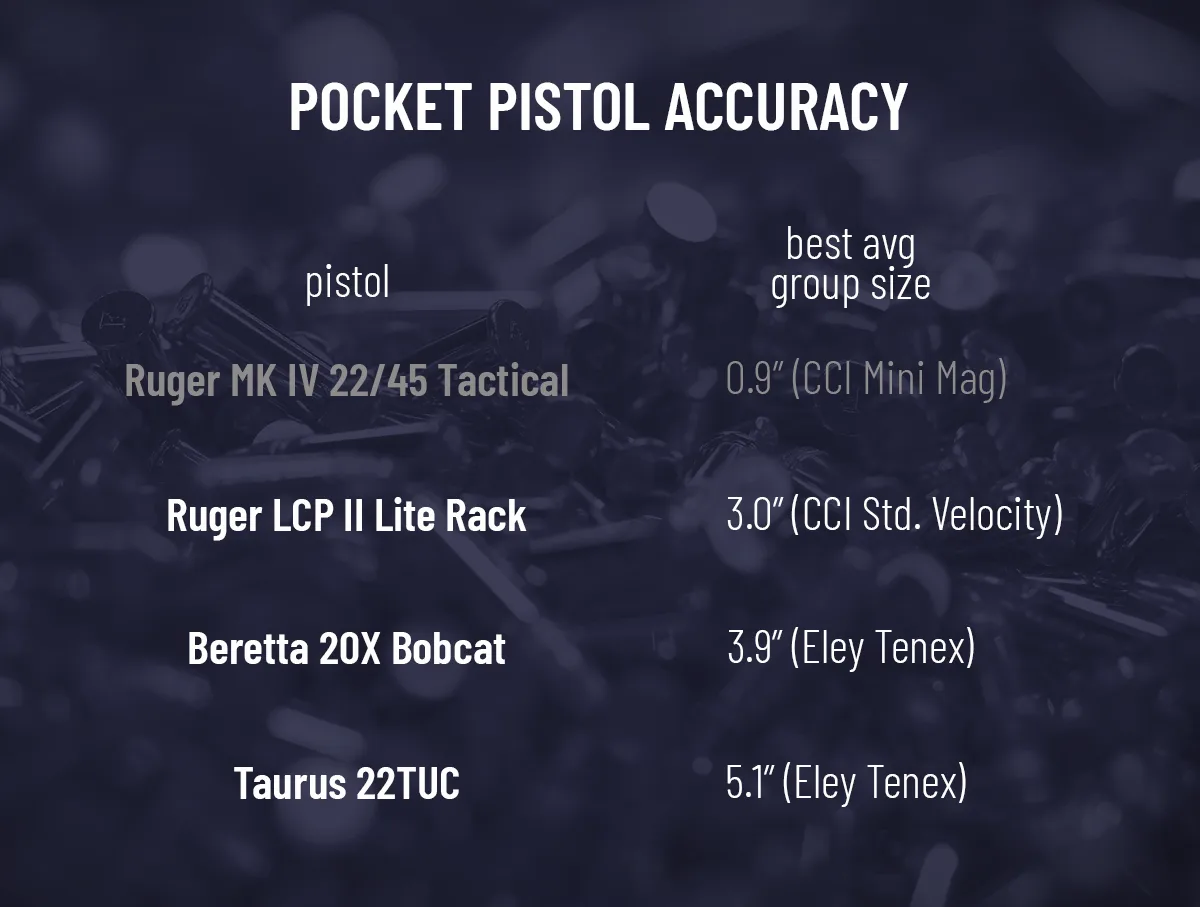
If we take each gun’s best-performing ammo based on average group size, the LCP was most accurate at 3 inches, the 20X Bobcat at 3.9, and the 22TUC at 5.1. For comparison, my Ruger Mk IV with a factory barrel and red dot easily shoots one inch or better. I’ve reviewed full size 9mm duty pistols that could barely do 4 or 5 inches with premium defense ammo. So all things considered, these groups are really not bad for these little guns.
Speed Test
For our speed test, I’ve replicated a stage from Steel Challenge competition called “Smoke and Hope.” From low ready, you shoot four 18”x24” targets one time each, then hit the 12” stop plate. I’m scoring this a little differently than they do in a match. I’m adding up my best four times out of ten attempts.
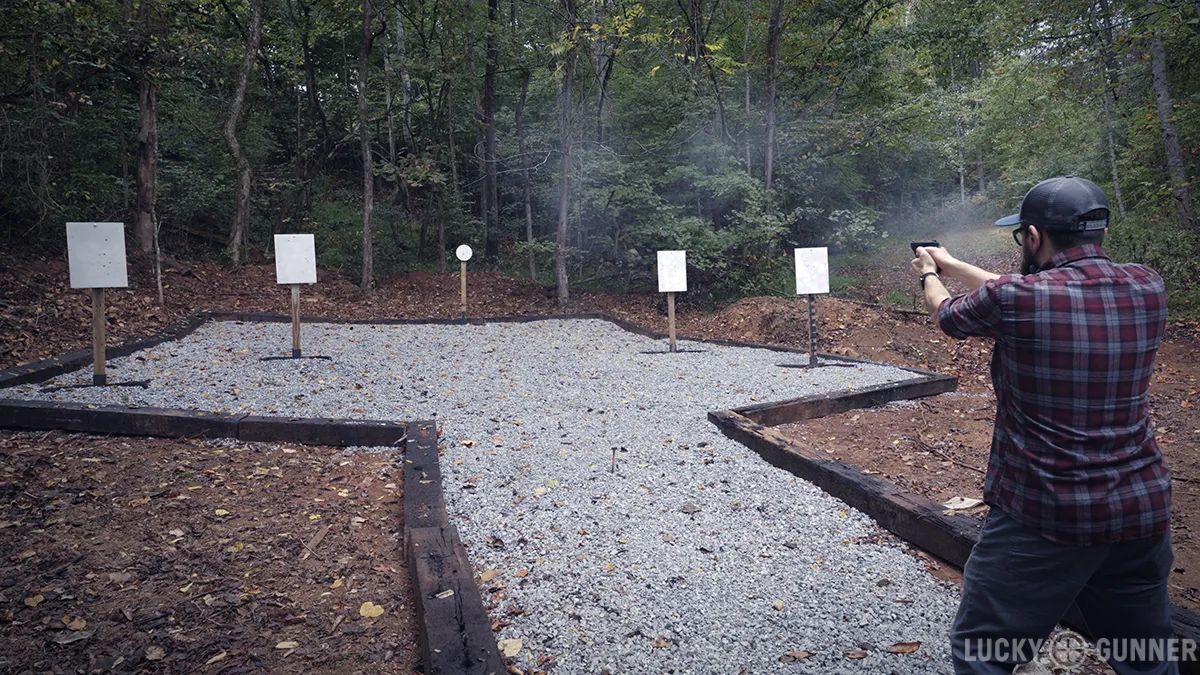
This stage came down to which gun pointed most naturally and had a front sight my eyes could pick up quickly—and that was the Taurus 22TUC. My best four runs totaled 9.98 seconds. For comparison, the Mk IV was 8.39 seconds. Again, not bad at all for a pocket pistol.
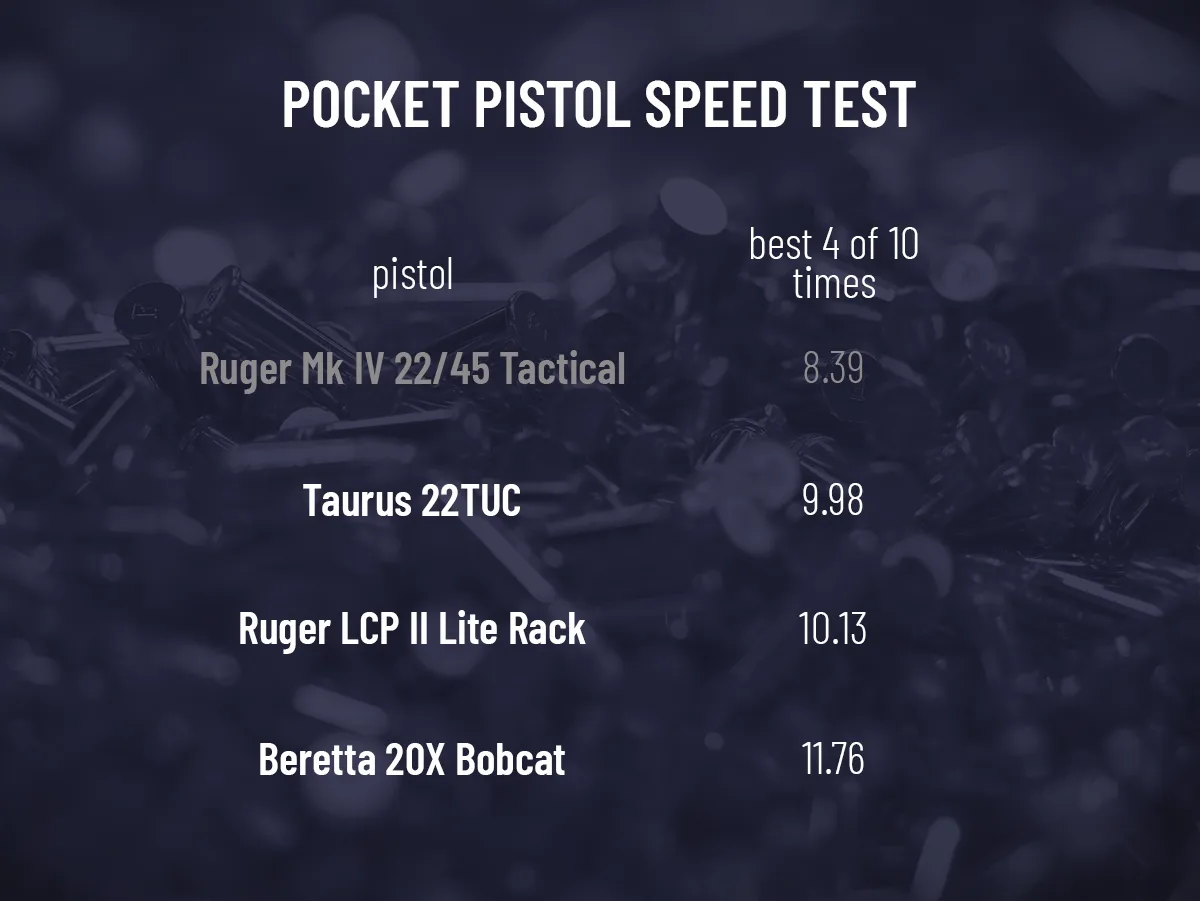
The LCP was less than a quarter second behind the Taurus. I think the shorter trigger stroke helped. The Beretta was slowest because a white dot front sight doesn’t really stand out against a white target. A little high vis orange paint like I put on the Ruger probably would have brought it on par with the other two.
Practical Test
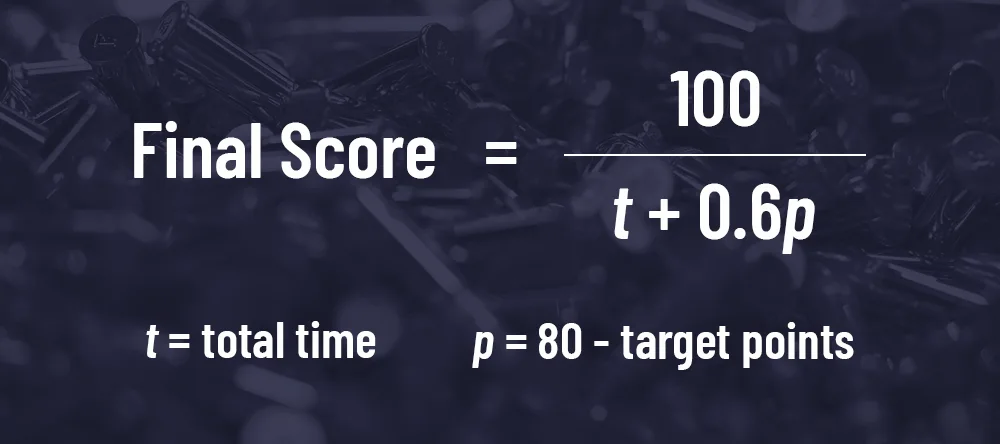
The Practical Test measures both speed and accuracy. At ten yards, I fire eight rounds at a B-8 bullseye as fast as I can while attempting to keep all my hits inside the black. I plug my time and points into this formula to get my final score, which heavily penalizes misses. I’m using the best of five attempts for our scoreboard.
This test really highlights differences in sights, grip, trigger, mechanical accuracy, and overall ergonomics. For reference, my best run with the Smith & Wesson M&P22 Compact was 19.2.
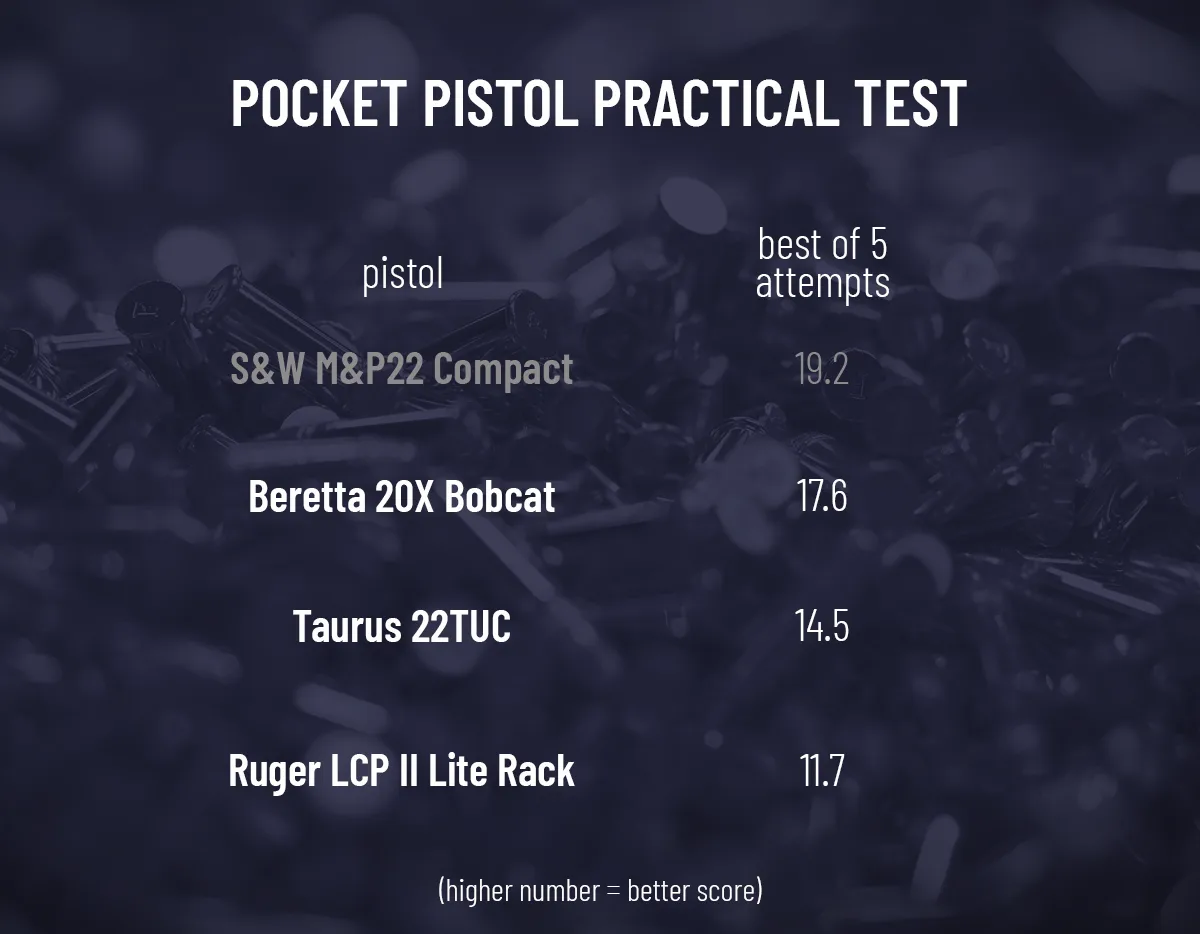
Out of the three pocket pistols, the Beretta 20X scored best at 17.6 thanks to its smooth DA/SA trigger and ergonomic grips. The Taurus’s DA trigger is a little tougher to control at that speed. The LCP’s sights hit a little to the right, so I had to do some Kentucky Windage, which slowed me down some.
Reliability
Reliability is always a big question for .22s, especially when they might be used for personal protection. For this series, I’m running every gun through a very simple 200 round reliability test. 100 rounds of Mini Mags and 100 rounds of CCI Standard Velocity.
The Beretta 20X had a failure rate of 1-2% depending on the ammo. When I ran the test again with a suppressor attached, the failure rate dropped to zero. The Taurus 22TUC had a 2-4% failure rate.
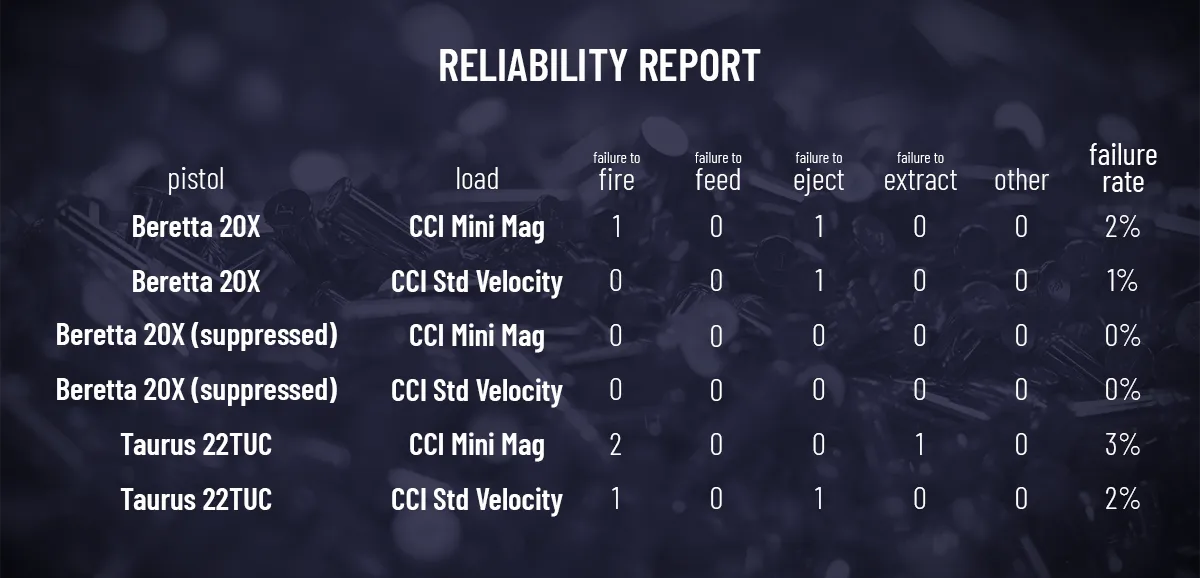
I also tested these two guns with CCI Velocitor, Blazer, and Federal Punch. The ammo type doesn’t seem to make much of a difference in reliability with either.
In my 2020 review of the LCP, I mentioned persistent issues with light primer strikes. That problem has only gotten worse. I was getting roughly 4 to 5% failures to fire, so I installed an aftermarket extra power hammer spring from Galloway Precision. That took care of the problem – 250 rounds with no issues.
But then, just after I started filming B-roll for this video, I ran into a new issue. First camera shot – 10 rounds, no problem. Then I set up my second shot and… click. Broken firing pin. So that’s not good.
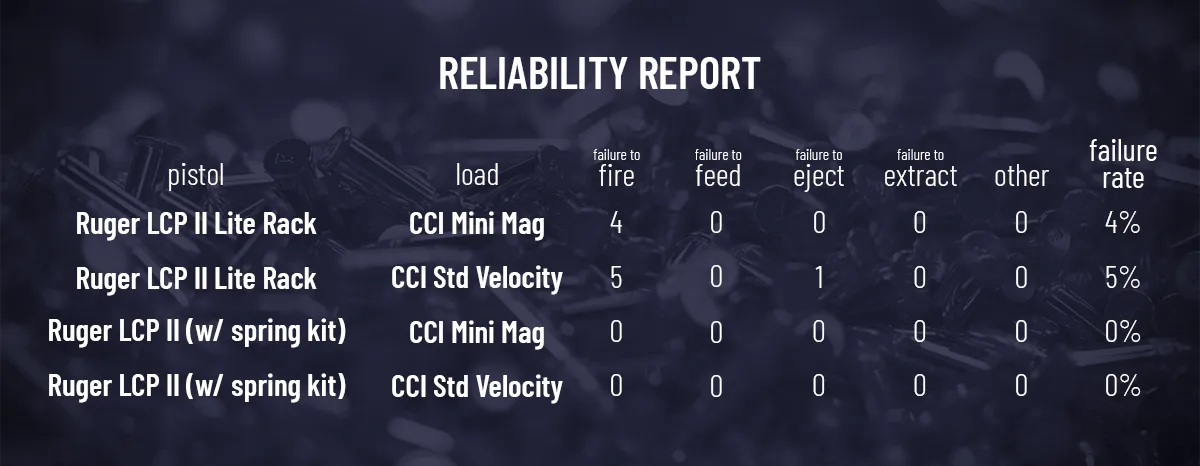
Did the new hammer spring cause this? I don’t know. But based on the 1700 comments on my first review, this is not uncommon. At least six of you reported broken firing pins, with dozens more reporting failures to fire, and feeding problems. Some had success with spring kits or warranty work. Just as many reported that those didn’t help.
Are They Any Good?
Okay, now that we’ve got all the pesky facts and data out of the way, let’s get to what you really came here for: my completely subjective, but definitely 100% correct opinion.
One of the reasons I started Project Rimfire is because .22s are fun and I think sometimes in the shooting world, we forget to have fun. Most .22s are purchased for reasons other than self-defense. They’re usually the fun guns in our collections. Pocket pistols are the exception.
A lot of people who resort to carrying something like this do so because of physical limitations that make it very difficult for them to shoot or manipulate other small guns. I get messages all the time from elderly folks, people with arthritis or hand problems, recoil-sensitive shooters. Shooting is just more challenging for them.
And a lot of them are also statistically far more likely to be the target of violent crime than me or probably most of you watching this. So I take this category very seriously.
Unfortunately, none of these three guns are slam dunks. There’s a chance you will get one that runs like a clock. I know people who own reliable samples of each of them. But there’s also a good chance you end up with one that runs more like these.
Is a .22 pocket pistol you can shoot really well but is only 98% reliable better than a centerfire pocket pistol that’s 99.8% reliable but hard for you to shoot? I’m not really sure. It depends on whether that centerfire gun is nearly impossible for you to handle or just kind of difficult.
Setting aside the reliability question for a minute, all three of these guns share some advantages. They’re easy to load: the Taurus and Beretta with tip up barrels, and the Ruger with an easy-to-rack slide. They all have workable triggers for people dealing with hand strength issues, though in different ways. And they all have sights that are major improvements over previous generations of pocket pistols.
Ruger LCP II Lite Rack
The Ruger is easily the most concealable and holds the most ammo. The trigger is nothing special, but it’s usable. Aside from reliability, the thumb safety is the weakest part. I’m hesitant to recommend carry guns with manual safeties unless using them is already second nature.
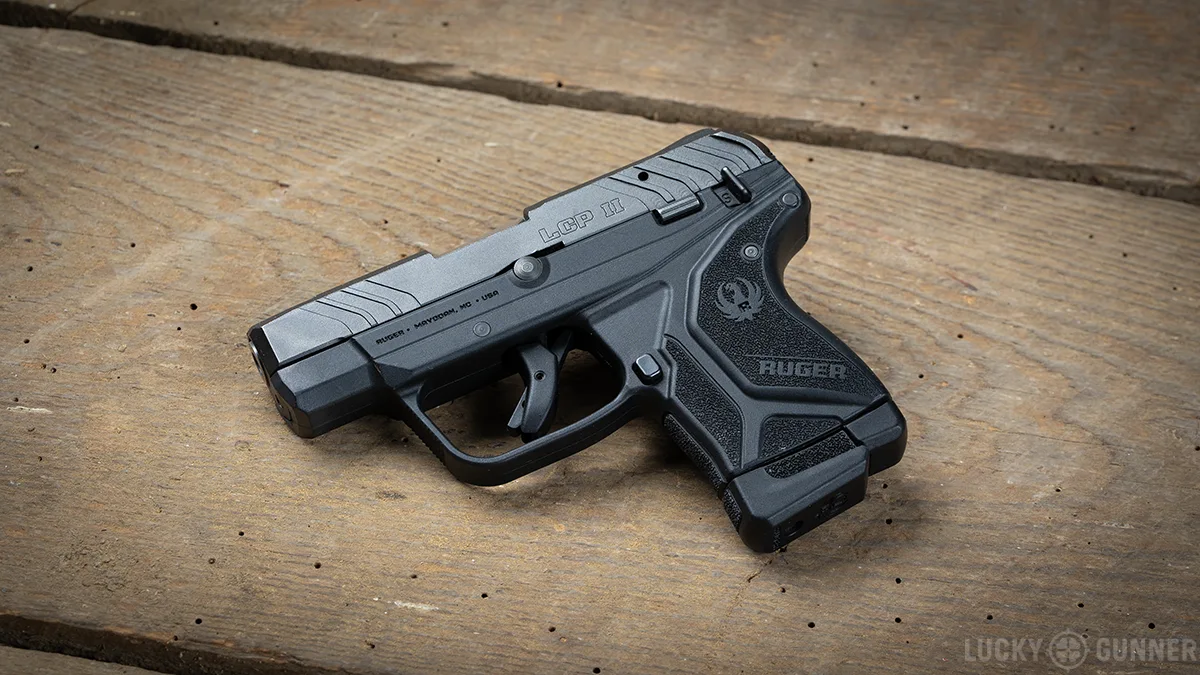
This one is particularly awkward—it’s really far back on the frame so you can’t use it without breaking your firing grip, and it’s small and hard to deactivate during the drawstroke. I would much rather see this with no safety and a light double action like some variants of the original LCP.
If you want this for more of a recreational gun, Ruger used to sell a threaded barrel, but I haven’t seen them for sale in a while. There are also several compatible laser sights that clamp right to the trigger guard for better aim with a can attached.
Taurus 22TUC
The Taurus 22TUC is the best in terms of overall usability and safety. Comfortable grip, great sights, no manual safety to worry about, and the long trigger stroke helps prevent unintentional discharge.
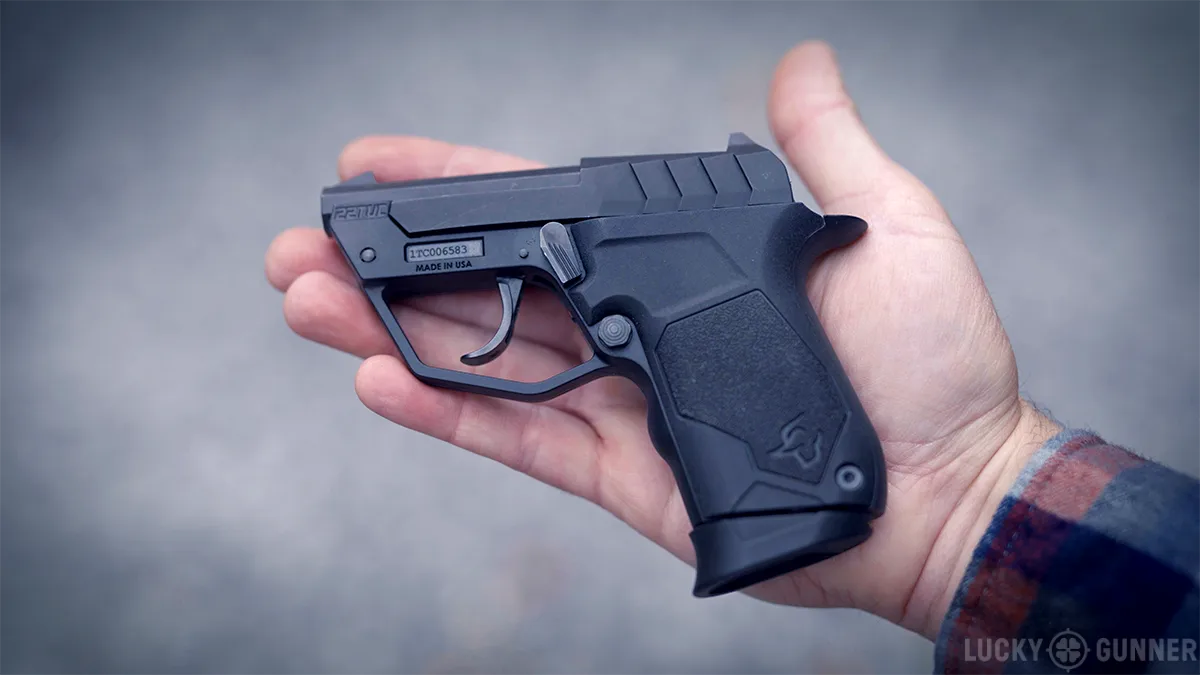
Some folks might struggle with the trigger weight. If you can manage the trigger, you might actually be better off with a .22 revolver instead. The Ruger LCR has a similar trigger. It’s not as small, but it’ll be a lot more reliable.
Beretta 20X Bobcat
The Beretta 20X also has a user-friendly grip. The double action is comparable to the Taurus. The single action trigger is the lightest of the three guns. This is meant to be carried hammer down. You can safely decock it with the barrel tipped up. The safety lever itself is well-designed and easy to use as long as you’re right handed. Technically, it could be carried with the hammer cocked and the safety on. But I’m not sure if that’s drop-safe and the manual is oddly silent about it.
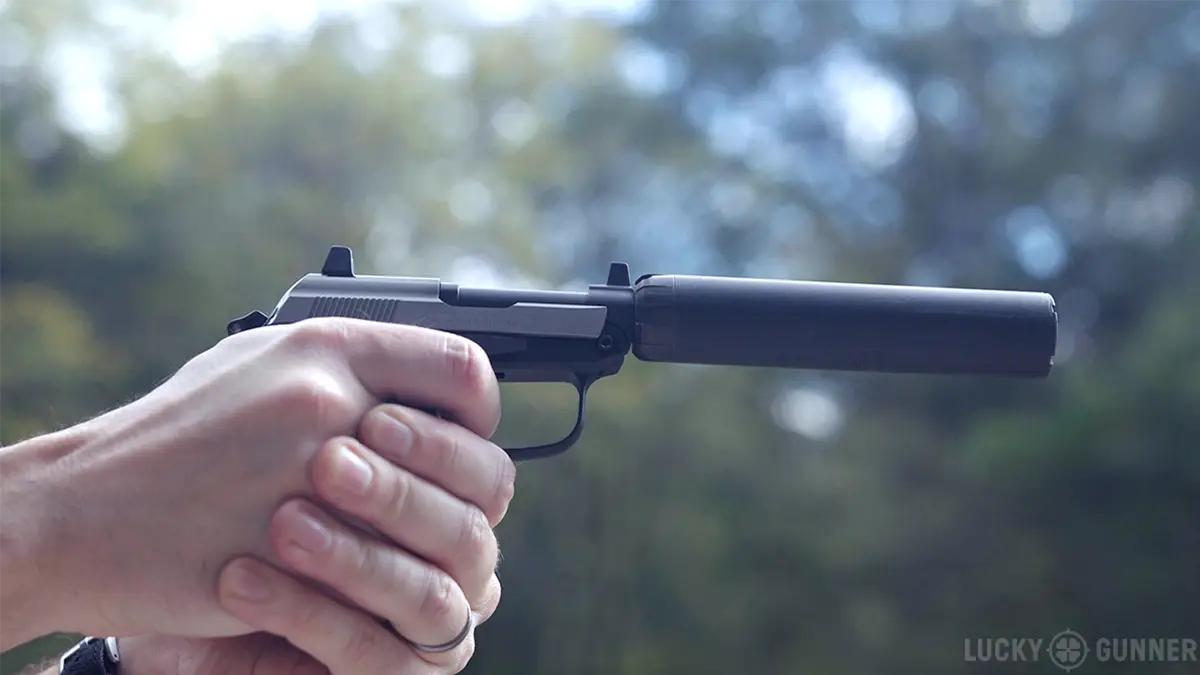
For anything other than self-defense, the 20X—specifically this version—is the way to go. The weight makes it feel more satisfying to handle. It’s a fun suppressor host and Beretta is planning to offer optic adapter plates sometime soon. Maybe it’s not reliable enough for life-saving equipment, but it’s just a neat little gun.
The Best Low-Recoil Pocket Pistol
I’ve said this many times before, and I’m standing by it: the best low-recoil pocket pistol is not a .22 at all. It’s the Kel-Tec P32 in .32 ACP.
It’s not a perfect gun. The ergonomics are not great. I’ve got this Hogue grip sleeve on here that’s actually made for an LCP and I had to cut the bottom off to make it fit. The sights are terrible. The trigger is just okay. But the gun works and its even smaller than the LCP.
This one has not given me a single problem in over 1000 rounds. I’m sure there are some lemons out there, but everyone I know who has one of these has had nothing but good things to say about reliability. It’s the only Kel-Tec product I would trust my life to. The recoil is noticeably more than a .22, but nowhere near the snap of a .380 in this size class.
Conclusion
So those are your options for .22 pocket pistols. If you absolutely need something this small and .22 is what you can handle, any of these three could work for you—just understand the reliability trade-offs. If you’ve got a little more flexibility, seriously consider that P32 or maybe a .22 revolver instead.
I’m going to take a break from Project Rimfire for a couple of weeks to cover some other topics, but I’ll be back with the next category soon. Until next time, if you need some ammo with lightning fast shipping… I think you know where to find it.