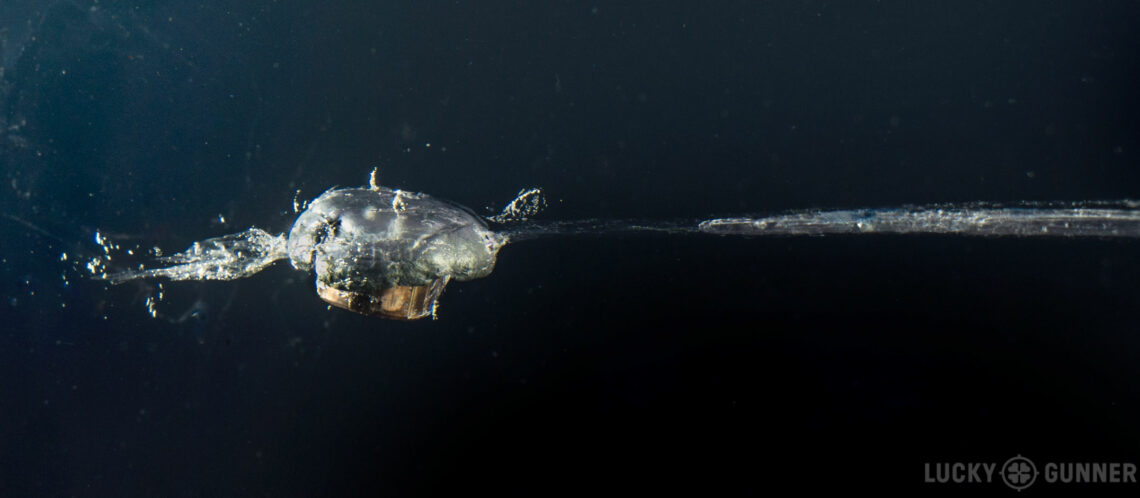

Revolver fans rejoice! It’s been a long time coming, but we’re finally ready to show you the results of our ballistics gelatin tests for .38 Special and .357 Magnum self-defense ammo.
For this batch, we tested 38 loads total — 20 are .357 Magnum and 18 are .38 Special. The post for our previous ballistic gelatin tests outlines all of the detailed specifics of our test protocol and explains both the value and limitations of gel testing. If you are unfamiliar with how these tests work, I highly recommend looking over that article before moving on to the results here. You will also be able to see the results of 146 semi-auto loads that we tested covering popular self-defense ammo in .380 ACP, 9mm, .40 S&W, and .45 ACP.
Before we get into the test results, I want to thank everyone for all of the encouraging feedback and suggestions on our previous tests. The overwhelmingly positive response we’ve received from the online shooting community so far has made it possible for us to keep testing more defensive ammo. If you have found these tests helpful, I just ask that you consider shopping at LuckyGunner.com the next time you need some ammo, whether it’s self-defense loads for your revolver or another case of FMJ .223 or 9mm. We’ve got a huge selection and super fast shipping — any orders placed by 3PM EST on a weekday will ship out of our warehouse the same day. You’ll get your ammo in a hurry, and you’ll be supporting great projects like this one.
Test Procedure Overview
We followed all of the same protocols for our .38/.357 tests that we used in our semi-auto tests. All shots were fired from a distance of 10 feet from the gel blocks. The front of each block was covered with a four-layer heavy fabric barrier (denim, fleece, and two layers of cotton) to simulate clothing. To accommodate loads that penetrated beyond the full 16 inches of the gel block’s length, we positioned a second block behind the first one, giving us a total of 32 inches to capture the fired bullets.
We fired five rounds of each load into the gel block and measured the penetration depth of each bullet. The bullets were then recovered from the gel (that is, dug out with a big knife), so we could measure their expanded diameter. The velocity of each load was measured with a chronograph.
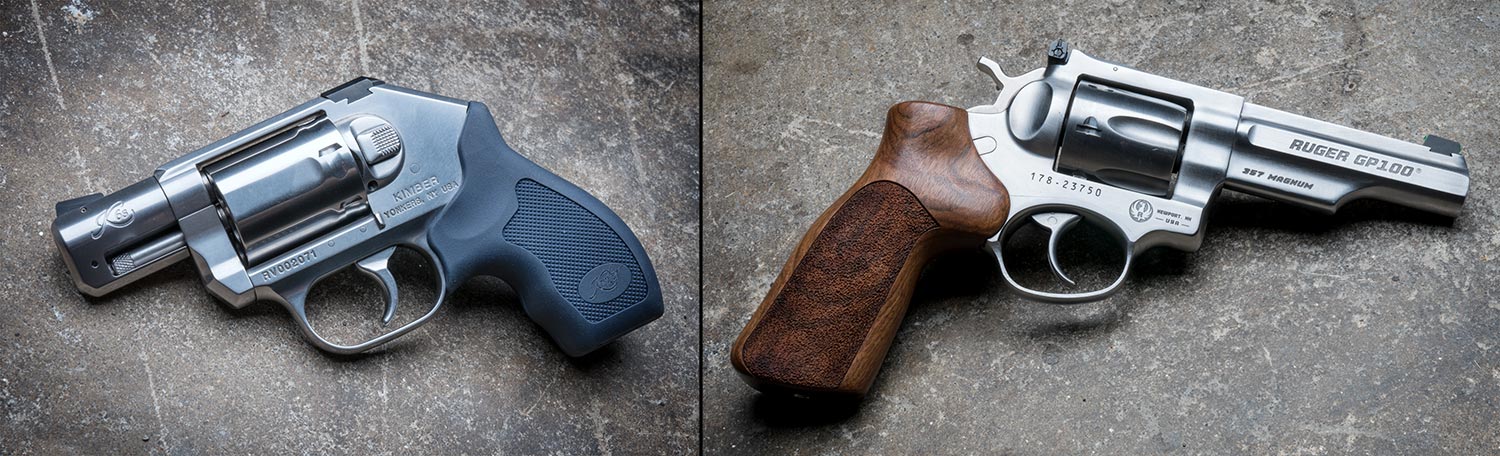
There is one aspect of this batch of testing that is a little different from our previous tests. This time, we tested each load with two different barrel lengths: a 2-inch Kimber K6s and a 4.2-inch Ruger GP100 Match Champion. The velocity of .38 Special and .357 Magnum can be highly dependent on barrel length, so we wanted to test the two most common barrel lengths for defensive revolvers. For more on why we chose these specific test guns, read our post on how barrel length affects the velocity of revolver ammo.
.38 Special vs. .357 Magnum
If you don’t have much prior experience with wheel guns, you might already have some questions about the relationship between .38 Special and .357 Magnum. For our purposes today, all you really need to know is that any revolver that’s chambered for .357 Magnum can also fire .38 Special ammo because .357 Magnum is basically a .38 Special that goes extra fast. Despite the names, both cartridges fire bullets with a .357-inch diameter. The .357 Mag cartridge case is ⅛” longer than the .38 Special’s in order to prevent the magnum rounds from being accidentally loaded into a revolver that’s only designed to fire the lower pressure .38 Special.
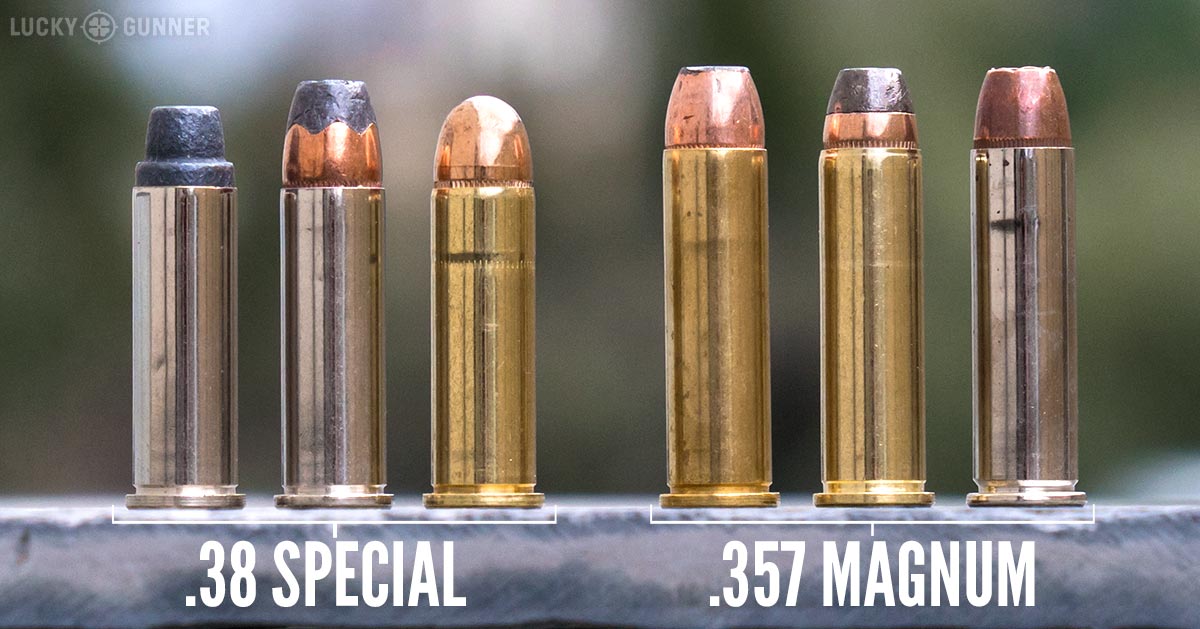
Loads that are designated as “.38 Special +P” have slightly higher pressure and velocity than a standard .38 Special load, but still far less than a .357 Magnum. With very few exceptions, current production .38 Special revolvers are easily able to withstand the pressure of +P ammo. One of our test loads is designated at +P+. It’s a high pressure .38 Special load that is still well below typical .357 Magnum levels, but exceeds the official threshold for .38 +P established by SAAMI.
Recoil Matters
“Keep in mind that the loads with the best numbers might not necessarily be the best choice for your defensive revolver once the effects of recoil are taken into account.”
One aspect of these loads we aren’t able to quantify on a graph is the amount of felt recoil they deliver. There is a world of difference between a standard pressure .38 Special load and a high velocity .357 magnum. The degree to which that recoil affects the shooter is a combination of several factors. The weight of the gun is a big one, but other important considerations are the barrel length, the shape and material of the grips, the technique the shooter is using the grip the gun, the shooter’s hand size, upper body strength, and perhaps most importantly, their level of shooting skill and experience. I’ll be expanding on this topic in detail in a future post on Lucky Gunner Lounge. For now, when you’re looking over these test results, keep in mind that the loads with the best numbers might not necessarily be the best choice for your defensive revolver once the effects of recoil are taken into account.
Reading the Results
The interactive charts below provide a summary of our test results. Clicking on any of the column headers will sort the chart by the attribute in that column. The search box in the top left allows you to quickly find any specific load. The left-hand column displays the name of the load tested. Clicking on the name of the load will take you to a new page with additional photos, a high-speed video, and the complete test data for that load.
The next column shows the length of the test barrel. As mentioned above, all of the 2-inch tests were conducted with the Kimber K6s and the 4-inch tests were done with the Ruger GP100 (which has an actual barrel length of 4.2 inches).
The next column shows a graph representing the penetration depth of each bullet in order from least to greatest depth, followed by the 5-shot average depth. Clicking on the graph (or the photo icon if you’re using a mobile screen that’s too narrow to display the graph) will display actual photographs of the bullets in the gelatin block.
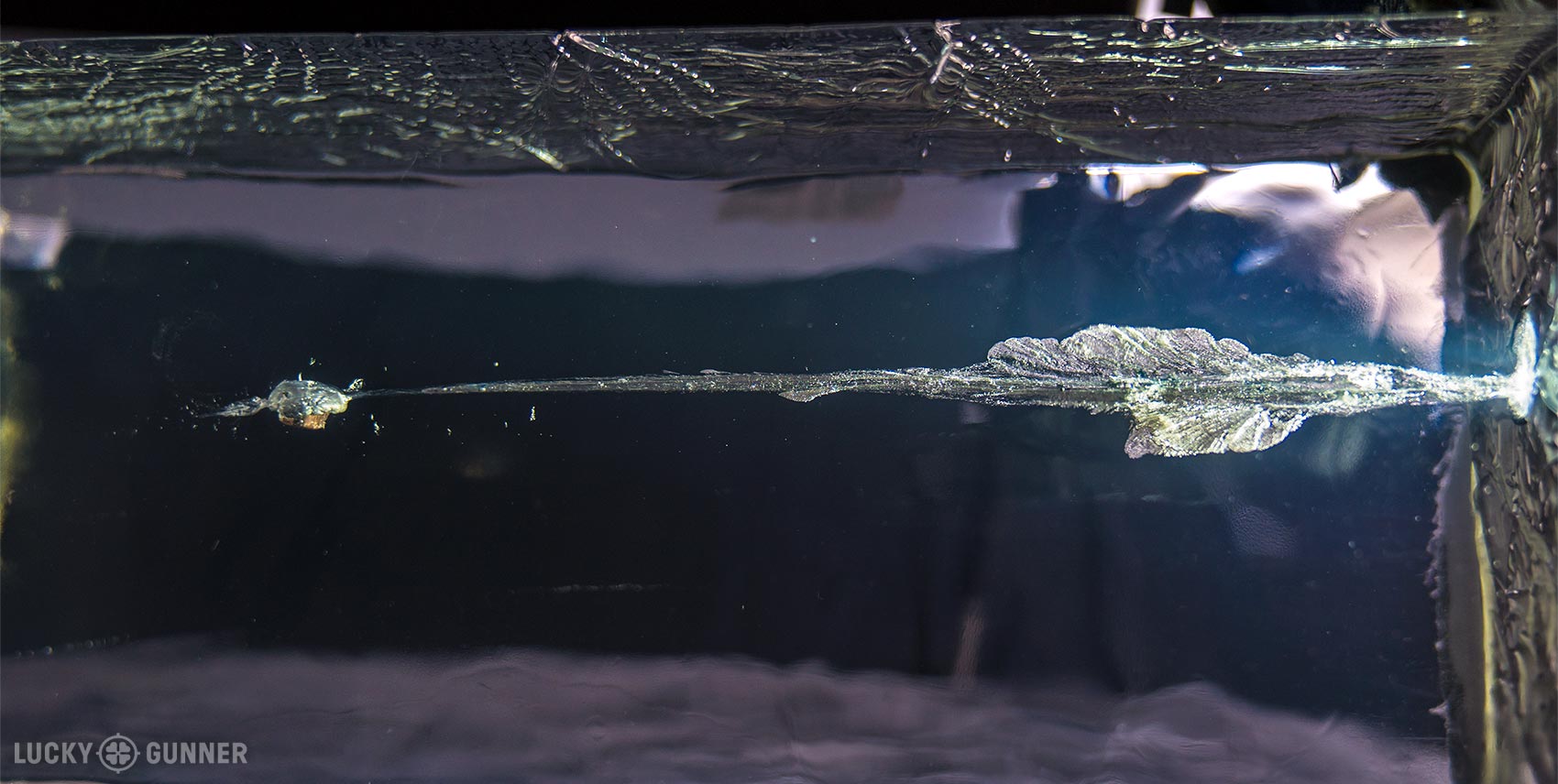
According to the FBI’s research, bullets that penetrate between 12 and 18 inches in 10% ordnance gelatin correlate heavily with bullets that sufficiently penetrate soft tissue in real-world shootings. The synthetic Clear Ballistics gel we used typically yields results similar to the FBI’s organic-based ordnance gel when testing defensive handgun ammunition for penetration and expansion. Keep in mind that the 12″-18” range is only a guideline and not an absolute predictor for which loads will deliver acceptable real-world performance. I would not suggest discounting a specific load due solely to slight over or under-penetration in the Clear Ballistics medium, especially if that load also exhibited consistent expansion.
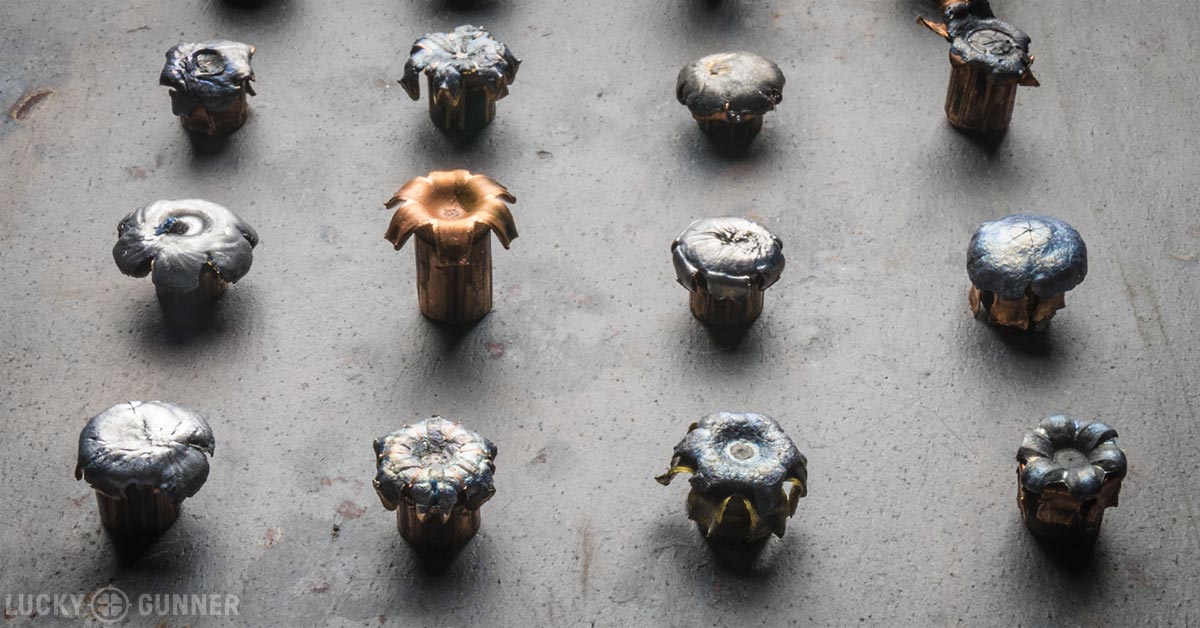
The expansion column displays a photo of the fired bullets from each load along with their average expanded diameter. It’s important to look at both the average and the photo because, for example, a load that completely failed to expand for two out of the five rounds fired could still have a decent average diameter, despite sub-par overall performance. Unlike the penetration depth, there is not a widely accepted standard for expanded diameter, but one commonly used guideline is to look for an expanded diameter that is at least 150% of the original diameter. For both .38 Special and .357 Magnum, that is roughly .54 inches. For the purposes of self-defense, adequate penetration should be prioritized over expansion, but an ideal load will have both.
The final column shows the average five-round muzzle velocity of each load. A quick look down this column makes it easy to see which loads varied the most between the two test barrels.
Test Results
.38 Special Ballistic Gelatin Tests
The majority of the .38 Special loads showed consistent penetration depth into the ideal 12-18” range, though most were at the lower end of the range. Bullet expansion was not as encouraging. Out of the 18 loads we tested, 12 of them had at least one bullet become clogged with fabric and completely fail to expand. Five loads were unable to expand with any of the 10 rounds fired. The extra velocity of the 4-inch barrel improved the performance for a few loads compared to the 2-inch numbers, but in general, the poor performers yielded unimpressive results regardless of barrel length. Overall, the performance of the .38 Special loads we tested falls somewhere between the typical .380 ACP and 9mm results from our previous tests.
.38 Special Ballistic Test Results
- Medium: Clear Ballistics Synthetic Gel
- Barrier: Four Layer Fabric
- Test gun: KIMBER K6S RUGER GP100
* - indicates bullets that failed to retain an average of at least 85% of their initial weight
.357 Magnum Ballistic Gelatin Tests
As expected, the .357 Magnum loads performed, on average, much better than .38 Special. Only 4 of the 20 loads tested had any bullets that failed to expand. Under-penetration was almost non-existent, but several loads exhibited severe over-penetration. Many of the loads that showed overall good performance on paper also delivered harsh recoil that would likely compromise controllability for most shooters, particularly with smaller framed guns. I personally found that the loads in the 125-135 grain range traveling at around 1100-1200 feet per second were the easiest to manage recoil-wise.
Some of the loads that exhibited borderline performance through the 2-inch barrel showed better numbers when pushed to slightly higher velocities with the 4-inch barrel. This seems to support the conventional wisdom that magnum ammo tends to underperform when fired from short barrels. However, in at least a couple of cases, the reverse was true — the extra velocity from the 4-inch barrel lead to slight over penetration and less expansion than the same load fired from the 2-inch barrel.
.357 Magnum Ballistic Test Results
- Medium: Clear Ballistics Synthetic Gel
- Barrier: Four Layer Fabric
- Test gun: KIMBER K6S RUGER GP100
* - indicates bullets that failed to retain an average of at least 85% of their initial weight
Conclusions
As with our previous gelatin tests, I’ve refrained from offering any specific recommendations here. I have tried to limit my commentary to simple observations of the raw data. If you would like to know which self-defense loads I would suggest after conducting these tests, I’ve got a post over on the Lounge with some of my thoughts.
Of course, don’t forget that gel test results should be just one factor to consider when choosing your defensive ammo, and ammo selection is a very small part of a comprehensive strategy for personal protection. That said, I hope that the test results provided here will help you make better-informed choices with your life-saving equipment.
Love the tests. You guys do an awesome job.
The video for that 125 Grain Barnes XPB HP is terrifying. I watched it four times in a row just to re-watch the lightning clap.
Yes, but that is due to the large percentage of petroleum products in Clear Ballistics brand gel.
Thank you for the new information. Another great resource from Lucky Gunner and just one of the reasons I order from you!
These tests are a huge contribution to the shooting community, thank you for all of your hard work.
Indeed, I’ve tried to glean from numerous online sources, but this comprehensive apples-to-apples test is far clearer.
I see a few old bullet designs in some old loads still get the job done just fine.
Federal Nyclad. Wish they’d bring it back with perhaps 50-100 fps more velocity but not to +P level.
Numerous terminal tests in Clear Ballistics stuff shown here have outcomes whereby, for a given type of round and comparable impact velocities, penetration is significantly increased as expansion is also significantly increased! Very “interesting” indeed!
Observations:
1. Remington 125gr Golden Saber looks consistent across the board. I wondered why they have not updated it. Maybe because it still hangs with all the others’ premium pills? I prefer 158gr loadings, but hard to argue with such consistency.
2. Ancient Remington SJHP in 158gr & 125gr surprisingly good performers for such dated tech.
3. First test I have seen where std pressure Hornady 158gr .38spl did so poorly. Might have to reconsider it as SD carry ammo.
4. Target .38spl wadcutters put it in the middle of the sweet spot with teeny-tiny recoil.
5. Remington FBI load in .38spl put it in the sweet spot, but only expand with 4″ bbl.
I don’t get the impression that Remington is investing a ton into ammo R&D these days, so it’s no surprise that the Golden Sabers are still around. I do wonder if we’d see a performance increase if Remington did a bonded version.
FWIW: Remington Golden Saber Bonded exists, but only in common semi-auto service pistol cartridges.
I’m not certain as to the status of the Golden Saber Black Belt, designed by Tom Burczynski. It seems to fallen off of the map.
I recently purchased a box of Remington Ultimate Defense for compact handguns but I haven’t had the chance to fire them into anything to see the results. I was most surprised and impressed by the Winchester Train and Defend 130gr especially considering the relatively low speed of that round.
These tests have just about made me give up my wheel guns for self defense purposes. With only a few exceptions the .38 special doesn’t seem to expand AND penetrate enough for my taste. Then .357 magnum seems to give very good ballistics but the damn blast and decibel level rules it out if I have to shoot it in a confined space or at someone trying to rob me in my car while at the ATM. I want to survive a self defense encounter AND still be able to hear afterwards. .357 magnum is still a great woods caliber for sure. I guess, faced with the facts, will have to succumb to the 9MM semi auto crazy. I’m actually pretty sad about that.
Great, fantastic, awesome, super-duper job with the tests Lucky Gunner.
Revolvers still have their place. The reliability thing is often over-stated, but I do think a snubby is, on average, far more reliable than most small autos, particularly in a contact distance encounter. I’d say go with whatever you shoot the best and have the time and motivation to practice with.
I’m going the opposite direction. After viewing the numbers and photos, it’s cinched the deal, and I’m getting the 2.25″ SP101 in .357 that I’ve been eying. Love DAO revolver, and that kind of power is hard to beat.
I’m a die hard revolver guy and have carried .357 for years. I just hope you never have to use that .357 and if you do its in wide open space. Your hearing will be glad. Picked up a Glock 43 and a Glock 26 for carry. More ammo with no difference in ballistics for a similar sized package. Trust me, its hard for me to move to semi autos. I have a certain disdain for them and love my revolvers. Like I said above, its a sad day for me.
I routinely carry a G27 in a SmartCarry, or a G32 in a Raven Concealement Holster, but I prefer revolvers, and if I’m ever actually forced to use my .357 to defend my life, tinnitus will be the last thing on my mind. I’ll deal.
You DO realize that the SP101 is also chambered in the .327 Mag? Pretty wicked cartridge from what I can tell, without the recovery time required when firing full .357 Magnum loads. And it’ll give you an extra round. Wish Ruger would chamber the 1759 TALO in 327 Mag. That’d be one hell of a fun range gun.
I realize it, but I don’t want a .327 mag. No idea why everyone blathers on and on about recoil. It seems that every debate knocking the .357 mag boils down to recoil. The 9mm guys eventually get around to admitting to it, too. Even after blabbing about the F.B.I., the S.E.A.L.S, “improvements in ammo technology”, and how they can make more accurate shots, it all boils down to not being able to handle recoil. Men used to be tough. It was considered a point of honor to be tough, and to use the best tool for the job. Americans always wanted bigger and better. The .357 was designed to trash bad guys. If you can’t handle the caliber, start exercising. Do some push-ups, chins, and keep a gripper in your truck. Don’t accommodate weakness – overcome it, and use a real caliber.
i agree with you, john Reid
i am a little old fat guy and i fire my .357 with one hand.
i dont work out.
if you dont like the kick, go giggle with the girls.
liked the old better, when men were men.
I wonder if Bruce Jenner has a 25? A 22 would have too much kick for him/her?
You were correct with the first pronoun… “him”. Don’t give into the madness.
I don’t really hear many folks that know shit trash the .357 Mag. as a SD/hunting round. It performs at the top end of size/caliber class, and that’s why folks that shoot ’em from a pocket gun, don’t like ’em. I was just throwing out an alternative with the .327.
well, i think the recoil of the snubbie in 357 is what the complaints are about…if all that recoil and blast wasnt wasted because of the short barrel not giving the bullet enough time in the barrel to utilize it, it would be great….a 327 is an extra round (6 vs 5)..but very few have thought it through and so its to friggin scarce and that sucks..but it too wastes power and is loud and extra flashy…but 6 rounds of 400 ft lbs??, better than a 357 only because of the extra round..and only in snubbie..after that its nothing better …a 9mm snubby is the best compromise…the reason is fast burning powder is the way to go in a short barrel…and you cant put it in the larger case of 357 because the pressure would blow it up….
Blow it up?…you don’t fill the case with fast burning powder. I have both the 357 and 327 and the six shot Ruger sp-101 in 327 is a fantastic carry gun. I load most of my own ammo (but also have 10,000 plus rounds of store bought for the 44 guns and counting I own) and chronograph my ammo. I get well over 300 ft-lbs with my 32 H&R mag. Handloads, and out of the 4.2 inch Ruger, I get 450 ft-lbs out of most of the store bought 327 ammo, and 500 ft-lbs out of the gold dot and Federal soft points which also expand well. I get 520 ft-lbs out of my handloads with 100 grain xtp. I do carry a 7 shot 357 mag at times, with two speed loaders. Love both rounds…I agree, if you do not handload, the 327 can be scarce on ammo. Handy gun though. Can shoot 32 s&w, 32 s&w long, 32 H&R mag (Buffalo bore makes a great 100 grain xtp load), 327 mags, and even 32 acp in a pinch since it is semi-rimmed. They may not extract for you though. Very versatile gun. I am looking for one of the longer barrel single-six/sevens in 327. And I am no recoil averse wuss, own and shoot often, 357 mag, 44 mag, hot loaded 45 colt, which in my opinion is a much better round than 44 mag (in my 45 colt Redhawk they are a beast to be reconed with…probably my favorite handgun round), and a Ruger Superblackhawk five shot 454 Casull. I love the 454 too, and with the Bisley grip is not bad to shoot at all. Can also shoot 45 colts in it. I shoot 20 to 30 full house 454 rounds with no problem, or ill effects. We are talking almost 1900 ft-lbs, and with right ammo has taken nearly every game on the planet. Not quite a 460 or 500 s&w mag, but in a much more packable gun. Would love to get a 480 Ruger, or 475 Linebaugh as well. Probably the 480, in a superblackhawk like the 454. The Linebaugh would be a custom gun/freedom arms, which are not in my price range. BFR makes a Linebaugh, and they are nice guns..maybe one of those?
Different people react to recoil differently, just as some people have much higher pain thresholds than others. It’s not something to be denigrated, as if the person is somehow effeminate if they are recoil or noise sensitive; it’s something to accommodate and adjust to by selection of a different weapon. Personally, a .44 Magnum doesn’t bother me at all – but there are those who are affected by a much smaller caliber. The objective is to select a weapon that YOU, and you alone, can and will practice with and fire effectively – that won’t happen if you find shooting your weapon unpleasant, and that aversion to practice makes you less effective against a threat. Who cares? That’s why Baskin-Robbins has 31 flavors.
It’s not about being tough, it’s not being a whiny baby, it’s about shorter split times. I have no problem handling the recoil of any big bore revolver, I’ve owned many over the years, carried a few, and enjoyed them all while shooting thousands of round through them. But the fact is that the few tenths of a second increase between shots just isn’t worth it. Any of these calibers is going to put a deep hole in a bad guy. I’ll pick the one that can put more holes in a shorter period of time. There’s no reason I need to flex and pose with a magnum. I’d rather put three holes in a bad guy instead of just two, in the same amount of time.
John – after a couple months of thinking about it, I think I’m going to stick with my revolvers as I have over the years. I just really love revolvers and I really, really hate semi autos. Did you get that SP101 yet?
I did, and I’m really enjoying it. If you decide to buy one – and I can’t praise it enough, one thing that I will pass along is that the fixed sights on mine appear to be set for a 6 o’clock sight picture. I’ve really grown accustomed to that, and have adjusted my other revolver accordingly, since anything over 3 yards, and the sights obscure the target with traditional poa/poi sight pictures. I can also recommend the Pachmayr grips for it. Wood is pretty, but rubber is pretty useful for actual .357 loads.
On a side note, a local fun store has a pretty good price on a CZ SP-01 Tactical in .40, and I’ve been in to look at it, a couple of times, but to be honest, I just love revolvers more. Even cleaning them is a labor of love.
My next purchase will be the Ruger 1704.
Another thing going for revolvers is that you don’t have to go through 500-2000 rounds (depending on which auto loader fan you ask) to have confidence your gun is reliable enough for SD, like with an auto loader. Unless a revolver is actually broken, it just works and isn’t picky about what brand of ammo it eats. The same auto loader fans who berate revolvers will post elsewhere about how many rounds they put through their gun to satisfy themselves it’s reliable. And they’ll trash certain ammo brands as “causing” malfunctions. An auto loader can malfunction even when it’s actually not broken. (Yes, I do know they have certain advantages, mainly more capacity.) But I prefer revolvers although I own a few auto loaders, too.
A one or two shot exposure isn’t going to cause permanent damage to your hearing. My Dad and his friends are old-timers who came up shooting in the 1960’s and 1970’s. They averaged about a hundred primer-flattening .357 loads every weekend….and they can still hear about as good as can be expected for guys in their late 70’s. I wouldn’t let decibel level (by itself) force you to choose a less effective caliber
Actually, within the confines of a house or car, it can – if your ears ring afterwards, your hearing has been affected. For people who are noise sensitive, there are ear plugs that can be worn comfortably all day that allow hearing normal conversation, and then shut off on impact noise. If your hearing is sensitive, or you want to protect it, that’s not a big sacrifice to make. I used to shoot .22 a lot when I was a kid – long before it was common practice to wear protection, and my ears ring and my high frequency hearing is attenuated. No big deal, but I’d rather it weren’t the case.
Who cares if your ears ring for a while if your life depends on it? Not trying to be a smart ass, just saying, use what you are comfortable with and/or have at your disposal. I have a seven shot 357 at the bedside, but loaded with 38 +p ammo. Have two 7 shot speedloaders if the crap hits the fan with 125 grain 357 mags. Wife has a 410 shotgun with 3 inch triple ought buck in it (she is recoil sensitive), also have a 9mm carbine accessible with two glock17 round mags. I switch off what I use, but thst is current lineup. Also, have a 38 spcl. Derringer as a backup, last resort gun.
9mm snubby is the answer…these tests wont show you that it bests a 357 in a 2″ platform because its cheap and sold everywhere and there is a real danger with crimp jump with heavy +p reloads in ultralight snubs ( ie ,. smith and wesson scandium frames etc.)….but with factory standard pressure loads in the 124 to 147 gr weight range, you’re in the 300 to 350 ft lb range and 14 to 18″ penetration range with recoil less than 38+p…and if it doesnt bother you to much +p or +p+ will outperform 357 (except an actual contact shot) with less recoil ( but not much less ) but a lot less blast ( flash and noise!! )….500 ft lbs can be acheived with loads from underwood and buffalo bore….in a 2″ barrel revolver which is equivalent to a 3″ semi auto due to a .357 chamber length of the cylinder..TEST THAT!!
LCR 9mm….Best for pocket..the hammerless one anyway…no need for special sights either..practice pull,point,shoot techniques,(pps), maybe a laser grip..but you cant count on it working when you need it…but even training with it will help you with muscle memory in the pps techniques…and revolvers ARE more reliable in their function and especially in shooter caused malfunctions under quick and stressful situations…forget about reloading quick in a fight…carry 2 !!!
9mm isn’t any softer shooting that 38 +p. It is physics, they are shooting similar weight bullets, at about the same speed, 9 mm may be slightly faster which would mean more recoil. An all steel snubbie weighs as much as most compact 9mm. The autoloader may dampen the recoil some, so I will give you that. I doubt you get 350 ft-lbs out of a 9mm snubbie? Heck a lot of the articles I see show barely getting 300 ft-lbs with +p ammo. A lot of the 9mm ammo out of a short barrel does not even expand. If you have one of the 3 inch 9mm, you are getting subpar performance, and your so called +p or +p+ is running into same problem that you claim 357 snubbie has, you will burn half the powder and have a HUGE muzzle flash. Most self defense situations have about two rounds fired. I would take 2 357 hits over 2 9mm hits any day of the week. Just choose the right ammo for a snubbie. The 500 ft-lbs Underwood is NOT being shot out of a short barrel 9mm if so they are NOT getting 500 ft-lbs..probably a service length gun. I can get 700 ft-lbs out of a service length 357 with Underwood.
truth right here
people need to stop looking at the box and look at what the chrono says they’re getting out of their gun
if you want to carry a compact, .40 has the lowest fall-off from reference (box) velocity to short barrel velocity.
anyone notice the seemingly sudden increase in high round count police shootings? Jacob Blake took 4 9mms to the back at point blank before stopping. the wall of lead trigger doctrine is good at wounding but a civilian going deep into the magazine is going to result in murder 2 charges
I don’t think you are looking carefully at the results here. There are sufficient acceptable rounds that will do the job out of a 2″ or 4″ barrel. The .38 special is alive and well due to modern ammunition in a time when a hollow point might also reduce collateral damage. The old NYC police load was a 200 gr. 38 spl. It penetrated and did not expand. It had knock down power. These tables are a GREAT starting point. A look at Paul Harrell’s channel on youtube with a pseudo real world example of bullet effects using a “meat” target will open your eyes as well. I just wish he organized and cataloged his work as well as these boys at Lucky Gunner. If they combined their efforts that would be phenomenal.
Great test, really appreciate all this data. I know you guys can’t test every ammo on the market but if you do an update, consider trying Remington SJHP in 38 special. Thanks again.
We will consider it. Whenever Federal releases their .38 Spl HST, we’ll do an update with a handful of loads that didn’t make it into this batch.
As always, I look forward to your tests. I was pretty disappointed with the offerings from Federal as well as the 135gr Gold Dot.
How about testing the Federal C357B? It would be interesting to see how it stacks up with the Remington/UMC 125gr SJHP you have already tested. Head to head with two classic rounds! BTW the Federal .38 Special HST has been out for seberal weeks now….. Thanks!
Also the standard pressure Gold Dots in .38 Special.
Awesome information; thanks for doing these tests and presenting the data in such an understandable and useful way.
Been waiting months for this to be published! Awesome resource, thank you.
Your work to benefit and educate the shooting community (experienced or novice) is simply outstanding. Thank you!
Chris,
THANKS so very, very much for the exhaustive test. I have the Remington 125gr +P Golden Saber in the 4-inch gun around the house. I find that it hits hard, is accurate and expands reliably. Interesting that the snub expanded more.
Glad you have found it helpful. The diameter was technically wider with the 2-inch, but if you look at the photos, the 4-inch bullets had much more uniform and consistent expansion. Results like that are why we encourage people to look at the photos *and* the numbers!
Hornady used to be one of the top performers, but I noticed that they re-designed their XTP profile. This leads me to believe that’s why they don’t expand well in this test. Look for the slight slope near the nose, I noticed the cavity can be crimped slightly closed with most seater dies.
the xtp bullets are round specific..meaning they are designed to expand according to speed..in a light slow moving round such as .380 or 38spl short barrel they only open a little in the hopes they will also have acceptable penetration…you know…that “perfect” depth of 12-18″….
I wonder If the bullet-jump from the 38 sp caused any issue with how it preformed. I would like to see the same test using a SW J-frame.
.38 specials do not devlop the same velocity when fired from a .357 chamber. The data should be more impresive if they were to use an actual .38 special revolver.
What is the difference in velocity?
Great study/comparison thank you.
These results – particularly expansion – are so far off from what has been consistently obtained in law enforcement and ammunition manufacturer testing in true 10% ballistic gelatin, that I don’t believe they are accurate. Perhaps the clear gel (which is not true laboratory ballistic gelatin) was and odd batch or not correctly calibrated.
“Proper calibration” is a necessary but not sufficient condition for dynamic terminal equivalence between a proper simulant and soft tissue. Clear Ballistic stuff cannot have decent dynamic equivalence — even with “perfect calibration”– any more than, say, a piece of wood can have with the same calibration. Numerous results obtained here in Clear Ballistic stuff are so at odds with results in 10% standard ordnance gel (and virtually all soft solid homogeneous media) so that — the results here are for entertainment purposes only!
So true. I love the open testing that Lucky Gunner is doing here. But gosh I wish they had used the correct medium. It would really make these articles a golden resource.
Unlike terminal results in 10% standard ordnance gel, results in Clear Ballistics stuff are often unpredictable, unreliable, unrepeatable and thus make no sense — if one assumes that this stuff is pretty much homogeneous and isotropic (as ordnance “gel” should be) and physics applies. Quite evidently, in Clear Ballistics stuff the same or very similar ballistics input (bullet mass, shape, and velocity) quite frequently does not result in a similar terminal output (expansion and penetration)!
Quite often, in this Clear Ballistics stuff, it is evident that — for the same type of bullet (even same lot) and comparable velocities, penetration is significantly greater when expansion is significantly greater!
well, you can certainly compare round to round in it without being an M I T grad…..problem with these tests is everyone seems to fire multiple rounds into the same block..and that is what accounts for inconsistency……
Awesome work. As always, well done.
I know you cannot test everything. However, if you are open to requests for a second round of testing, I would appreciate seeing the Corbon 110 gr DPX in .38 SPL +P.
Thanks for the hard work and excellent presentation.
Please test buffalo bore items 20a and 20c (158 lswchp and +p)
Great Stuff… thanks
Great info.
Thank you for the time and effort involved which was such an undertaking. Easy to read and decipher.
I have an old Ruger Security Six .357 Magnum with a six inch barrel from the 1970’s. It loves the Hornady Critical Defense and the Buffalo Bore.
Thank you for the work you are doing educating shooters on these types of issues. It is not only important to hit what you aim at but also to know what the results of that shot will be. Love the .357 Magnum and nice to have the same caliber for my ole Lever Gun in the corner.
Excellent! Thanx for your heroic effort you have put out to help educate folks!
Thanks!
Those coders did great work on the charts.
Yes, they are my heroes.
You have the best, and most consistent data I have found , thanks
The interactive chart would be a LOT more helpful if it allowed concatenated sorting [ie, I’m only interested in perf out of 2″ barrels, so I click that 1st. Then when I click on expansion to float the reliable expanders to the top, it sorts those *within* the previously selected limitation of barrel length. Etc., etc…] Or, you *could* have just given us a summary with the 3 products in .38Spec that reliably expanded to 150% of original diameter out of a 2″ barrel & saved the reader a lot of work… ::)
Don’t take that comment as derision: your efforts are greatly appreciated! Just constructive crit for next time… ;-D
It’s a relatively simple matter to highlight the rows of interest, then paste into an Excel spreadsheet and manipulate however you like. I usually paste a master sheet, then copy the cells of particular interest into another for manipulation, using format painter to reduce them to simple text to eliminate, for example, the tendency of a cell formatted as a link to trigger a link follow and load a page in your browser. Doing so, I was able to use the Data, Sort capability to sort first by 2″ barrel, and then by expansion diameter, or whatever criteria you choose.
Well done guys. I hope this article becomes a “sticky” someplace because it’s probably the most unbiased test I have seen in recent years. This is the kind of info that benefits both kinds of shooters. Both the shooters who have been shooting for a while and know a lot, and those who have been shooting for a VERY long time, and have come to realize how much they have yet to learn. I’m not insulting anyone here, just remarking that the longer you deal with guns, the more there is to learn. You guys did a great job in breaking it down, so kudos to y’all.
I have noticed that several of your tests have significant outliers, and that interests me. The brands of ammo used does not raise issues of QC in my mind, so the cause lies elsewhere. I’m talking about the strings where 3 or 4 rounds would penetrate to more or less where you’d expect them, but the other 1 or 2 would penetrate significantly further. I assume that you are not Obama-stupid where money is concerned, so you are not going to fire each round into a new gel block. That’s be a waste, but I also assume that each 5-shot string was fired into a new block, else the entire test would be as useful as tits on a duck, right? That said, I believe that the most common cause for the outliers would be that they are the last shots of the string, and instead of expending as much energy carving a “wound channel” they follow a preceding round’s path, thus meeting less resistance. Sound fair?
Then what could possibly explain the Speer Gold Dot (both 125gr and 158gr) from the 2″ Kimber? I mean, look at the 158gr string that all want to penetrate a whale through-and-through, except for little Johnny that decided to quit halfway through. Another example, though not as extreme is the Barnes Vortex 140Gr from the Ruger. When 4 of the 5 rounds stop at almost the same depth, and one decides to just quit about a foot from it’s buddies it makes me ask “why.” I’m open to any reasonable explanation.
Another question I have wondered about regarding the .357 Mag, is why were they changed from a Large Pistol primer to Small Pistol primer right after the last dinosaur died back in the day. Was there a specific reason for this change?
Glad you enjoyed the tests. We have not noticed any correlation between outlier rounds and the order in which they are shot. We try to space out the shots in the gel blocks so that each round creates a channel that’s at least a couple of inches from the other wound channels. Sometimes there is a bit of overlap, but it’s rare, and even that has not seemed to cause any outliers. Usually, the deeper penetrating rounds are because the bullet is right on the edge of being able to expand at its current velocity and it either just barely defeats the fabric barrier or it chokes and fails to expand, which leads to deeper penetration. The lack of consistency could be due to any number of factors — variations in the bullet’s construction, bullet velocity, the way the fabric layers happen to be resting against one another, inconsistencies in the gel itself, etc. We try to make the conditions as consistent as possible, but there is no practical way to get it perfect, just like there is no practical way to get each round to have the exact same velocity. In real life, there are many more variables, which is why even the best bullets don’t expand 100% of the time in street shootings. There is a correlation between bullets that do well in gelatin and bullets that do well in real world shootings, but it’s not quite as clear cut as just looking at test results on a chart and ranking them to find the definitive “best”, which is why I always encourage people to look at the gel test as just *one* factor to consider in ammo selection.
Excellent, excellent. I consider both the pistol and now the revolver tests to be the best available. They are consistent, documented and completely unbiased. They have sure helped me decide what ammunition to use for my defensive carry. Keep up the great work. You have become the go to reference.
I think this shows the writing is on the wall more for lead-based 357 loads than for the revolver in general. There are plenty of arguments you can make for revolvers having tactical advantages in certain circumstances (superior fired from a jacket pocket, for example), but this is telling me that there are steadily decreasing arguments for anything other than solid copper. If you select for max. expansion you see 8 of the first 11 are solid copper! (and all in the penetration wheelhouse).
I’d like to say thanks for running all of these tests! They are comprehensive and thorough! Also, your videos are all very well produced!
Hopefully people will see that the caliber wars are silly and that there are capable loadings in all of these calibers.
Solid copper tends to tumble, creating large wound channels.
What’s wrong with a large wound? Personally if I shoot an intruder I don’t want them to get back up.
That’s funny, I looked at this and felt like I’d rather buy the cheaper lead stuff… the results are there for a lot less money.
I thought the same — a keith style hardcast lead semiwadcutter or wadcutter , in 148 or 158 gr is still a great choice in .38 and in my opinion mid range 357. Sufficient penetration. Remember most copper HPs do not expand reliably at 38 sp velocities anyway. Penetration is the thing you have to have. In self defense, your target won’t be ballistic gel, but have leather and/or fabric, bone, non-ideal shot angles, barriers, etc.
ALSO the big elephant in the room is that off-the-shelf standard-pressure .38 is often loaded to lower than SAAMI specs, to be easy on a lot of the old historic 38 revolvers out there. SO, if you handload, you can stay within standard pressure .38, and have lead bullets doing 800-850fps instead of 650 fps! WIth .38 +p you can have those moving at 1000fps.
I believe a lead bullet (not round nose) with a wide face (meplat) and clean edges, will make a better would channel than a HP that does not expand (which they often don’t, esp in lower velocity cartridges, and even in higher velocity, when they encounter fabric).
How is it that the hornady 110 grain 38 special moves slightly faster and is a bit hevier than the hornady 90 grain 380 but the 380 still seems to both expand larger and go deeper ? Seems odd .
I know every suggestion means more expense on your part, but I would love to see .22, .25, and .32 rounds tested to round out the most common self-defense rounds for concealable handguns. This would prove to be extremely valuable information in the never-ending debate on the minimum caliber for SD. Personally, based on a significant amount of research I wouldn’t go below .380 in a pistol or .38 Special in revolver. From reviewing other sources, .22-.32 rounds expand little to none and have trouble meeting minimum penetration requirements. Anyway, eventually getting to those calibers would definitely round out this research. Thanks.
Excellent product, most excellent indeed. My thanks and applause. A lot of surprises, especially in the performance of the Speer products and the LSWCHP in the 2″ guns.
When you expand this chart (as you have done with the 9mm/.380/.40/.45 charts) could you please include the generic 110 grain SJHP and 158 grain SJSP .357 magnums? These are fairly common and it’s likely that anyone searching for .357 ammo will stumble across them, especially in a big box store or Walmart.
Will your next new chart be for the big bore revolvers? Even though they’re a very small section of the carry community, I’d love to see how various .44 SPL and Magnum loads perform.
This is really good work. Thank you so much!
This is an outstanding resource that you’ve put together! I’m unable to comment on the technical aspects of the Clear Ballistics Gel, but I’m satisfied that it gives at least “ballpark” reasonable comparisons of apples to apples, and is therefore of great value. Sure beats shooting water jugs, and even the latter give us some idea of what handgun loads are and are not likely to do.
Was pleasantly surprised by both Winchester “Defend” 130g results for standard pressure snub .38 SPL loads and also found Hornady CD 110g results worth a look in that category.
Thanks very much for something we shooters can utilize without a crystal ball!!!
I’m surprised you didn’t test the Federal 125gr C357B. That one has been a standard for years. I’ve sort of standardized on those and the 180gr Hardcast. This great information though. I’ll probably give the Federal 130gr mag loads a try.
I just can’t get over how well-done this project is, what a major contribution you’re making to the consumer and SD/HD/CC public, and how LONG-OVERDUE this is in a market flooded with sales pitch hype that strategically omits so very many important factors. The issue of test-barrel length alone would fill volumes.
Let me get over to LG now and try to put my money behind you! Thanks!
Absolutely love the work you are doing with these ballistic tests. Any chance you are planning to work through .357sig? Looks like a lot of us would be anxious to see the results!
Great tests, thank you. Would love to see more tests from the 2″ .38, with a load that has the Barnes TAC-XP bullet. Also the new Federal HST. Maybe some offerings from Doubletap or Buffalo Bore as well.
Just out of curiosity, why did you test the buffalo bore .357 loads but leave out their .38 special +P loads they claim were made for snubs and generate low end .357 ballistics?
Aim for the head and this discussion becomes a moot point 🙋
if only the attacker or attackers will hold still, my 22lr will do just fine….
Best info anywhere—buy my ammo from you.
Very amazing work, Mr. Baker your experiments are quite possibly the most informative, quantitative, and visually detailed projectile experiments I have ever seen.
On a critical note, I noted that on your summary you did not discuss the wide spectrum penetration difference of the round compared to the 9mm (from the video) and 38 spl. I only raise this point because the 21-31″ margin was only achieved by the .357 magnum. Is this because the target in question in all of your experiments is solely assumed to be a human or human sized adversary? City & country carrier asking.
Really appreciate the hard work any plans for .44? I like my 2″ .44 special but wonder about penetration.
Dear Lucky Gunner, I have order from you 3 times and each time the fed-EX guy delivers the package my 4 yr old son gets Excited and thinks its something for him! Is there any way you could put a Hot Wheels car in with my orders so the kid wont CRY?
Some of the computer parts places I order from have included a roll of lifesavers or a small pack of M&Ms. (Lol the 1st time it happened I felt bad thinking the guy that packed the order must have had it fall out of his shirt pocket.) It could be something to think about and certainly cheaper than a Hot Wheels :)
Great job!!
Just noticed in the videos you never account for “bounce back” when measuring penetration as I have seen on other videos using clear gel. Just curious as to why that is? Thanks.
Thank you for your work. I carry a 640-1 and appreciate the 2″ bbl data. Kinda cuts thru all the crap out there.
I’d love to see the 32 H&R & 327 Federal creep into the revolver list, factory loads available in contrast to the 38 & 357 should make for a shorter test…
We would like to test those. Hopefully late this year or maybe next Spring.
The .357 magnum was actually more of an extension of the .38-44 HD. You are factually correct (more or less) that the .357 was chambered in a longer case to prevent it from being chambered in .38’s as was the case with the .38-44 HD rounds. A few .38 specials were blown up as a result but there was a cartridge before the .357 that was chambered in a special cylinder mounted on a .44 frame before that.
That being said the .357 was never officially adopted due to it’s over penetration on soft targets. Back in the day when the men were men and the sheep ran scared this thing was created to penetrate the thick steel of auto bodies in the early 1900’s. The kind of steel that a .38 often didn’t penetrate. It’s still a powerful round but as someone who has fired firearms indoors, I would hate to have to pull one on someone in an enclosed room in the dark. The fireball is going to render your night vision to crap and the report is going to ring your bell and leave you slightly dazed. Still a favorite of mine, just not home defense.
Are you planning on doing something like this with 357 sig? We’d really appreciate it.
Don’t forget 10mm too!
I know u said u wanna limit your commentary but.. Which 357 magnum round would you use for HD
That depends entirely on the gun I’m using. I would only use magnum ammo with a steel frame full-size gun, and even then I might be tempted to stick with .38 Spl ammo for several reasons. For .38 Spl, I really like the Winchester PDX-1 and Winchester Ranger. Remington Golden Saber was looking pretty good too. If I was going to go with .357 in a 4-inch barrel, I’d consider Speer Gold Dot 135 gr, Winchester PDX-1, and Remington Golden Saber.
Thanks for all the great information, the next time I need ammo I will order from you. Revolvers use the length of the cylinder plus the barrel, they also have a small gap, what would you estimate the length of a semi-auto barrel, that would compare with a 2 or 4 inch revolver barrel, or is the difference miniscule? Also I would like anyone to weigh in on the best caliber choice for us in California who are limited to 10 round magazines, and cannot take advantage of the extra capacity of a 9mm pistol. I keep a Glock 23 for home defense, loaded with Ranger T-Series 180gr, I find the recoil lighter than the 165gr, and prefer the idea of a heavier bullet. Any thoughts?
Semi-auto barrel measurements typically include the chamber while revolver numbers do not, so it can be difficult to nail down an apples to apples comparison. The “real” barrel length of the semi-auto is more like the stated barrel length minus the overall length of the cartridge. But then, as you mentioned, the revolver has a cylinder gap. But the semi-auto uses some of its energy to cycle the action. Honestly, I don’t think there’s any easy answer.
As for ammo for CA, the limited 10 round capacity would not change my personal preference for 9mm. The ballistics are very good (by pistol caliber standards, anyway), and it’s easier to shoot than the larger calibers. With today’s ammunition, you really don’t gain much by going to a .40 or .45, especially not in a compact gun where the difference in recoil is going to be more pronounced.
I do appreciate these tests …. Gel is the standard test media…
But the human body has bone , fibrous muscle , ligaments.. gas pockets ( lungs and gut ) … Thats when heavier bullets with better SD will out perform lighter bullets ..
The 357mag 158gr Remington SJHP out of my 357mag LCR will be my choice for carry
By far the best and most informative test chart I have seen. No exploding watermelons here.
What’s the deal with Gold Dot? Are they supposed to resist expanding?
Exceptional data. Do you have similar information comparing 9 mm?
Im looking forward to a test on Federal 130gr +P HST
Can you do a test for the Super Vel Super Snub as well as the new HST Micro?
It would be awesome if you could update the chart with a column that had the cost per round for the cartridge available on your site as well or, at least, the cost per cartridge when you performed the test.
I recently bought a glock 19. I can’t choose a holster. Found here a selection https://secretstorages.com/best-hidden-holsters-for-women/. Does it suit me or do I need to buy a special 19 holster?
Holster selection is a very individual decision and without knowing the details of your situation, I would not try to tell you what holster to use any more than I would tell you what shoes to wear. I will say that if you plan to carry a Glock 19, it may be very challenging to find a suitable carry solution that does not involve a quality holster attached to a sturdy belt. The elastic pouch type holsters found in the list of products you linked to may work for very small guns, but they are often insufficient to support the weight of something like a fully loaded Glock 19. If you do attempt to use one of these products, you might consider complementing it with a hard plastic insert such as The Flex offered by Keepers Concealment (http://keepersconcealment.com/products).
Fantastic!! Learned more plowing back and forth through your tests than I’ve ever picked up before from a single source. Thank you. An ammo order is forth coming. The .357 looks like a ninnybaby in your report. You might note that there are heavy-frame .357 mag or .44 mag pistols with six-inch or longer barrels, launching heavy bullets out at over 1600 fps which you exclude because they are not practical for most pistol users.
I would really like to see Federals 130gr 38spl +P HST micro ,tested
Me too! Also the Gold Dots standard pressure in .38’s.
Excellent tests and presentation of the results.
Thanks for the information.
Excellent comprehensive info. I will check your ammo prices/availability more often when shopping. Thank you for helping me decide on 38 Special & 9MM.
https://uploads.disquscdn.com/images/18a5517acabbac0721dbc534b833fc7d7211be1f67c2e0b04f4778e266395b34.jpg
My new conceal carry.
This project is such a great resource for the shooting community. Thanks and I hope you will continue to add to the database.
I’d love to see the Speer Gold Dot 110 Short Barrel 38 and some 32HR/FedMag tests.
EXCELLENT as always
may we see 357sig & 10mm labs please?
Too soon?
Yes.
Why are some stats different on the compiled main page vs when you click on the ammo itself? For example: Barnes 140 gr XPB VOR-TX
Bullet depths on the main page are listed at about 3″ deeper than they are if you click the ammo and scroll down and the velocities are off by about 200fps. I’ve seen other discrepancies elsewhere but I don’t remember them off the top of my head.
https://www.luckygunner.com/357-mag-140-gr-xpb-barnes-20-rounds#geltest
When you click on the load and go to the product page, the page will default to showing you the results from the 2-inch barrel test. There’s a dropdown menu at the top of that section to select the 4-inch test results. That’s probably why you’re seeing a discrepancy.
Hello,
I live in the Czech Republic. I have an LCR (.357 magnum). In the Czech Republic, it is illegal to use bullets with increased damage (JHP, SP …). Lagal ammunition is FMJ type. Can you recommend some self defense ammunition for me? I was impressed by the positive results of Wadcutter (they are legal in the Czech Republic !!!), but they are only sold by Sellier & Bellot and Fiocchi in the Czech republic. Is it the use of these cartridges (S&B, Fiocchi) more advantageous than using FMJ? What do you think of a wadcutter in .357 magnum? I am currently using FIocchi’s Black Mamba ammunition, but I am looking for a change …
A stupid question at the end. Under conditions prevailing in the Czech Republic, what caliber weapons would you have chosen?
P.S. I apologize for my bad English … (I know only google translator)
Big fan
The point of JHP and SP ammunition isn’t to increase damage. It is to prevent over penetration and hitting targets that are not intended. Some places in the United States have laws that are written with the same fallacy in mind unfortunately.
They do create more damage, but they also limit over penetration. For example, the overall wound cavity for an expanded 9mm round is much larger than the wound cavity from a fmj that zips right through. That is why a lot of special operators use 45 acp in the military, because the are limited to ball type ammo, and the crush cavity of a 45 is WAY bigger than 9mm if limited to ball type ammo.
overpenetration is only a concern because of wasted kinetic energy.
the first known expanding projectiles were dum-dum bullets.
this is absolutely false
hollowpoints have been known since the 1870s.
they are not designed to prevent hitting other targets…they were adopted because they were more effective on soft tissue
they exist to maximize energy transfer to the target. wound channels are larger and with sufficient energy, hydraulic effects frequently come into play (stopping power)
I’d agree with that. Hollow-points are unpredictable, but when they expand, they do a lot of damage. If they don’t, they often pinch shut and act like a round-nose, which is the worst bullet type. For reliable function, semi-wadcutters are hard to beat. Flat nose bullets make a belly-flop-like splash while giving good penetration and minimal deflection. Pick a weight that gives enough penetration at the intended velocity. At less than 1000 fps, soft lead may be better. Faster than that, hard-cast or FMJ seems appropriate. Lots of variables, such as polygonal rifling, can rule out soft lead. If you have enough penetration, a flat nose, and reliable feeding, there is no need to over-stress velocity.
Wadcutters
This is the best ballistics test I think I’ve ever read. The charts are awesome and show true fact. Keep doing more of these, I’ll keep giving you my money!
Are you going to test the Buffalo bore hard cast full wadcutter and the new federal hst 38 special?
Okay Chris, I’m ready for 327 Federal and the rest of the 32 caliber lineup now!
Me too…love my 327 sp-101…shoot factory and load my own, with the 100 gr and 85 gr xtp, and 90 gr sierra. As well as 115 gr and 130 gr hardcast. Also load my own 32 H&R mags, with same bullets, but do not use 130 gainers. Load 32 longs and even 32 s&ws. Also have a 32 s&w lemon squeezer that I load for as well.the 327 is a versatile gun. Anywhere from 85 to over 500 ft-lbs. I want a single six in 32 H&R and a single seven in 327 mag. Love the 357 too, but the 327 makes a great little carry gun. I get over 500 ft-lbs out if my sp-101, with both the Federal 100 gainers and gold dot 100 gainers, and my handloads as well, while staying within spec of 45,000 psi.
Still can’t get our hands on any 38 spl HST? I’m eager to see the tests and place an order but this stuff is scarce!
Awesome and very valuable thank you. BTW shot a few of these 357 loads out of my K6S and let me tell you Chris is a better man than me, never doing that again!
This Test shows me Standart is 90% some Bullets perfrom to 95% and other to 85%.
But the resault is always the same it disable an suspect quickly oder somew sec’s less
For me is not importand what brand i will use for defence ammo.
for me is total clear i will use only all copper bullets.
yeah, ive seen a lot of rounds for snubbies, but that federal 140 gr dpx had escaped me…looks wicked..and probably delivers the most damage….
I’d be very curious to see how the Federal HST Micro 130gr .38 +P stacks up against the rest. Ballistics info I’ve seen so far shows a very good combo of expansion and penetration, with a better degree of consistency than a lot of the competition.
In almost every case each successive bullet penetrated further. Temperature maybe?
I don’t think that’s the order in which the bullets were actually fired, they’re just arranged top to bottom in the chart from the shortest to longest distance to clearly show the best, worst and average that can possibly be expected.
Thanks Marty — that makes more sense
Best load is what you have with you a 5 shot 38 with ball amo is better that nothing.. I have seen many of 38 victims in my career.. if the is a a load that better that other I would say 158 grain LSWC hp .. it is still no magic bullet.
Great work guys, and wonderful user friendly interface. I appreciate the massive time and energy investment that these tests represent. That said, I’d request testing of 10mm and .357 Sig next! Particularly full power loads like buffalo bore, Cor-Bon, etc. I personally love my Glock 29 and 20, 10mm is a beast with full power rounds (forget the snub .357 mag, a Glock 29 with full power rounds will trump it any day ;P), and I buy .357 sig conversion barrels for most of my .40s, but it’s difficult to find ballistic results on 10mm and .357 sig, and it would likely help ignite some new interest in a pair of high power, well designed rounds. Thank you for all you do.
The testing would likely be much quicker too, since there are less factory self defense loads on the market.
Love these tests, am a huge fan, and buy lots of ammo from y’all! Where are the .357 Sig tests you promised back in the day?
They’re coming. Sometime this year.
I have a 357 Magnum 10″ from stock to end, revolver. It is MOD 27-2 with 63173 with a big 7 under that when I drop the barrel.
I find it interesting that the 125 gr..38 Special “Remington Golden Saber” is one of the top performers in this test. How much have they changed since their early days, Bonded bullet, etc???
How does an average round of 357 ball ammo do in gel? I’d expect to see an extra 5″ of penetration without research or proof. Thoughts?
I’d like to see Federal 130gr HST 38spl tested
Do they do “bullet drop” charts for these tests? Shoot gel for penetration tests, then shoot long distance paper for drop tests.
Inside of typical self-defense distances (1-15 yards), the bullet trajectory is a non-issue. Even at what would be considered “extreme long distance” by the standards of a defensive gun use (25-50 yards), bullet drop is insignificant. It might be interesting or fun to test the trajectory of various calibers at extended range, but it really wouldn’t be worth doing for more than a couple of different loads.
Why do many of these tests show deeper penetration from the 2″ barrel over the 4″ barrel in the same ammo?
Often, the 2-inch barrel doesn’t get the bullet up to the velocity required for the bullet to expand. When a hollow point fails to expand, it will typically penetrate deeper (though it will be more susceptible to deflection on contact with hard structures than an expanded bullet).
As I have just today found this presentation, I would like to add MY $0.02 worth.
This is a HUGE help to see your hard work presented for others who can make an informed decision as to what “might” be their best ammo for use in a Defensive firearm. As noted, until this article and the attendant charts, we have had to read SO MANY different articles to try and glean what YOU have compiled here, saving us all countless hours on the range and a not-inconsiderable quantity of money were we to try and recreate your findings.
You are truly a Gentleman and a Scholar or doing this
God Bless you Be Safe out there.
I’m looking at the Hornady critical duty in 38 spl for use in a 4” revolver. I notice the +p actually had less penetration than the standard load. Was this possibly an error or can someone offer some insight as to why? I see the 357 Hornady critical duty is just about perfect but my relatively light model 66 combat magnum kicks considerably with magnum loads
Thank you for this excellent work. I frequently refer your tests to my colleagues as a reference point from which to make decisions. I’m also thankful that you managed to pick two of my most favorite guns for the tests.
Would love to see a 44 Mag test series!!!
Excellent info and data! Probably the most comprehensive available. Thanks!
Very good study in performance of different loads. Very thorough. If it was at all possible, I would like to see how the Federal Nyclad 38 Special 125gr load will perform. According to several sources, ” the Nyclad round is a standard-pressure, self-defense load with a nylon
clad 125 grain soft lead hollow point. The Federal Nyclad Ammunition
for the .38 Special nylon coating allows the bullet to reliably expand
at low velocities. Many experts feel the 125 grain Nyclad hollow point was the best
standard pressure cartridge loaded for the .38 Special. It offered
excellent expansion with a relatively light recoil in even the lightest
of revolver frames.” There does not seem to be much, if any first hand experience testing this load, and I would hope to see you test it in the near future. Thank you.
light bullet weight + low velocity + rapid expansion = inadequate penetration
I appreciate all of your work with revolvers and revolver cartridges. Could you add the Buffalo Bore all copper Barnes loadings in .38 spl, both regular and +P? I’d happily pay for the ammo if there’s a way for me to take care of that.
My sister wss a member of the Indianapolis PD. Her d
Please test the Federal 357 magnum 158 gr jhp and the 125 gr jhp
Have you ever tested ammo from Precision One Ammunition? They have some pretty good reviews on YouTube for their .38 ammo and would like you to add them to your tests if possible.
Barnes 357 Magnum, Same ammo, more speed, less expansion, why?
Thank you so much for this!!!! The only request I have is to be able to sort the list by price per round just like the store front. This is only a minor wish though. Would be awesome to see this for all calibers and carbines as well. I know that is very expensive but I will be buying here to support this awesome information. Thank you LG!!!!!
This is pretty cool! Anybody know if there is a similar test done for 327 mag/32 mag self defense ammo, as well as 44 special?? I would be really curious to see if those cartridges compare favorably to the 38 special. @luckygunner: if you guys don’t already have test results for these calibers, you should consider it!
Thanks!
“I can’t believe you didn’t test my favorite – the ..27 caliber Elbonian flat nose” – or something to that effect . . . Seriously, concentrating on the mainstream calibers, and within them a very large and diverse cross-section of available ammunition, is a very focused and ambitious undertaking, and a valuable contribution to the literature – for which I am very grateful.
Being able to compare terminal ballistic effects like this systematically, side-by-side, leads to greater insights than could ever be gleaned from reading about them in scattered, non-parallel conditions. One thing that showed up clearly was that penetration depth is sometimes inversely correlated with muzzle velocity – that is, a low-velocity hollow point round may not upset, resulting in deeper penetration because of the smaller frontal area and resultant lower frictional drag; it’s not just bullet design; the same bullet out of a 2″ barrel at lower velocity may well penetrate more deeply as a result of expansion failure, which is initially counterintuitive.
I will study these tables, as will many, to our great collective benefit. I can only express my thanks by putting your link uppermost when it comes time to purchase ammunition.
Now – about that .27 caliber Elbonian flat nose . . .
Thanks so much for doing all the work. I am a paper/ plastic kind of guy and really appreciate the info. So many calibers so little time…..
I check into this site weekly. I always learn something new. Thank you!
I have shot gel a lot, even if probably not as much as you. I shoot almost exclusively handloads so I get different velocities and expansions than represented in your tests with the same bullets. Obviously there is a maximum expansion velocity, a maximum penetration velocity, and perhaps more interestingly a maximum crushed volume velocity for each bullet in each medium. Handloading and doing your own gel testing allows one to find what ever max they want for their preferred gun – recoil combination
LG,
I’m unsure how often you come back to engage the comments on these posts, but I’m just coming in off the “why caliber ears are dumb” post, which I found very edifying. So, I’ve been thinking about getting a nice j-frame S&W, and I’ve been doing some backy/forthy between 38 special and 9mm in your labs. Question is; why, given that the two cartridges have projectiles in the same weight/diameter neighborhood, is the .38’s performance (penetration and expansion) generally more anemic than the 9mm? I can only guess that the same tech the 9mm has benefitted from over the years has not yet been applied to 38?
*um, that’s not “caliber ears,” of course. That’d be the “Caliber Wars” thing. I have no idea how that happened.
the notion that there has been a revolution in bullet design is false- it is literally marketing hype.
petaling hollowpoints like GS and Black Talon have been around since the 1990s. They have merely become more ubiquitous. Even prior to the “revolution”, there were known good loads in every caliber. The ones in 9mm known to perform well through street rep were very high velocity, up around where .40 is now.
all calibers are *not* the same. police agencies that have to shoot dogs immediately noticed a profound difference after a switch from 9mm to .357 SIG for example. people who hunt deer with both 9mm and .357 notice a major difference.
all these calibers are pretty much equally effective at creating wounds but that is merely part of the story.
Simply some of the most amazing work out there on what is honestly one of the most biased parts of gun culture.
Thank you for your hard work in testing and posting these results. The .357 magnum is an astounding cartridge and its stopping power also most likely is the greatest of all handgun rounds. But every benefit comes with a price. The .357 would be my top choice in the wilderness and while camping, hiking and fishing. But Smith & Wesson and Ruger have screwed the pooch by making their 4- and 6-inch revolvers virtually uncarryable by adding too much weight on the guns by putting underlugs on the barrels and other places. The Ruger Security-Six never should have been eliminated as the GP-100 is far too heavy for outdoor use. It’s also not as accurate as the S&W 686, which shoots both lightweight and heavy bullets with astounding accuracy. The Ruger seems to favor heavier bullets. Which is okay in most cases because hunters favor heavier bullets for longer trajectories and almost everyone will use lighter bullets for self defense at closer distances.
Colt Pythons, S&W 686s, and Ruger GP-100s are all good range guns, but poor outdoor guns. The old S&W Model 13 and the Ruger Servive-Six were my favored and recommended choices for home defense, loaded with .38 rounds. For cross country travel, I favor .357. (If David Mann (Dennis Weaver) had either one of these fine guns in the movie DUEL, a story of a guy who’s terrorized by a maniacal truck driver, the movie might not have lasted more than ten minutes!) Again, in close quarters, adjustable sights are not needed.
One question that I have on the graphs is each graph on the penetration results shows the shots from least depth at the top to most depth at the bottom. Are these results arranged that way after the fact or are these results in the order that they were fired? I suspect the former, but if the latter, this is unusual. I would think that a revolver’s chambers would open up slightly with the heat of firing, thus each consecutive shot would lose a slight bit of velocity due to the resulting lower chamber pressure. Also, the cylinder to barrel gap will change slightly due to the heat and may increase pressure slightly. Some of these loads are displaying pretty different pressures/velocities across a five shot string. I would suspect that these differences are due primarily to tolerances induced at the time of loading at the factory, but could be, at least partially, to cylinder chamber size/barrel gap at firing. Any insight would be greatly appreciated and thanks for a great article!
An old page, I know, but this is great stuff, thanks for running these tests and sharing the results. One small suggestion…it would be nice to be able to separate the standard pressure and +P .38 Special loads for folks looking for low recoil and/or rounds to suit older guns that can’t take extended use of +P ammo. Thanks!
I’ve seen many gelatin tests and every one puts in their own factors, like cover fabrics, and different gelatin mixtures. I find them all informative, but something I never see anyone attempt to measure is the transfer of energy from the bullet to the gelatin. If you could imaging being whacked by different size hammers, or at different speeds, there might be a noticeable difference. No thanks, I don’t want to be first. I’ve seen the bullet cavity expand and jiggle in slow motion, but I’ve never seen a method to measure shock effect one round over another. BTW this article did clear up my decision on a defensive carry round, and I thank you for that.
I was reading your recommended picks for the 38 special loads, these are the ones that performed well in both the two and 4 inch barrels, however I did not see the federal HST Micro in your recommendations even though they appeared to perform well in both barrel lengths and had outstanding expansion, is that because the penetration was on the low end of the scale? 13” and 14” respectively falls with the FBI penetration range of 12-18” and the expansion was amazing. Is there a reason that it didn’t make the cut for top choices?
When the product name on .38 Spl. Winchester 158gr LSWCHP for the 4″ bbl is selected, the information for the 2″ bbl is displayed.
Disqus is a PITA. Everything provided to ID me is fabricated. Just trying to help – I don’t need the Disqus crap.
let’s try this: F*U*C*K Y*O*U
Will you be adding the 38spl Sig V-crown to this test list at some point? just curious really appreciate the info here
A really good comparison resource….thanks…
I wish that they had included the cheaper 38 special hollow points. Winchester white box, Remington HTP 125 grain SJHP, Blazer JHP, etc. Some of these loads are well regarded and are cheap enough to practice with what you carry. I would be ecstatic if the cheaper hollow points did well. Obviously I’m not expecting the moon from them, but as long as they penetrate 12 inches and have at least some expansion, I would be happy.
This website is awesome! Now do .44 mag!
Thanks for the great information
I know this is a tad late, and is a feature request, but could you to put the effective kinetic force for each bullet in a table column? If a bullet expends all of its energy within a moving target, would it stop the target from moving? For example, both fired from the same gun, while the lower velocity traveled farther in the gel:
Buffalo Bore 125 gr Barnes XPB has a velocity of 1425 = 564ft/lbf
Remington 125 gr Golden Saber has a velocity of 1096 = 333ft/lbf
I’d rather have the Buffalo that’ll slow a two-legged, 300lbs bigfoot from attacking due to the energy that’s expended sooner more than the Remington.
I hope that you can expand this at some point with the 148gn WC choices. Maybe add Federal and Remington.
Would like to have seen non +P 158gr loads.
Hey Chris,
Regarding adding more bullet types to this study.
Would you consider comparing hand-cast lead bullets?
Specifically I use a Lee 6 bullet mold in 158 grain.
In the days of scarce ammo, it is a lifesaver!
thanks!
I would really like to see some Underwood ammo tested in the various calibers to see how they compare especially in .38 Special +P 125gr. Bonded Jacketed Hollow Point using the .38 Special 125gr. Gold Dot bullet rated at 1,250 fps out of a 4″ barrel but out of the 2″ to see what it will do..
I think these tests are doing much for the resurgence of the revolver as a concealed carry choice. The .357 Magnum has never been eclipsed as a potent cartridge regardless of barrel length, and the difference between .357 magnum and 10mm is almost indistinguishable. The revolver lacks capacity, but it is the superior choice by every other metric, and in fact, few have or will ever need to shoot more than 5-6 rounds in a self-defense situation.
I have a house full of semiautomatic pistols, but more often than not what I choose to carry is a compact revolver because it’s easier, and is perfectly adequate for the most likely threat scenario!
I’d be interested to see some higher velocity options. How about these, as follows:
357 Mag 110 Grain SJHP Remington HTP Ammo – RTP357M7A
9mm Luger 108 Grain Monolithic Hollow Point Norma Home Defense MHP Ammunition – 299740020
The first six rounds from my 2″ Taurus 856 and my 4″ S&W Model 65-1 will be .38 Spl +P Federal HST 130 gr Micro; however, the HST with its wadcutter profile is not conducive to fast reloads. If reloads prove necessary, I have Winchester 130 gr Train & Defend in strips or HKS speed loaders for the Taurus and Speer 135 yr Gold Dot Short Barrel Magnum in Safariland speed loaders for my S&W. The Winchester in strips will also work well in the S&W. I use different speed loaders for each caliber to avoid confusion when loading out. When carrying both revolvers, I dispense with the HKS DS-A speed loaders, again to avoid confusion.
I seem to be in a shrinking population of revolver toters, so your work has proven invaluable to someone, like me, who has depended on “six-shooters” for over 40 years. Thank you.
Federal HST Micro worked BEAUTIFULLY in .38 spl, I wish I could get my old man some of that still.
If you consider the total energy “dumped” into the gel, (using muzzle energy as a guide) a lot of the down tuned projectiles are no netter than a hot 124gr 9mm.
Once the velocities of the 125s surpasses 1170 fps (the velocity of the Fed Hydra Shock tested by LG) then the energy dumped increases.
If you are simply duplicating a hot 9mm from a 2″ bbl, why bother with the extra power needed to accelerate the projectile to 9mm speeds without any gain in energy dumped ?
The 125 gr Golden Sabre for ex. Generates less muzzle energy from a 2″ bbl than a 9mm 124 gr +p fed hydra shock.
Why use it for SD ?
Once we get into 4″ range then the 357 numbers shine, (in some cases v 9mm) but for the 2″bbl, it seems the 158s are better if one can be found to stop inside the 12-18″ range or slightly past it – the 158 rem sjhp
Still a very relevant report. Thanks Man for the awesome ballistics! Very useful, I’m sure it took a lot of time to develop. I have a Kimber K6s and wanted to know how the 140gr Hornady LeverEvolution performed and I got my answer – appreciated it!
I love that you have done this much work, which I think is invaluable to the community. I was already a customer before I came across your videos which led me to the labs, and I want to say thank you for all your work on all fronts.
One thing I would like to add is that you had a follow up video to the ballistics testing here specific to the recoil of these guns and how it may lead to worse shooting scores. I believe it is relatively easy for you to include a quantifiable measure of recoil with your tests based on the muzzle energy of the bullet, the weight of the round, and the weight of the gun.
There is an equal amount of pressure on the bullet as there is on the gun, and since you collect the muzzle velocity for each shot already, it’s easy to calculate:
Muzzle Energy = .5 * Bullet Mass * Muzzle Velocity^2
Since you collect the muzzle velocity and the bullet mass is known and the energy is equal on the gun and bullet, you can calculate the recoil acceleration as:
.5 * Bullet Mass * Muzzle Velocity^2 / Gun Weight + Additional Round Weight
Which is the expanded version of Acceleration = Force / Mass, which give us the acceleration in m/s^2 which can be converted to G’s by dividing by 9.80665 and the formula for that in Google sheets would be:
=((convert(110,”grain”,”kg”)*(convert(839,”ft”,”m”)^2))*0.5)/(convert(23,”ozm”,”kg”)+(5*convert(0.0375,”lbm”,”kg”)))/9.80665
With the example using the bullet weight of the 110gr Federal Hydrashok HST 38sp, the average velocity from the 2” Kimber K6S, the manufacturer’s claimed weight of the revolver, and an approximate weight of 5 38sp rounds.
Based on that formula, the Kimber should have 32.2g’s of recoil with that load, while the Ruger would only have 24.4g’s. Inputting the values for the Barnes 125gr Tac-XPD 357mag round it would be 81.5g’s (!!!) in the Kimber and 66.4g’s in the Ruger.
It’s not a perfect formula (even if you actually weigh the bullets) since there is recoil energy that isn’t imparted onto the bullet because of the cylinder gap, so it’s probably better to say there is AT LEAST that much recoil acceleration. It gets even sloppier with semiautos since the springs take some of that energy. But it’s a fair point of comparison between guns and ammo, especially for revolvers
Any chance you can test Underwood in each of the standard handgun calibers?
why do so many .38 sp. fail to expand even in a 4″ barrel?
why make ammo that doesn’t expand like it is supposed to?
I am curious why you didn’t include a column for foot-pounds of energy. Sure, we can calculate it. But in trying to make a quick comparison to understand the tradeoffs between 38, 38+P, 357, 9mm… FPE seems the more relevant outcome of the different weights and speeds.
Thanks!
We need federals newest 154 gr hst for 357 mag! Please and thank you.
This data is akin to “The Living Bible” of ballistics data! Every post should quote from the expensive date Lucky Gunner has compiled and with proper attribution of course!
I am new to your site and just saw these test results. Thank you for all your hard work on this. It is very valuable to many of us revolver shooters. I noticed that the velocities in your test varied quite a bit from the Ballistics By The Inch (BBTI) test data. Your muzzle velocities seem consistently higher, some as much as 200+ fps. Do you have any idea of why this is? Truth be told, I like your results more, especially for the 2″ barrels.
Thank you again,
Ed
Superb work!!!
It is sad that rounds such as Underwood extreme defense wasn’t included in the tests. Unlike hollow points, it doesn’t plug, it penetrates well and is impressive in gel testing. I believe Mossad recommends it as a wonderful 380 round for self defense.
These tests expose the dirty secret that many “magnum” labeled loads are grossly underloaded. For example, the Reminton Golden Saber 125gr. that clocked just 1,197fps/397fpe from a 4-inch barrel! That’s OUTRAGEOUS and the average buyer has no way to validate the ammo. People who pay for magnum ammo should GET magnum ammo. There should be a standard in labeling to insure the consumer is getting what they think they’re getting!