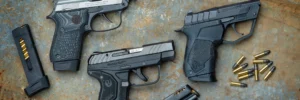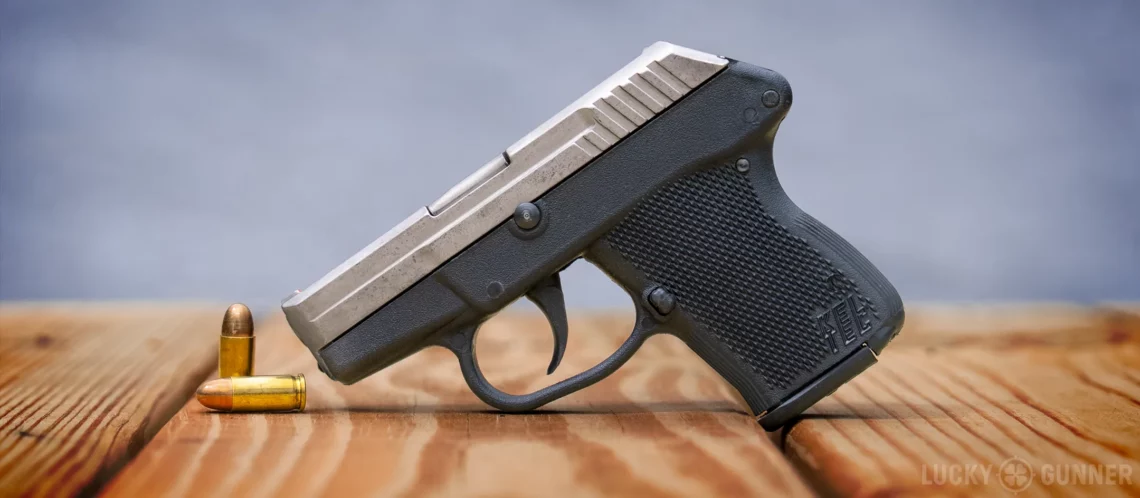

A quarter century ago, the humble KelTec P32 became the template for the pocket pistols that dominated the concealed carry market over the next two decades. But in the process, manufacturers may have left behind what made it effective in the first place. Today we’re looking at what the P32 got right and why it’s still a viable carry option today.
Details are in the video below, or keep scrolling to read the full transcript.
Hey everybody, I’m Chris Baker from Lucky Gunner, and today we’re talking about the KelTec P32 – a pocket pistol the entire gun industry copied, improved, and also somehow made worse all at the same time.
I’ve recommended the P32 plenty of times in other videos, most recently in the .22 pocket pistol roundup. We’ve had this particular gun since 2018, but I’ve never done a full video on it and that feels like an oversight I should correct.
Fair warning: this is going to be a little different from my typical reviews. I’m not getting into range testing or useful modifications or any of that kind of stuff today. Instead, we’re looking at how this underrated pistol helped shape the modern concealed carry market, and why even today, it does some things better than the pistols that have tried to replace it.
What Is the KelTec P32?
In case you’re not familiar with the P32, here’s what we’ve got. It’s a tiny pistol chambered for .32 ACP. It’s hammer-fired, double action only, with a polymer frame and seven round magazines.
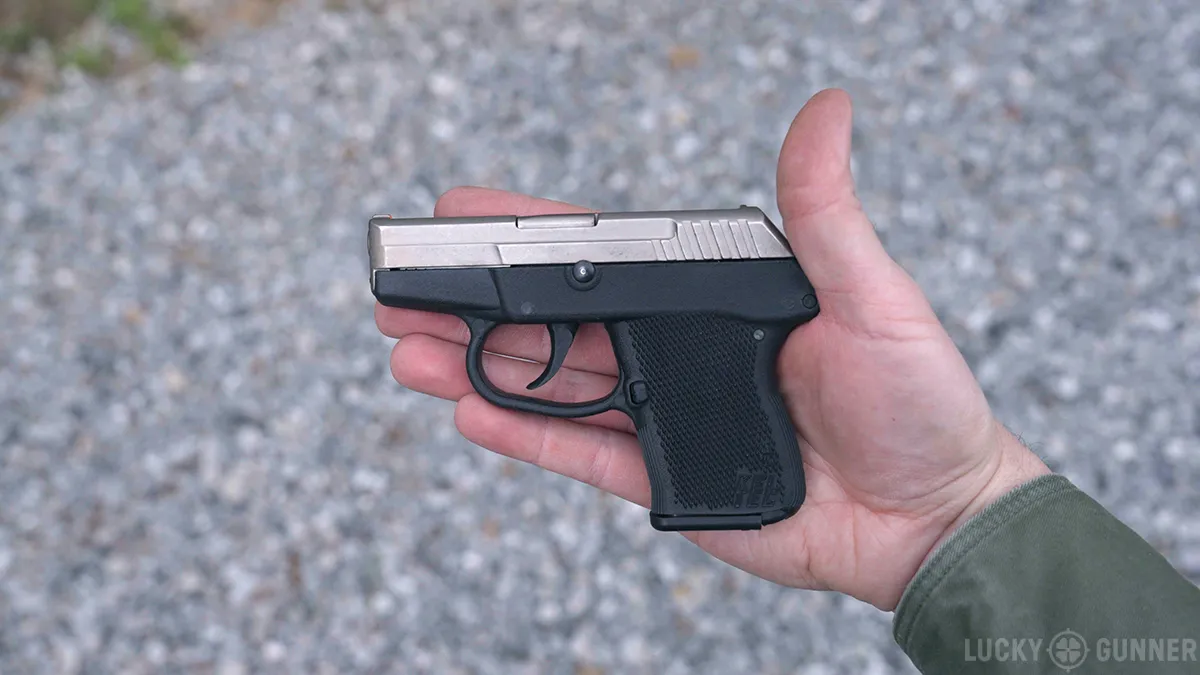
It weighs seven ounces empty and ten ounces loaded, making it the lightest centerfire pistol in current production. It’s also dimensionally smaller than just about any other pistol today, including a width of just three quarters of an inch. And that comes with a modest MSRP of $350.
The Late ’90s Pocket Pistol Problem
Now, it’s the lightest and smallest, but not by a dramatic margin. There are other small pistols that come pretty close. So what actually makes the P32 worth talking about? For that, we need to go back to that long-ago era known as the late 1990s. Concealed carry was just becoming legal and accessible in much of the country and a lot of people were suddenly in the market for a small pistol.
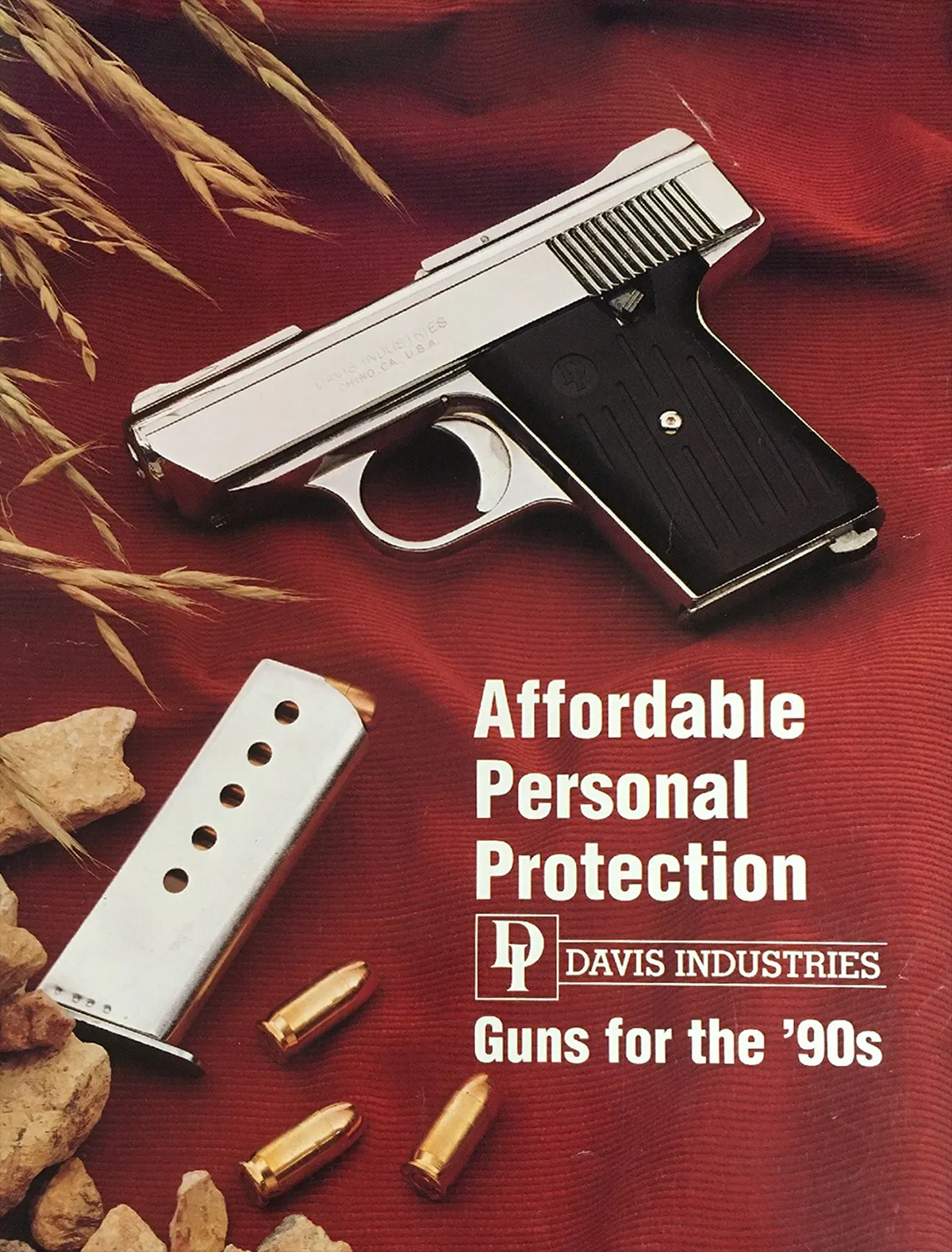
Their options were not great. For a truly pocket-sized gun, you were basically choosing between the cheap pot-metal junk churned out by the infamous Ring of Fire companies, or something more expensive and better constructed that was still probably not all that reliable. Nearly all of them used simple blowback operation, which meant they were heavy for their size and, depending on the caliber, often unpleasant to shoot.
The Design That Changed Everything
When George Kelgren rolled out the P32 in 1999, it was unlike anything else in this category. The obvious difference was the polymer frame. Glocks were common by then, but nobody had yet applied that technology to something this small.
And there’s a reason for that: polymer frames don’t pair well with simple blowback actions. So Kelgren used a locked-breech, recoil-operated action, assisted by this little guy here: the dual captive recoil spring. None of these were new concepts individually, but this was the first time they all came together in a single miniature package.
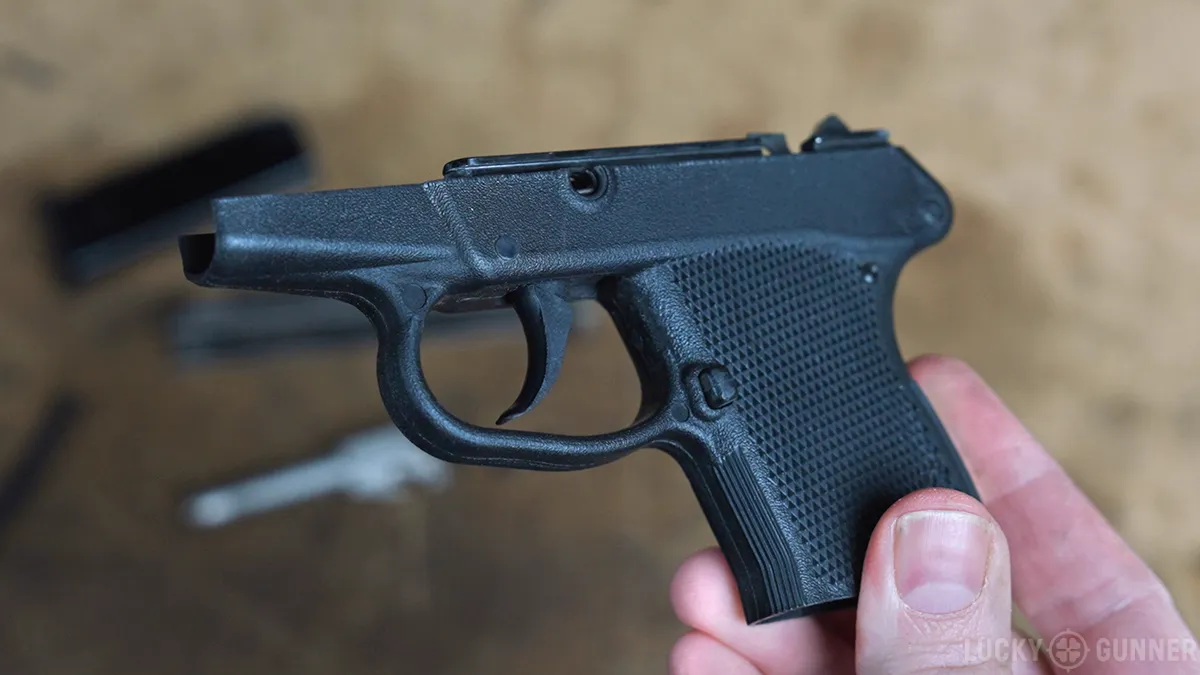
The practical result is a gun that shoots softer than the heavier blowback pocket pistols it was competing against. The design is also remarkably reliable. Ours has well over 1000 rounds with no malfunctions and that is not unusual for the P32. There’s also less stress on the components than a small blowback pistol, making it far more durable than you might expect from something so lightweight.
In its first five years of production, KelTec sold around 120,000 P32s. That’s a major achievement for a small company nobody had heard of selling a gun chambered for a cartridge nobody wanted. The design, or at least the key elements of it, eventually became the template for most of the pocket pistols that dominated the concealed carry market through the late 2000s and 2010s. Or to put it less charitably: everybody copied it and made a ton of money. And in the process, I think they left behind the thing that actually made it a good pistol.
From P32 to P3AT: The Turning Point
The first step in that direction came in 2003, when KelTec released the P3AT, which was essentially the same pistol, but chambered for .380 ACP. Stuffing .380 into a package this small is really pushing the limits of what’s practical. The frame did have to grow ever so slightly – it’s a tenth of an inch longer. But they made it work. Kind of.
And you can probably guess what happened next. Shooters quickly discovered that stepping up to .380 comes with real tradeoffs. The recoil goes from pleasant to obnoxious. The gun runs right at the edge of its mechanical limits, so parts wear out faster, reliability suffers, and things eventually break. The public took one look at all of this and said “no thank you, we were perfectly happy with the .32,” and the P3AT was discontinued shortly after…
No, of course that’s not what happened! You can’t feel recoil or predict reliability when you’re standing at a gun counter. Like any patriotic American, if you see two nearly identical tiny pistols, you buy the one that shoots bigger bullets. In the first five years of the P3AT, KelTec made nearly 194,000 of them, and only 80,000 P32s.
The .380 Explosion
KelTec probably could have sold a lot more of both, but they simply couldn’t make them fast enough. So in 2008, Ruger very generously offered to produce their own better-looking version of the P3AT in exchange for… nothing. They just did it. Because Keltec didn’t have a patent. And that’s how we got the Ruger LCP. In its first five years, Ruger made – are you ready for this? – 910,000 of them.
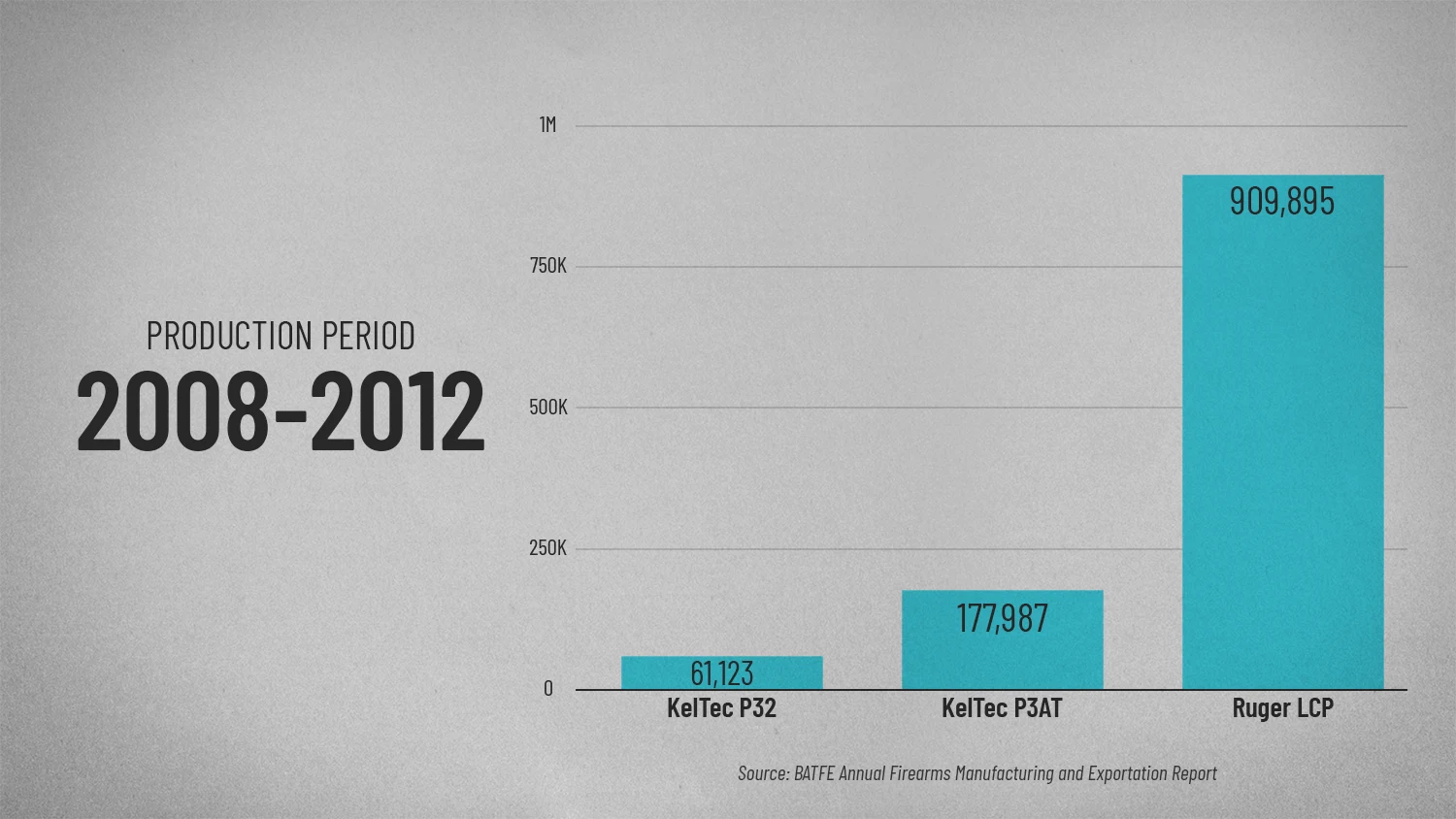
That’s what really blew the doors off the pocket pistol market. Within a couple of years, practically every major manufacturer had their own pocket .380. Reliability was very hit or miss across the board. Most of them were not a whole lot more fun to shoot than the P3AT. There were some exceptions. The Sig P238 and other 1911-style .380s are pretty decent shooters. And they’re actually not based on the Keltec at all. But that doesn’t really matter for our purposes today. Reliability still leaves a lot to be desired.
And in 2014 Glock came out with their late entry to the .380 scene with the G42. It’s a bit larger than the others, making it very shootable. Six round mags – same as the smaller 380s. Reliability is… okay. Better now than when it first came out. I actually like this gun a lot, but… it’s really not in the same size class as the P32.
Where are the .32s?
There is a very simple solution to the challenge of making pocket guns easier to shoot and more reliable. But as far as I’m aware, not one of the mainstream gun companies bothered producing a .32 ACP version of their pocket .380. Instead, most of them just immediately shifted to the race for the smallest possible 9mm.
I’m not saying all those pocket .380s are terrible guns. Some of them are pretty decent… if you get a good one and you put in the practice.
What I am saying is that the ballistic difference between .380 and .32 is marginal. Close enough that it’s very difficult to demonstrate in any meaningful way. But if you let someone shoot a P32 and an LCP-sized .380 side by side at the range for ten minutes, the difference in shootability is definitely not marginal. It’s immediately obvious.
The reliability thing is harder to prove, but even if it was just as obvious, I honestly don’t think it would have mattered. There was just too much momentum behind .380 for anyone to take a chance on .32.
The P32 Today
So where is the P32 now? It’s still in production… for the time being, although they’re only making a couple thousand a year, at most. It remains the smallest centerfire pistol you can buy, and it still doesn’t have a direct competitor. Most of those pocket .380s have come and gone, including the P3AT itself. If any of the major manufacturers were going to take a serious run at a .32 pocket pistol, the ideal window for that was probably around 2015. At this point, it seems unlikely.
The current favorites in this category are the LCP Max and the Bodyguard 2.0 — both closer in size to the Glock 42 than the original LCP, but with double-digit ammo capacity. And there’s a lot to be said for that. A Glock 42 or a Bodyguard 2.0 is plenty small enough for most people’s needs, and both are better guns than the P32 in most respects.
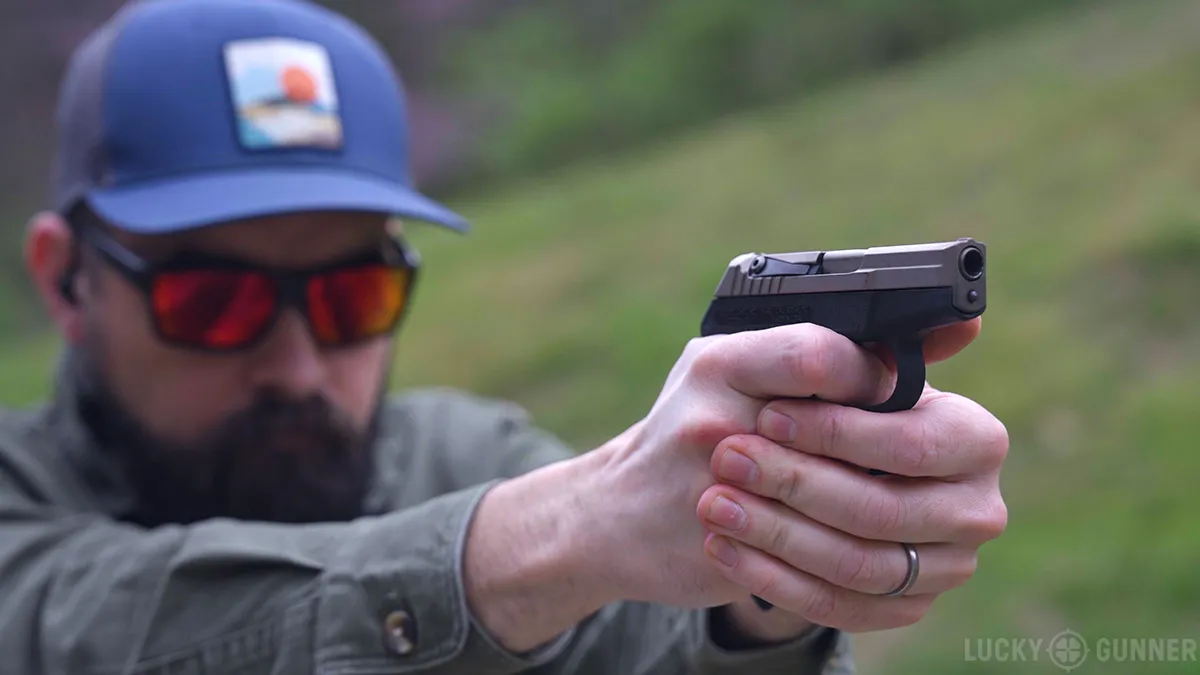
The Keltec has real drawbacks. The sights are nearly nonexistent, the ergonomics are mediocre, and .32 ACP costs more than .380. It’s probably the only consistently reliable gun in KelTec’s catalog. But they’re going to crank out some bad ones on occasion. It’s still a KelTec, and I understand that’s a psychological hurdle a lot of people are not going to get over easily.
But there are situations where the P32 still shines. Deep concealment in strict non-permissive environments. Carrying in your back pocket tucked behind your wallet. Or just those days when you’re in gym shorts and want something feather-light clipped to your waistband that you can forget is there. And it’s a double action only, which is much safer for some of the less conventional carry methods these little guns often get used for. For those use cases, the P32 is still uniquely well-suited.
It could easily be rendered obsolete overnight. A .32 version of the original LCP or Bodyguard would probably do it. That’s probably a tough sell for the suits upstairs at Smith and Ruger, but it’s got to be less risky than some of the other stuff they’ve tried recently. Like, maybe, .30 Super Carry, for example.
But what do I know? I don’t make the guns, I just sell the bullets… with lightning fast shipping at Lucky Gunner.