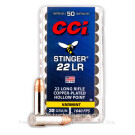
| Product Type | Ammo |
|---|---|
| Manufacturer | CCI |
| Condition | New |
| Bullet Weight | 40 Grain |
| Bullet Type | Copper-Plated Round Nose (CPRN) |
| Ammo Casing | Brass |
| Quantity | 100 |
| Ammo Caliber | .22 Long Rifle (LR) |
| Manufacturer SKU | 75 |
| Primer Type | Rimfire |
| Muzzle Velocity (fps) | 1235 |
| Muzzle Energy (ft lbs) | 135 |
| Attracts Magnet | No |
| UPC Barcode | 604544711134 |
| Cost Per Round | 17¢ per round |
Use Type
Range Training
Varmint Hunting
Richard Speer admired the success of his brother Vernon, who had founded the ammo company that still bears his name in 1943. Vernon was eager to help his brother get into the same business that had treated him so well. Upon finding a proper location for Richard’s new venture – an old 17-acre poultry farm in Lewiston, Idaho – Cascade Cartridge, Inc. was ready to begin shaping the landscape of American-made ammunition.
CCI had a lot of successes since their foundation in 1951. It made priming compound for the U.S. Armed Forces. It perfected the aircraft-grade aluminum case, and began offering more economical Blazer handgun ammunition to the commercial market because of it. But most importantly of all, CCI made its name synonymous with the highest-quality rimfire ammo ever to come out of the USA.
This 22 LR ammunition celebrates CCI’s diamond anniversary. Its plastic box’s special label is the only difference between it and CCI’s usual Mini-Mag ammo (part #30). “Usual” hardly means bad, though. CCI’s premium brass and primers are splendidly reliable in all kinds of guns, and their bullets are uniform and accurate. In this case, they are 40 grain copper-plated round noses, which are clean-shooting, supersonic out of a rifle barrel, and ideal for target practice and small game hunting when minimal meat damage is desired. So long as your goal is to use a 22 LR firearm, then this ammo’s really and truly where it’s at. It’s quite literally the only stuff that works in my crabby old Ruger Standard!
CCI reports this round’s muzzle velocity out of a rifle barrel of unspecified length at 1,235 fps; its G1 BC is 0.130. Based on that, we can calculate its long-range performance like so:
0yds: 1,235 fps | 135 ft lbs | -1.5”
25yds: 1,155 fps | 119 ft lbs | 1.5”
50yds: 1,091 fps | 106 ft lbs | 2.9”
75yds: 1,039 fps | 96 ft lbs | 2.5”
100yds: 996 fps | 88 ft lbs | 0.0”
125yds: 959 fps | 82 ft lbs | -4.6”
150yds: 927 fps | 76 ft lbs | -11.6”
It is not possible to accurately calculate a cartridge’s muzzle velocity out of a shorter barrel than the one used by the manufacturer (without a chronograph, at least). That being said, if we assume a handgun delivers the bullet at 1,000 fps, then we can calculate the following rough estimation of its short-range performance:
0yds: 1,000 fps | 89 ft lbs | -1.0”
25yds: 963 fps | 82 ft lbs | 0.7”
50yds: 930 fps | 77 ft lbs | 0.0”
75yds: 902 fps | 72 ft lbs | -3.2”
100yds: 875 fps | 68 ft lbs | -9.0”