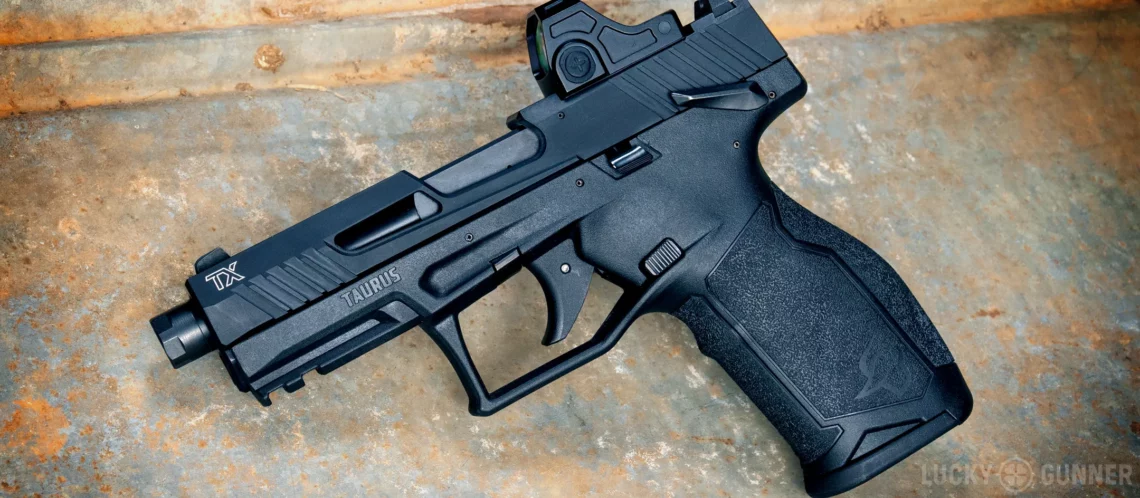

The Taurus TX22 has a reputation for being one of the best .22 LR trainer pistols you can buy. After testing both the TX22 TORO and TX22 Compact, I can see why. In this review, I’m looking at the usual benchmarks like accuracy and reliability, and also the forced reset trigger trend that has made these pistols so hard to find lately.
Details are in the video below, or keep scrolling to read the full transcript.
Hey everybody, I am Chris Baker from Lucky Gunner and today we’re talking about the Taurus TX-22.
That’s right folks, it’s Project Rimfire where I am reviewing a stupid number of handguns chambered for .22 LR. We’ve been looking at some highlights from the trainer pistol category. And now it’s time to look at what is possibly the most popular option in this category: the Taurus TX22.
Taurus TX22 Variants
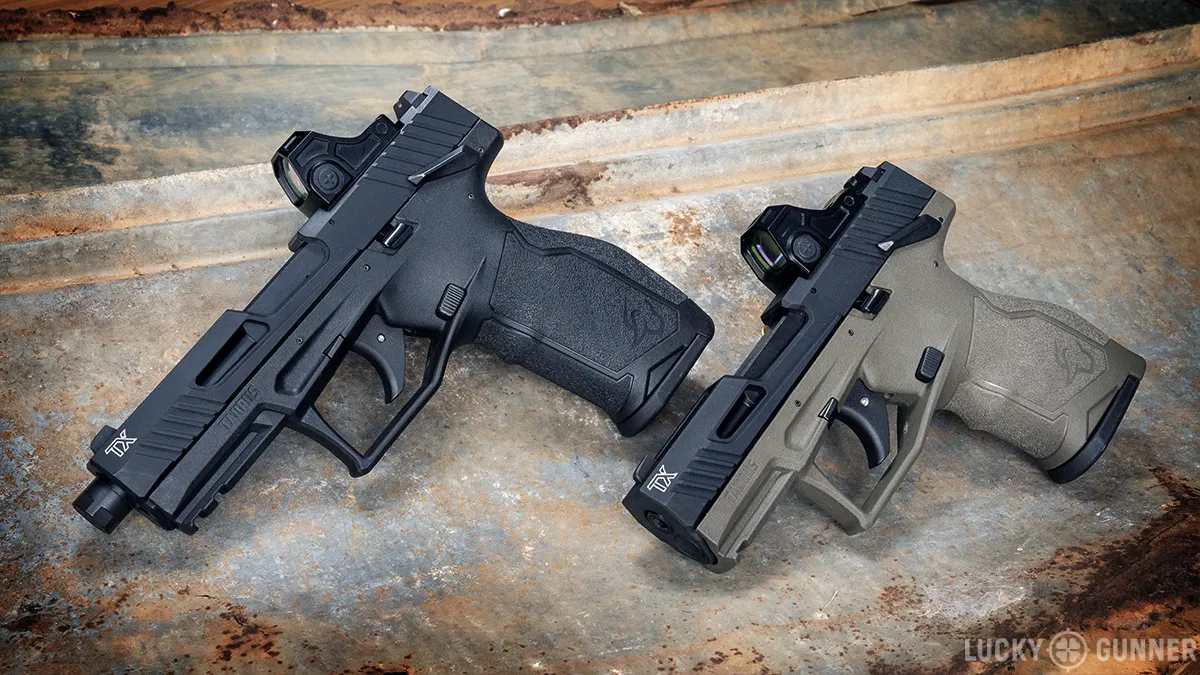
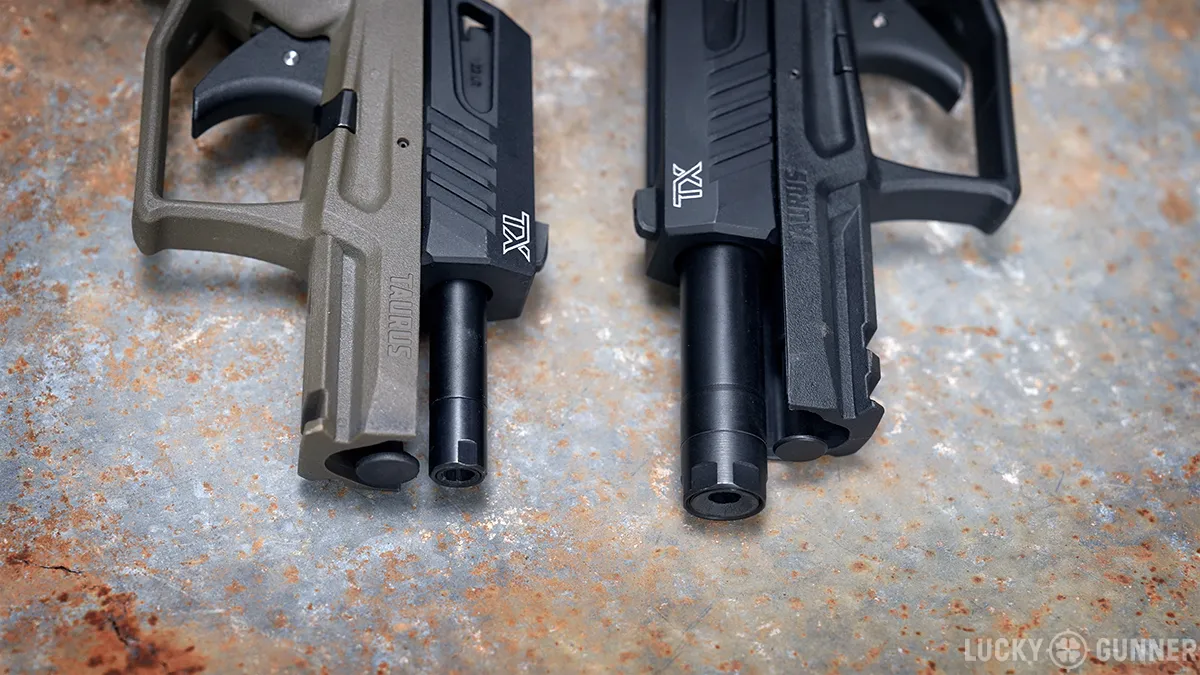
Taurus has several variants of this pistol. I have two of them here for us to look at: the full size TORO and the Compact.
The TX-22 has been a huge hit for Taurus since the original came out back in 2019. Two years later they added the Competition variant with a fixed optics mount on the barrel along with some other upgrades. In 2023, they released the Compact with a more conventional optic cut on the slide. And then the following year we got the TORO, which is the same size as the original, but with a heavy barrel like the Competition model and a slide optic cut like the Compact.
All versions of the TX-22 have been popular with shooters, but in recent months that popularity has reached unreal heights thanks to the availability of forced reset triggers. I will get to that in just a minute, but for the first part of this review, I’m going to pretend the FRT doesn’t exist. I’m going to treat this just like all the other .22s I’ve been reviewing.
Specs and Features
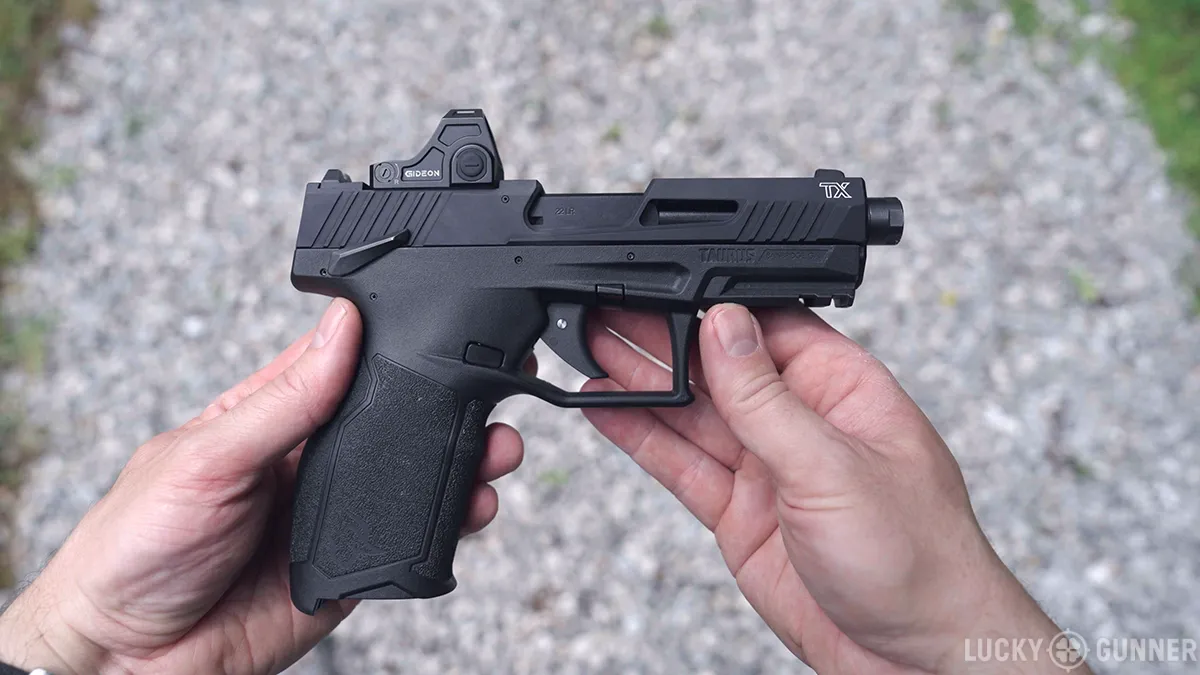
So let’s start with the basics. The TX-22 TORO has a 4.6-inch threaded barrel and weighs 17.5 ounces empty. The loaded weight depends on which magazine you’re using. The standard flush fitting mags hold 16 rounds (for a loaded weight of 21 ounces). It also comes with a 22-round extended mag. And you can get aftermarket mag extensions that increase the capacity to as many as 31 rounds.
The Compact, as you would expect, is a little smaller with a 3.6-inch barrel and 13-round flush fitting mags. It’s 15 ounces empty and 18 loaded. The larger mags will work in the Compact as long as you don’t mind the gap. The Compact barrel is also threaded, but unlike the full size, you have to use the included thread extender in order to attach anything to it.
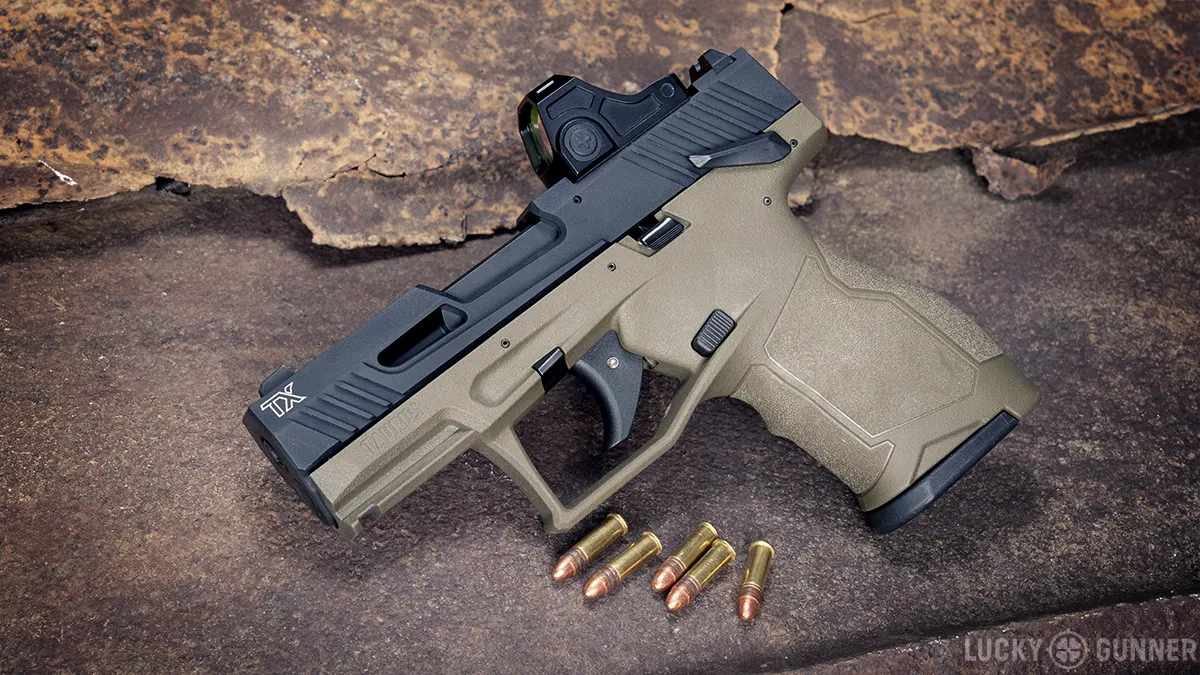
For iron sights on either gun, you get a basic white dot in the front and a black serrated u-notch in the rear that is drift-adjustable for windage. They’re kind of small, nothing special. You’re probably going to want to mount an optic, which is easy because both slides are ready for direct-mounting anything with an RMSc footprint. I mounted a couple of Gideon Judge red dot optics for this review. Special thanks to Gideon for providing all the optics we’re using in Project Rimfire.
Unlike most other trainer-style .22s, the TX-22 is striker-fired. Out of the ones we’re testing, I think it might just be these and the Glock 44. Everything else is single action hammer-fired.
The trigger pull feels a bit like a light double action. I measured it at about 4 and a half pounds on both guns. There is a wall, but it has a heavier takeup, so it’s easy to roll right through the break. Kind of hard to describe, but I actually like this trigger a lot. It feels like what I’ve always wanted factory Glock triggers to feel like.
Both of these guns have an ambi manual safety. At one time, Taurus was offering some TX22s without a safety but I believe all of the new ones have it. I think it’s a pretty good safety design. It’s in the right spot. It’s just wide enough that you can rest your thumb on it if you want, but not so wide that you have to. You get a nice positive click on and off.
Accuracy
Okay, everything’s looking good so far. How about accuracy? As always, I shot five round groups from a bench rest at 25 yards with three different types of ammo. With the Compact, I got an overall average group size of 2.9 inches. The best groups came from CCI MiniMags with an average of 2.5. That is… okay, but not great.
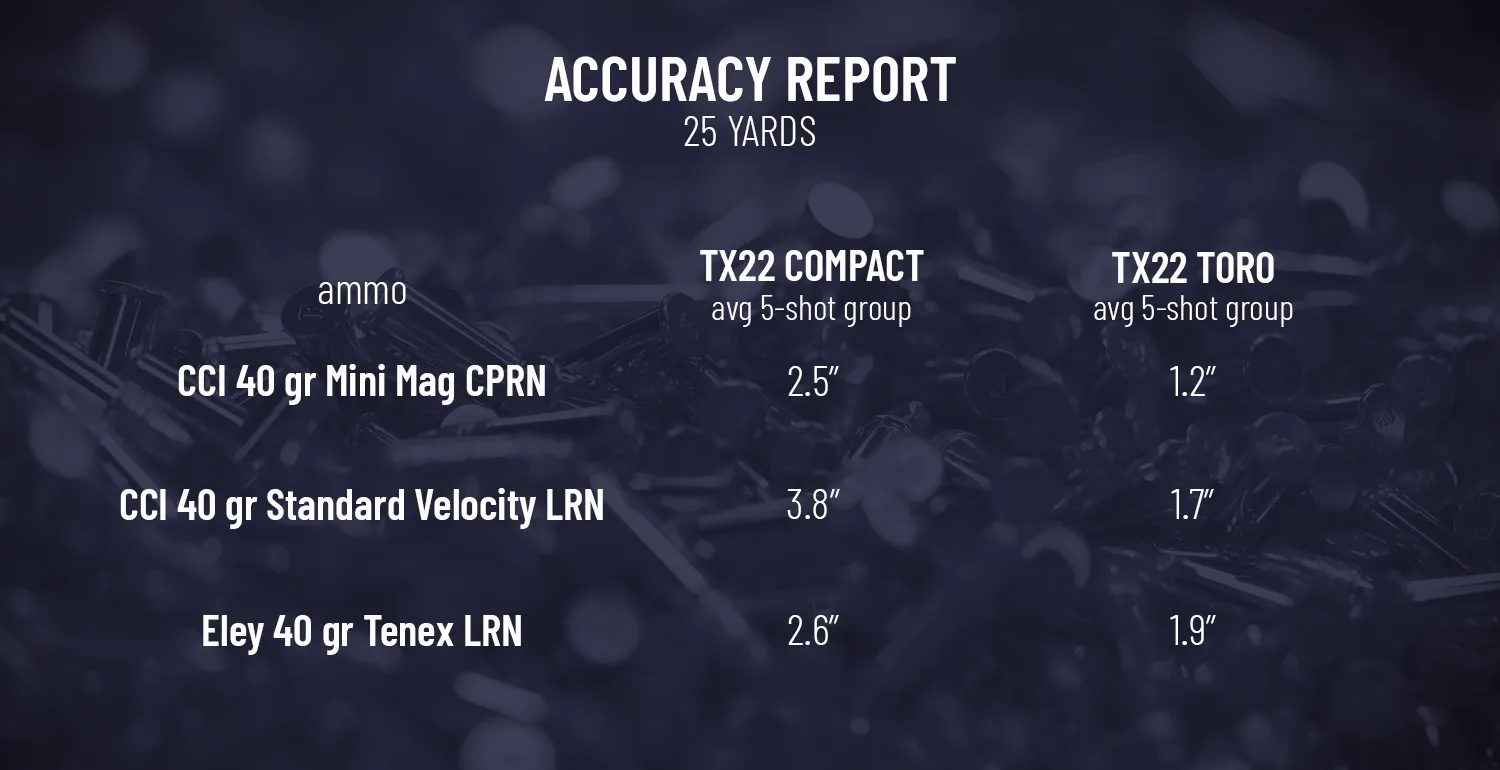
The TORO did much better, probably because of the heavier bull barrel. 1.6-inch overall average and again, it shot MiniMags best with a 1.2-inch average. That’s going to make it one of the more accurate pistols in this category, but we’ll get more into that in our upcoming comparison video. These groups are nothing special compared to the average target-style .22. But as we’ve been seeing, the trainer pistols are not designed with accuracy as the top priority. So all things considered, 1.2 inches is pretty impressive, especially from a gun that does not have a fixed barrel.
Reliability
The TX-22 has a lot of fans, and one of the things I keep hearing about is how reliable they are. You also don’t have to look too hard to find TX-22 owners who have had problems with them. Is that just the nature of .22s, or is Taurus cranking out more lemons that we should expect from this category? I honestly have no idea, but I’ll tell you what I’ve experienced with these two.
With a completely stock gun (except for the optic) the full size ran through 200 rounds of CCI Standard Velocity and 300 rounds of Mini-Mags without a single malfunction. It didn’t matter which magazine I was using. Suppressed or unsuppressed. Like the Smith 22X we looked at last time, this gun just works.
The Compact… not so much. For every 100 rounds, I got about two or three failures to extract. The case would come partway out of the chamber and just stop. A couple of times, I had to actually knock it out with a cleaning rod. It did this with both types of ammo I was using. And it happened when the gun was clean and dirty. I suspect there’s some kind of imperfection in the chamber causing this. The chamber might just need some polishing. Or I’m sure it would be an easy fix for Taurus if I sent it back to them. But like I said, I’m trying to review a stupid number of guns here so… I ain’t got time for that.
Out of these two, I much prefer the TORO. Even if our compact was running 100%, I’d still prefer the full size. Shooting them side by side, the Compact feels kind of jumpy. It has some noticeable muzzle rise, even for a .22LR. I also much prefer the extended threaded barrel on the full size for shooting suppressed. The thread adapters are kind of a pain to deal with sometimes.
Aftermarket Support
They both have great ergonomics. I can get all my fingers on the Compact, but some people will probably want some kind of pinky rest. If you use the larger mags, I’ve seen some spacers on eBay to fill that gap.
And that’s another benefit of these guns. There’s a ton of aftermarket support. You can get triggers, barrels, performance springs and upgraded internal parts, optic adapter plates. It’s not quite on the same level as the Ruger MK IV, but it might be a strong second place in terms of how much stuff is available for the TX-22 series.
The MSRP for the full size TORO is $390 and for the Compact, it’s $422. Until fairly recently, you could find either one for around $300. Sometimes even less. But now, a lot of online retailers are asking well over MSRP and most brick and mortar shops don’t have them at all.
Forced Reset Trigger
That is because of a massive spike in demand thanks to this little guy right here. This aftermarket part replaces the factory disconnector resulting in an FRT or forced reset trigger. With this installed, when the slide cycles, it forces the trigger to reset. As long as you maintain pressure on the trigger, it will fire again. And again and again.
Several different companies are making these. As far as I know, the Taurus is the only .22 with this conversion available, which is why they are suddenly in short supply because who doesn’t want a cheap gun with a go-fast trigger?
Last year, a federal court ruled that an FRT does not meet the legal definition of a machine gun, at least for now. The ATF has a history of not letting this sort of thing go, so by the time you’re watching this, FRTs may or may not be legal. And they’re already off limits in several states.
Of course, the TX-22 was not designed for such a high rate of fire, so it’s not always easy to get the FRT working smoothly. I had to add some aftermarket weights to the slide to get the TORO to cycle with an FRT, and even then, it would only work suppressed and often only for short bursts at a time.
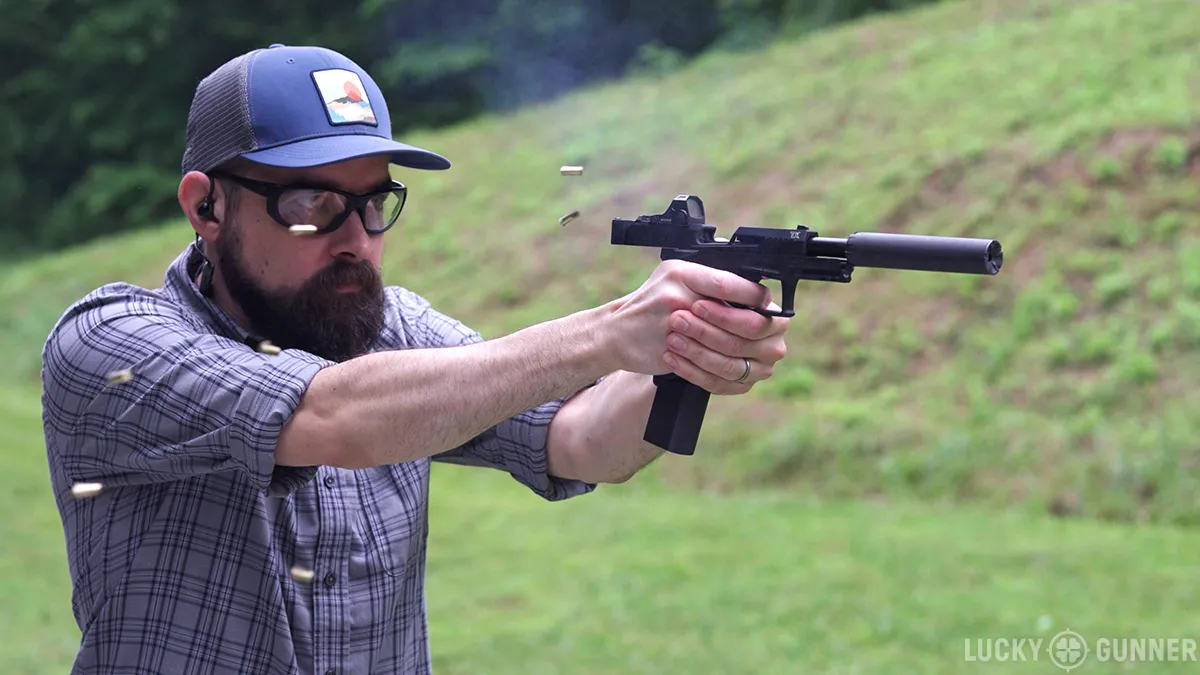
When it works, it’s a pretty good time. And it’s probably the closest you can come to shooting a full auto without shelling out hundreds of dollars for ammo and rental fees. Some people will never get tired of this and it will provide endless hours of entertainment. At least until the ATF changes their mind about these things.
Personally, I got bored with it pretty quickly. Maybe it’s because I couldn’t stop thinking about what a pain it was going to be to clean my suppressor later. And even though it’s only a .22, it’s still hard to control well enough to actually hit anything. But the main issue is that once the novelty wears off, you can’t just turn off the FRT and go back to shooting it like normal. You have to uninstall the part, which is somewhat involved and not something you want to do at the range.
No Gimmick Needed
The good news is that if you do get tired of the FRT (or if the Feds make you give it up), you still have a very solid .22 trainer pistol. Assuming you got one that doesn’t have any issues. I probably wouldn’t pay over MSRP for one, but otherwise, it’s an excellent value and a very strong contender in the trainer pistol category.
How does it stack up against all the other trainer .22s? That’s what we’re going to find out next time. I will be comparing no fewer than ten different options in this category. Make sure you are subscribed so you don’t miss it and the next time you need some ammo, be sure to get it from us with lightning fast shipping at Lucky Gunner.


