
Today we’re revisiting our most popular video ever — a tutorial on how to keep your home defense shotgun ready for use. We suggest the “cruiser ready” condition, and the original video explained what that means and a few of the whys. But in the years since that original post, you guys have responded with a ton of questions (and critiques, criticisms, and comments), so we’re going back to address some of those.
Details in the video below, or scroll down to read the full transcript.
Hey everybody, Chris Baker here from LuckyGunner.com. Earlier this year, I decided to revisit some of our older videos and offer a few updates, clarifications, and corrections. Today, I want to take a second look at our most viewed video ever: Cruiser Ready: How to Store a Home Defense Shotgun. This one is from February 2016 and it’s up to a little over 2 million views now on YouTube. I wouldn’t say it’s our best video. It’s not one I ever expected to be very popular. But I guess we happened to hit YouTube’s algorithm just right on that day.
It’s also one of the shorter videos we’ve done at just over five minutes. I don’t think it necessarily needed to be longer than that because the main point is pretty straightforward. This is a simple concept, it doesn’t require a lot of explanation. But a shorter run time does mean I didn’t elaborate much on every detail and that left a lot of room for questions. Fair warning: some of those questions are going to take us into the weeds a little bit and we’re going to cover a lot of ground beyond simply how to store your shotgun. So let’s watch a couple of clips from the original video and I’ll come back and try to answer some of those questions.
What Is Cruiser Ready?
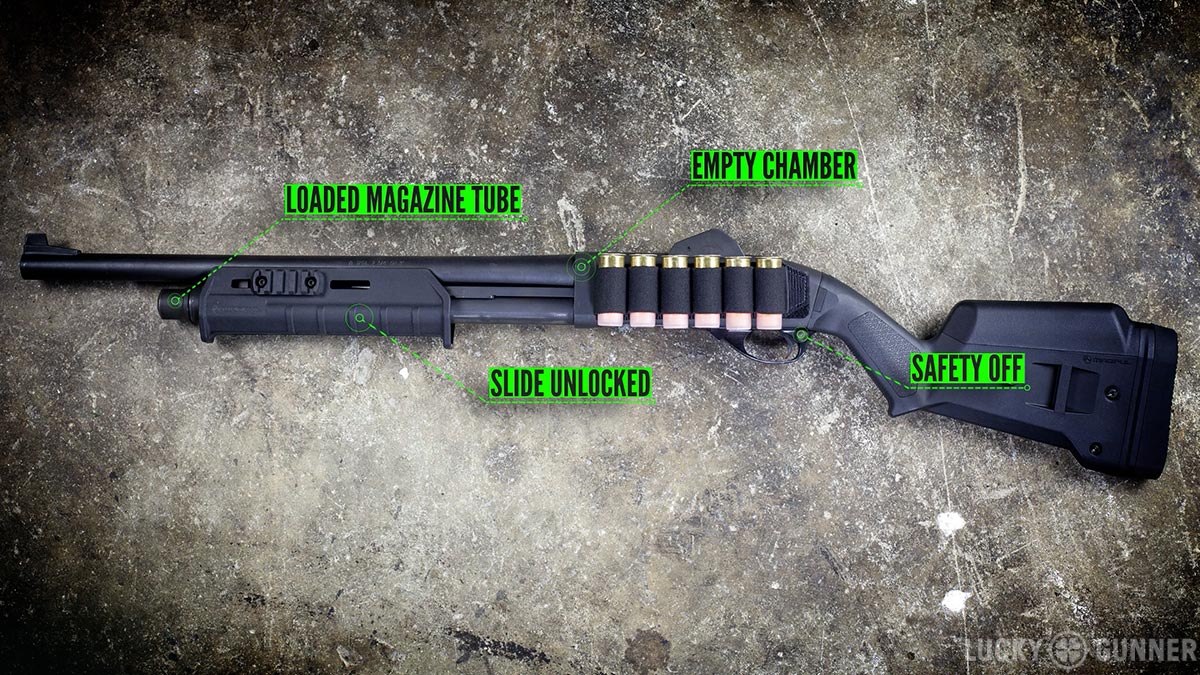
“I’m going to suggest that you keep a home defense shotgun in what is called “cruiser ready” condition. That name comes from the way cops have often stored shotguns in their patrol cars. And that is with the magazine tube loaded, the chamber empty, the slide unlocked, and sometimes with the safety on, but I’m going to suggest you leave the safety off. So that way, if I need the gun in an emergency, all I have to do is just grab it, rack a round in, and it’s ready to fire.
“There are a few reasons to store the gun this way, but as far as I’m concerned the only reason that really matters is the safety issue. Most shotguns are not drop safe. If there’s a round in the chamber and the gun falls down in the closet or it’s dropped, it can go off by itself. Even with the safety on — the safety just prevents the trigger from being pulled, it doesn’t block the hammer, it doesn’t block the firing pin, and it doesn’t prevent the gun from being discharged if there’s some kind of sudden jolt.
“And really, you’d be surprised at how little it takes for one of these things to go off if there’s a round in the chamber. If we keep it stored in cruiser ready condition, the chamber is empty, so we eliminate that possibility. And with the slide unlocked, it really just takes half a second to get the gun into action.”
The Demo Gun: Remington 870 SBS
Okay, a couple of things I want to add here. First, one of the most frequent questions I’ve been asked about this video is, “what shotgun is that?” It’s a Remington 870 with a Magpul stock and forend, and a 14-inch barrel. It is a legally registered short-barreled shotgun. I did a whole video about it just a month after the cruiser ready video if you want more info on it.
Shotguns Aren’t Drop Safe?
More importantly, in this first segment, I think I might have given the impression that shotguns are just spontaneously going off left and right without anyone actually pulling the triggers. I don’t want to over-state the issue of shotguns not being drop safe, but it is a real thing. In fact, most long guns are not technically drop safe. You are very unlikely to run into an issue with that if it’s a newer shotgun or one that’s been well maintained with all of the appropriate springs and parts replaced periodically.
But, you know, people tend to keep shotguns around for a long time. A lot of them get passed down in families. There are a ton of surplus police shotguns that are pretty beat up. Those are the guns that are far more likely to discharge if they are dropped. The problem is that there is usually no outward indication that the internals aren’t in great shape. And it seems like when they do discharge from a drop or a jolt, it’s often a very minor one. If you’ve got an old 870 with a worn out sear, there’s a chance it could drop the hammer just from something like tapping the butt on the ground.
Obviously, the most ideal solution is to keep your shotgun in good repair. That’s not going to make it 100% drop safe, but it will certainly help. Either way, there are other good reasons to store your shotgun with an empty chamber.
Protect the Trigger
My general rule of thumb is that outside of the shooting range, I don’t leave a round in the chamber of any gun unless, A: the trigger is completely enclosed and protected like it would be with a holster, AND B: it’s either on my person or locked up somewhere.
The reason for that is pretty simple. We tend to store guns in places that are kind of dark and cramped. If I’m grabbing a gun from the inside of a safe, a case, a bag, a closet, or under the bed, there’s a good chance I’m not going to have a great view of what I’m doing. I won’t necessarily be able to carefully pick up the gun in a particular way like I would if it was sitting on the table at the range in the middle of the day.
That’s usually not a big deal. But if you handle guns often enough, eventually, you will grab a gun and something will catch on the trigger guard or you will find your finger inside a trigger guard when you did not intend for it to go there. Combine that with a round in the chamber and a single action shotgun trigger that’s probably about 4 pounds, and you’re really close to putting a hole where you don’t want one.
An empty chamber also provides an extra layer of safety if you’ve got kids in the house or anyone else who probably shouldn’t be handling the gun. In general, it’s just an easy way to avoid accidents.
What Makes Magazine Springs Wear Out?
“I’m also going to leave the magazine tube down-loaded by one round. So this tube holds five rounds but I’m only going to load four in there. Normally, these pump-action shotguns are extremely reliable, but when they do fail, one of the things that tends to fail is the magazine spring. So I don’t want that spring to be under any more pressure than it has to be by leaving it fully compressed for long periods of time.”
This is probably the least important point I made in that original video but it’s the one that has provoked the most reactions. A great many people wanted to make sure I know that springs do not lose tension from staying compressed for long periods of time. They lose tension from being cycled — from being compressed and decompressed.
Yes, as a rule, that is true. My original explanation was not very good, and my suggested solution was not the best one. A new spring loses a little bit of its initial tension when it’s first compressed. But that decline levels off and it should be able to stay compressed for many decades before noticeably losing more tension. And it should be able to withstand many thousands of cycles before it loses tension. The average shotgun owner is not going to get anywhere close to that.
And yet… it’s very common for shotguns to have feeding issues that are resolved by replacing the magazine spring. So somehow, these things do wear out from time to time even though they’re not supposed to. Some possible explanations are that the magazine springs are maybe not 100% free from manufacturing defects. It could be that in order to maximize the advertised ammo capacity of a shotgun, the manufacturer is using a spring that’s actually being compressed beyond it’s designed limit every time the gun is fully loaded. Maybe the spring has been exposed to temperature fluctuations or corrosion and its integrity has been compromised.
I am not trying to argue against the rules of physics. I know springs are supposed to last a long time. But that’s assuming the spring is made properly, it’s in good condition, and there are no adverse environmental factors. Look at this thing — shotgun magazine springs are kinda flimsy and there’s a lot that can go wrong with them. They don’t exist in a vacuum. Sometimes they live a hard life. Again, a lot of people have shotguns that have been around for a while. The top two shotgun manufacturers right now — Remington and Mossberg — have not had awesome track records for quality control the last few years.
Down-loading the tube by one shell is one way to try to mitigate the feeding issues that can result from a bad spring. It’s not the best way. A better solution would be to simply replace your mag spring every couple of years. You can get a new one from Wolff Gunsprings for under 10 bucks. Also, replace your ammo at least once a year because the shells occasionally get deformed from sitting in a full tube for too long. And keep the follower and the mag tube clean and free of debris. If you do those things, there’s probably not any reason you can’t keep your tube loaded to full capacity.
Cruiser Ready for Semi-Autos
In the next part of the video, I demonstrated the procedure for setting up your gun in a cruiser ready condition. Basically, you clear the gun, double check it, dry fire it — pull the trigger on an empty chamber to release the action, and then load the mag tube. That works fine for most pump actions. For semi-autos it’s going to be a little different. I didn’t cover semi-auto shotguns because there are so many different types and the procedure for setting them up is different for each one.
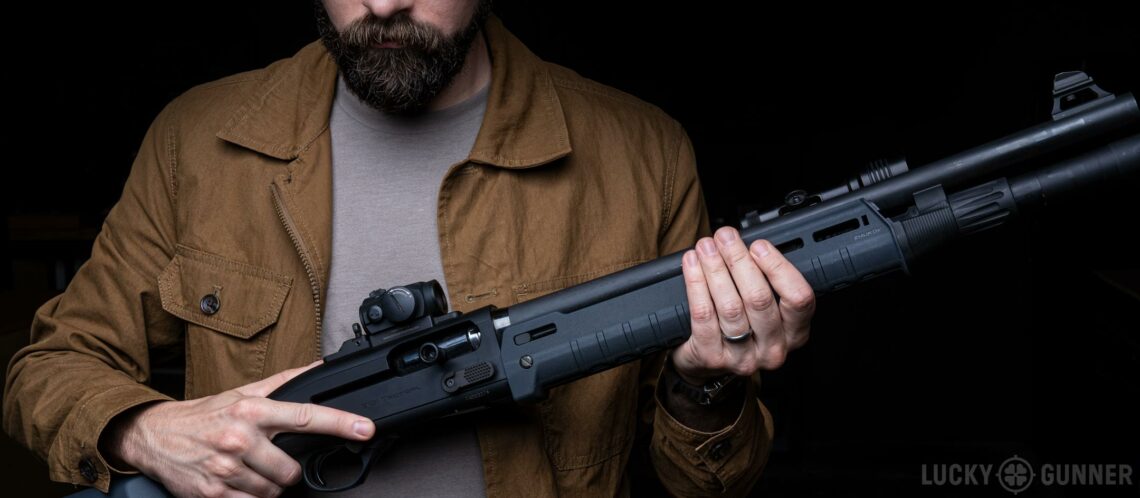
For example, for this Beretta 1301, if I load the mag tube and then run the bolt, nothing happens. The gun will not pull a round from the tube and chamber it when I do that. I have to press this little shell release button. That releases a shell from the tube onto the shell carrier. Then if I run the bolt, it will chamber the round. So for cruiser ready on this gun, I would load the tube, then press the shell release, and leave it in that condition.
Or if I really wanted to get one extra shell in the gun, with the Beretta, I would fully load the tube, then open the bolt, place a shell onto the carrier manually, and hold it down while I let the bolt ride forward over the shell. That’s sometimes known as “ghost loading,” although normally ghost loading also includes manually loading a shell into the chamber. It’s a method that 3-gun competitors have used to maximize their ammo capacity before shooting a stage.
Other semi-auto shotguns have different buttons or latches to release a shell onto the lifter and completely different procedures for ghost loading. Some shotguns can’t be ghost loaded at all. And some semi-autos will chamber a round directly from the tube when you run the action. So you just have to be familiar with how your shotgun works and practice with dummy shells until you can do it with your eyes closed.
Okay, let’s look at one more clip from the original video.
Giving Away Your Position
“It’s probably worth mentioning (because if I don’t, someone else will) the whole myth about the sound of racking a shotgun making bad guys pee their pants and run away. That has happened before — I’ve heard of it happening before, but it’s not really something we count on and it’s not the primary reason we keep the shotgun in cruiser ready condition. We don’t really want to count on fear and intimidation as a primary tactic.
“On the flip side of that, I also suspect some of you guys are thinking that you want your home defense gun to already have a round chambered because you don’t want to waste a whole lot of time and make noise that’s going to “give away your position.” Personally, I kind of think that’s a little silly. If there’s someone in my house who’s not supposed to be there, I want them to know that I’m there. I want to give them every possible opportunity to leave my house before we have some kind of confrontation.
“So, not only am I going to make some noise racking the shotgun, but I’m also going to issue some sort of verbal challenge, like “Who’s there?” And I’m going to have a flashlight in my hand or mounted to the shotgun. Now, if the guy still wants to stick around after that, that’s why I have a shotgun. But statistically, it’s far more likely that whatever noise I’m responding to is actually a member of my family or a roommate or a pet or something like that. And in those cases, making a little noise racking the shotgun is actually giving them one more opportunity to identify themselves.”
Based on the comments I’ve gotten on this video over the years, there are still a lot of people who have concerns about storing their shotgun cruiser ready because it’s too slow and too loud. People don’t want to make any unnecessary noises that might draw attention, or they are concerned about keeping a defensive firearm in a condition that’s not ready to fire the moment they pick it up.
I understand why the speed thing is a concern. The standard doctrine for concealed carry we’ve been hearing for years now is to always carry with a round in the chamber. You may have even seen some of the surveillance camera footage of armed citizens struggling and failing to get a round chambered in their carry gun once they’re already under attack. So it might seem logical to apply that same lesson to a home defense shotgun.
As for the noise issue — I understand, in theory, why you would be reluctant to broadcast your location in the home if you don’t have to. In practice, I haven’t seen a lot of evidence to support that as a major concern. I have yet to find a documented incident when making noise with a gun has gotten a homeowner hurt or killed. That doesn’t mean it hasn’t happened, but at the very least, it seems to be rare.
In any case, to address both the noise and the speed issues, we need to take a more critical look at the home invasion context. There are a lot of differences between a home invasion and a violent attack outside the home.
The Home Invasion Context
A home invasion is not usually an ambush. It doesn’t start with someone threatening you or brandishing a weapon where you only have a second or two to react. An attacker has to get inside the house first. Assuming they haven’t tricked you into opening the door for them and you keep your doors and windows locked, they are most likely going to make a lot of noise breaking in.
We don’t want to wait until we see a stranger standing in our kitchen to go and get the shotgun. We have the shotgun in case we see or hear something that might warn us of potential danger ahead of time. If you have enough time to retrieve your shotgun, you have enough time to rack it. Chambering a round takes less than half a second if you’ve left the action unlocked like I suggest. If you’re still concerned about not having enough time, you can buy a lot more time by hardening the exterior of your home than by leaving a shotgun loaded all the time.
A lot of you have probably heard me talk about this before — it’s the layered home-defense strategy. This is where you can really stack the deck in your favor. Make sure your exterior doors have functional deadbolts and replace the factory screws in your hinges and strike plates with three-inch or longer screws. That will make it much more difficult to kick the door in. Maybe get some protective hurricane film on any large ground-floor windows. Alarm systems are great, too, and they’re more affordable now than they’ve ever been. And dogs are good at making noise when they hear something out of the ordinary.
Anything you can do that will slow down a home invader and require them to make more noise is going to work in your favor. Not only does it buy you more time to respond, it also acts as a deterrent. And there are a lot of other things you can do to make your home a less inviting target.
The point is that the shotgun is just one part of a layered home defense strategy. That’s why I’m not too concerned about the racking sound giving away my position. Even if someone managed to force their way into my house before I got to the shotgun, I doubt they would hear anything other than an alarm blaring and dogs barking.
But let’s say you don’t have either of those things and maybe you forget to lock the door sometimes. If someone broke into your home and heard a shotgun being racked and you yelling “GET OUT!”, of all the possible responses they could have to that, which ones are going to be a problem for you and how likely are they? Will this home invader start blindly firing in the general direction of the sound? Are they going to take that sound as an invitation to come and try to find you?
Sure, both of those things are possible. I am sure at least one of them has happened before. Maybe I’m way out of the loop on this and it’s a lot more common than I think but I’m pretty confident those would be considered extreme outlier events. On the other hand, I can show you numerous examples of negligent death, injury, and property damage where storing a shotgun with a round in the chamber was at least one contributing factor.
Some Alternative Suggestions
To me, that’s a pretty straightforward risk assessment to figure out. But maybe I’m missing something and you have some really compelling reasons to store the shotgun loaded, chambered, and ready to go. If that’s the case, I’m going to make a few suggestions.
- Store it with the safety on.
- Keep the gun locked up, at least when you’re not going to be around.
- If anyone else in your home will ever have access to that gun, make sure they know that you keep it loaded and they know how to clear the gun.
- And consider buying something that will protect the trigger when the gun is not in use.
A company called TriggerSafe makes a device like this that fits a lot of different shotguns. I can’t vouch for this product. I’ve never used it myself, but it looks like a pretty good design. It’s even got a hole in it where you could attach a string or some paracord to make a little pull tab. Or you could possibly attach the other end to the inside of your safe, so that the shroud pops off automatically when you retrieve the gun. And I’m sure there are plenty of other products out there that accomplish the same thing. This one is only seven bucks which seems like pretty cheap insurance and wouldn’t have to slow you down at all.
Guys, I can’t believe I just talked about cruiser ready condition for 15 or 20 minutes, or however long it’s been. It seems long. But we covered a lot of territory. I hope you learned something or I at least gave you some food for thought. Next up will be the second installment of our lever action series, so be on the lookout for that. In the meantime, hit that like button, subscribe, and… call your mom today. She’d love to hear from you.


Two comments: the first is on shotgun maintenance and the second on ammunition issues.
I was part of the US Army in West Berlin during the early 1980’s and I became the defacto armorer for the quick reaction team weapons stored in the arms safe–a few pistols, three shotguns and enough M16A1 rifles to arm a platoon. I made sure that all the weapons were serviced (mostly cleaned and then given a function check) once per month–even picked up a proper shotgun cleaning kit because Supply provided only M16 cleaning kits, no others. The shotguns were two Winchester Model 1200 and one Stevens Model 520 converted to “trench shotguns” with bayonet mount and hand guard and sling swivels. The Stevens was still blued, not Parkerized. The Stevens also failed the function check: the hammer would fall with the safety applied when the trigger was pressed. I traced the problem to a worn safety switch. This meant that I had to red tag the shotgun as a safety deadline. The Army has a “circle x” provision for critical equipment; basically, the commander has to sign a memo stating that the equipment can be operated under emergency conditions with a work-around. In the case of the Stevens shotgun, following the arming posture that was SOP in West Berlin was how my commanding officer “fixed” the shotgun–the chamber was clear until the command to fire was given, and upon cease-fire the chamber was to be immediately cleared. Why not replace or repair the shotgun? Money–and obsolescence. Since at least the 1890’s military shotguns were generally commercial off-the-shelf (COTS) purchased for rear area guard duties. A charge of buckshot had a shorter down-range danger space and didn’t have the penetration of a rifle bullet but would be combat effective at short range. The Stevens was still in the inventory because it was left over from World War Two and replacing it with the then-standard Winchester 1200 was a very low priority. The Stevens wasn’t supported by the Army supply system for a number of reasons including its limited mission–the MP’s at the secure compound used the shotgun as their “heavy artillery” along with a few of the M16A1 rifles in the gun safe. I looked into buying replacement parts–not authorized! Not even with my own funds. There were no replacement parts in the Army system. However, the Stevens would perform its mission as well as the serviceable Winchester shotguns and as safely when the arming regulations were adhered to. Besides, those three shotguns hadn’t been fired since the Winchesters were added to the compound’s arms safe.
That situation is similar to many home defense shotguns. Yes, the shotgun is supposed to be in serviceable condition but replacing or repairing a shotgun may be way down on the priority list. An older shotgun might cost as much as a new set of tires to fix–more than buying a new shotgun would cost. The Remington 870 has been in production for a long time and some of the current parts won’t fit the older guns. Want to talk about shotguns that are out of production and might require fabrication of a new part to bring back to factory specs? It’s probably a bad idea to use a shotgun that lacks a working safety due to liability, but if the alternative is no shotgun or no gun at all and the danger level is perceived to be high, a shotgun with a problem or two will probably be kept on hand until funds and time permit repair or replacement. The defective shotgun may even just be kept as an heirloom–until the main home defense shotgun is sent to the gunsmith for repair and an emergency demands shotgun firepower. Some shotgun safeties will fail when the safety is on and the trigger is pressed hard enough, but I don’t have enough data on this issue. I can only say that it was a problem in the past–safety on, enough trigger pressure breaks the safety. “May safety worked before the hunt–I don’t know what happened!”
The ammunition issues crop up sometimes. With extended shotgun tube magazines, considerable force is compressing the shotgun shells. Storage conditions may make the shotgun shells soft enough to distort–to smoosh enough so that it’s difficult to chamber the shell. Both plastic and paper shotgun shells can be distorted by a combination of storage conditions and magazine tube spring pressure in extended magazines. The plastic shells have become distorted when stored in police cruisers due to the interior summer temperatures making the plastic soft and this normally isn’t a problem when the magazine holds only four or five buckshot shells–but can be a problem with eight-shot riot guns. In the Newhall Shootout (April 5, 1970) the California Highway Patrol was following the common best practice for the two Remington Model 870 riot shotguns carried by Patrolman Frago and Patrolman Alleyn; the magazine tubes were fully loaded with 4 buckshot shells, the chamber was empty, and the fore end was “sealed” with evidence tape to forestall excessive force lawsuits. No additional shotgun ammunition was authorized or carried. I don’t know how long the shotgun ammunition was carried in CHP shotguns before being replaced or even what their maintenance intervals (when their shotguns were unloaded and cleaned and inspected) were in 1970, but my limited experience with military and contract security guard ammunition is that of duty ammunition being kept on duty for years without replacement. Paper hulls are less heat sensitive (the wax may melt and cause other problems) but severely sensitive to moisture. It is enough that humid storage conditions will soften (sometimes mildew) the paper hulls enough to distort them and cause jams, and sometimes the moisture retained by the paper shotgun shells will lead to corrosion in the magazine tube. The expensive alternative is using all-metal shotgun shells. Note that slide action shotguns suffer fewer ammunition-related malfunctions than shotguns powered by gas or recoil–but “every solution produces more problems.” The pump shotgun suffers from more shooter-induced malfunctions when the shooter hasn’t practiced vigorously cycling the fore end–semiautomatic shotgun issues can be fixed in admin mode (off the battlefield) by careful maintenance and ammunition rotation away from the stress of being in a shootout but the pump gun’s susceptibility to poor technique has to be addressed with sufficient practice. Many people gravitate towards the shotgun in the mistaken belief that training and maintenance are unnecessary. Annual shotgun maintenance is not as common as it should be–by annual maintenance I mean a MINIMUM of inspecting the shotgun every 9 to 18 months, and this means unloading a cruiser-ready shotgun, cleaning it and swapping out the ammunition in the magazine tube with ammunition that hasn’t been sitting in the gun for the past year–or two, or three…the security force shotguns kept in that Berlin gun safe were stored unloaded and the ammunition was stored elsewhere. Loaded magazines (depending upon the time and place) were stored empty with ammunition in boxes, or the magazines were partially loaded for sentry duty with just five rounds (currently that’s doubled), or the magazines were fully-loaded and carried daily. When I was assigned as armorer I managed to download, inspect, service and reload all magazines monthly–may have been excessive, but I did run into unserviceable cartridges and the occasional damaged magazine that I was able to fix from the reserve stock (the unserviceable stuff had to be accounted for an disposed of IAW regulation). My own weapons and ammunition that I carried on guard duty got inspected and cleaned at least twice per shift–once upon issue, and then before turn-in. I was in harsh climates and sometimes sand storms or rain would make that a very good idea–cleaning up my toys before going on duty or after being relieved.
Chris, how often do you recommend checking and servicing the cruiser-ready home-defense shotgun? How often would you replace the ammunition kept in and with the shotgun? The video and text mentioned “at least once per year” and I missed that recommendation–twice! Ammunition replacement is important because shotguns are buckshot launchers and if the ammo won’t go BANG then the shotgun is no better than a baseball bat. It’s going to be fatally embarrassing if the cruiser-ready shotgun jams when cycling the action for the first shot (and that’s an excuse I’ve heard for keeping one round in the chamber–the defender will at least get one shot off).
Every time I head out to the range, I empty one of my ready magazines on target, and after the range session, reload with new rounds. The concerns about compressing plastic shotgun shells is perfectly reasonable, and readily handled by using what is loaded in the magazine as first ones downrange during training.
Thanks for the comment. If you will, please share your ammunition rotation practice. My own practice is to replace the ammunition if the shotgun is stored in my car every 90 days and, like you, expend the old ammunition for practice. When kept in a gun locker indoors and in a temperature-stable controlled-humidity environment I feel okay with replacing that ammunition at a 12 month interval, but attempt to replace those rounds no later than six months.
There’s been ammunition droughts the past decade and it might be difficult to replace even five or ten rounds per year. That five or ten shots per year for buckshot familiarization is probably inadequate (cheap trap loads for practice provide some training value on reactive targets) but when there’s very limited ammunition, maintaining at least ten duty rounds and practicing may be a challenge.
Hey Chris, just want to ask your thoughts about break barrels as defense shotguns…I like all you have said and published, awesome job! Very informative and well stated. But I would like to suggestion to you the idea of break barrel shotguns for defense.What I like about them is the lack of mechanical issues, they are very very reliable. Yes its true they only hold two rounds, but it is a shotgun and it will stop a bad guy real quick. An auto loader can jam or have a low fire round that does not produce enough gas to eject a used cartridge. A pump can jam and the guide lever can break and jam, the 870`s have two levers so that is a bit better. A break barrel almost guarantees a perfect shot every time because there are fewer parts to wear out so those two rounds are very worth while and reliable. If you have ejectors instead of extractors you can learn to load real fast. Some men who practice well can shoot and load break barrels nearly as fast as a pump, pump is still faster but the reliability in the break barrel is sterling. I purchased an over under 20 gauge for my wife, its a youth model so it fits her and she loves it. Plus not having to learn to operate a pump or auto but instead just point and shoot with a bit lower recoil has helped her become willing to defend herself with a firearm. I also have a side by side double in 20 gauge and I have that ready as well. Yes we do have nice 12 gauge pump but that is just gonna be for goose. As I mentioned you have done a wonderful job sharing high grade information about the cruiser and all but there are a lot of us who use a break barrel and love em, have a good day! and thanks for sharing the wealth you have learned I appreciate your blogs and share them with my friends. Thanks!
Bought a Rem 870 Home Defense last year…synthetic and 4 + 1 rounds model. Really slick action after lubing with Rem Oil. Have it Cruiser Ready, Action open, but no rounds in tubular mag. Practiced putting four 2 and 3/4 inch #4 buckshot shells into mag. Takes about 4 seconds. Ready to rack the slide and rock. Completely safe for husband, me, and teenage kids, who are home-defense prepared. Try that instead…
Check out Senator Biden’s video about homeowners owning double-barrel shotguns…LOL
Timely post. I very much subscribe to the idea of layered defense. We have locking storm doors. That makes breaking in a noisy matter. After that, there is the alarm. Our Livestock dogs are outside, guarding animals but they would raise a fuss at noises near the farmhouse.
Home invasions are rare here, but venomous snakes are common. We keep a shotgun ready with a flashlight on the barrel for them. The dogs alerted us to one in the late spring, so I got my Mossberg out, cruiser-ready with three rounds of birdshot, and One shot dispatched a copperhead the pups had cornered.
We keep a few slugs in a drawer near the bed, in case it is not a snake sometime…
Pump guns for this old-timer. I never had the Mossback jam on me in a goose blind, when my buddies’ semis got finicky.
As always Chris, your contribution to the firearms community has been both educational and entertaining.
I’ve always stored my shotgun in a similar manner, with a couple of added layers of safety. First, I’ve always locked the slide on an empty chamber. It is easy enough to unlock. Second, I’ve always stored it with the safety on. These added layers of safety gave me peace of mind when I had very young children at home. Pump guns being the ultimate bang per buck firearm, they are often found in homes where money is tight, and quick access gun safes are unlikely.
If I were ever to reach for my HD shotgun, I would immediately take off the safety and cycle a round. Common sense and trigger discipline would be the only safety remaining.
Well made point. As most seasoned 1911 operators will tell you, disengaging the thumb safety becomes second nature. I find that true with my Mossberg. I have hunted with it four decades now, and the safety is so intuitive: slip forward with the thumb of your trigger hand, the same direction the bullet goes, before firing. Never slowed me down on a hunt, when I do have a shell in the chamber.
Great video. What sights are on that Beretta and are you satisfied with them?
The Cruiser Ready condition will apply to lever action carbines as well.