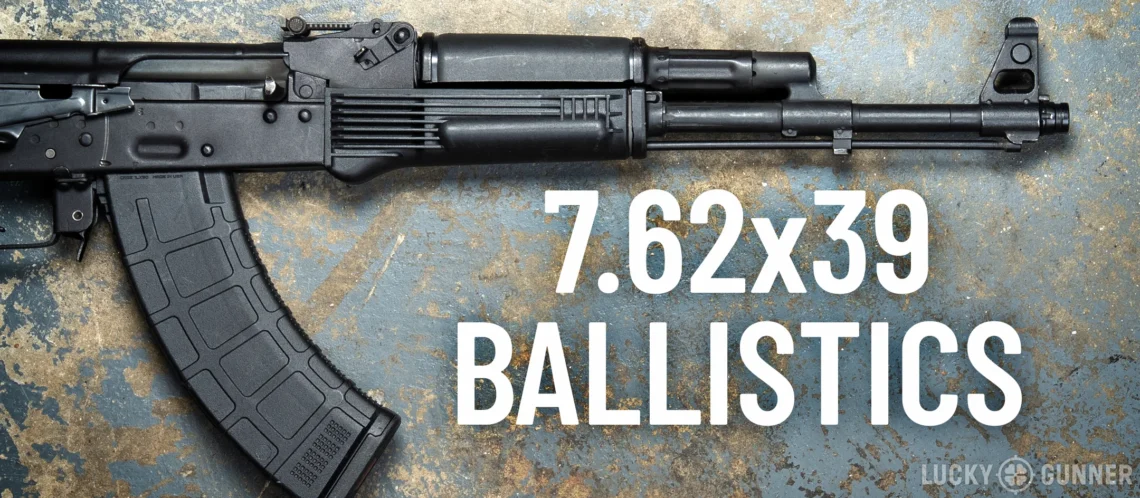

7.62x39mm has always been the province of the AK. And most of the time, that means a 16-inch barrel. However, pistol-pattern and short-barreled AKs are nothing new. And with the proliferation of reliable ARs in 7.62×39, SBRs in this caliber are more common than ever.
So that naturally raises the question of how much performance we give up when 7.62×39 is fired from shorter barrels.
Test Procedure
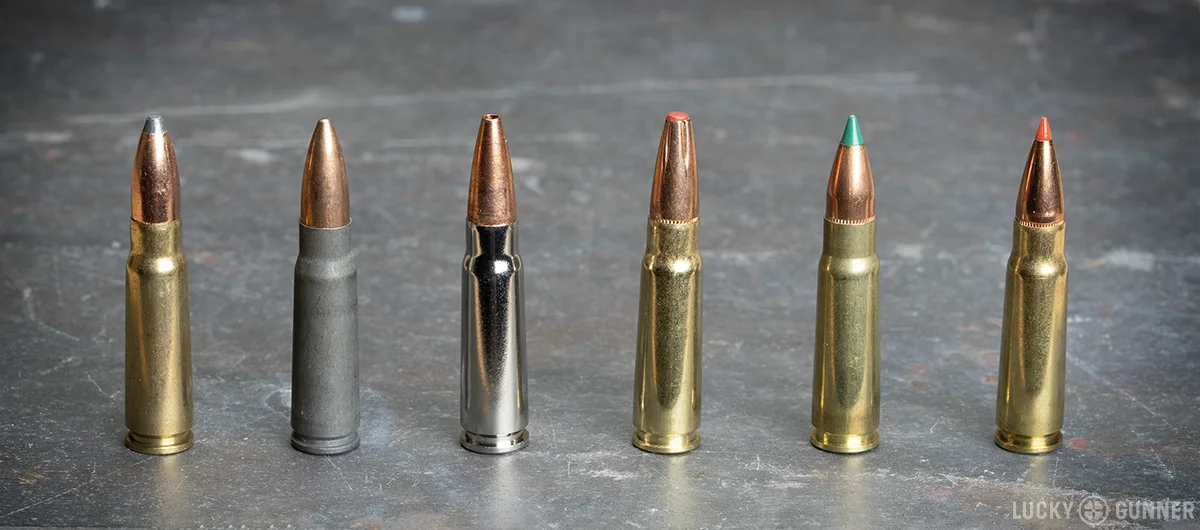
To find out, we tested 13 different loads with three different barrels. There is not as much bullet variety for this caliber as there is with many other rifle cartridges. The vast majority are ~123 grain FMJ, with a handful of soft point and ballistic tip offerings. A few subsonic loads with heavier bullets have also made their way to the market in recent years, and we included two of those in our testing.
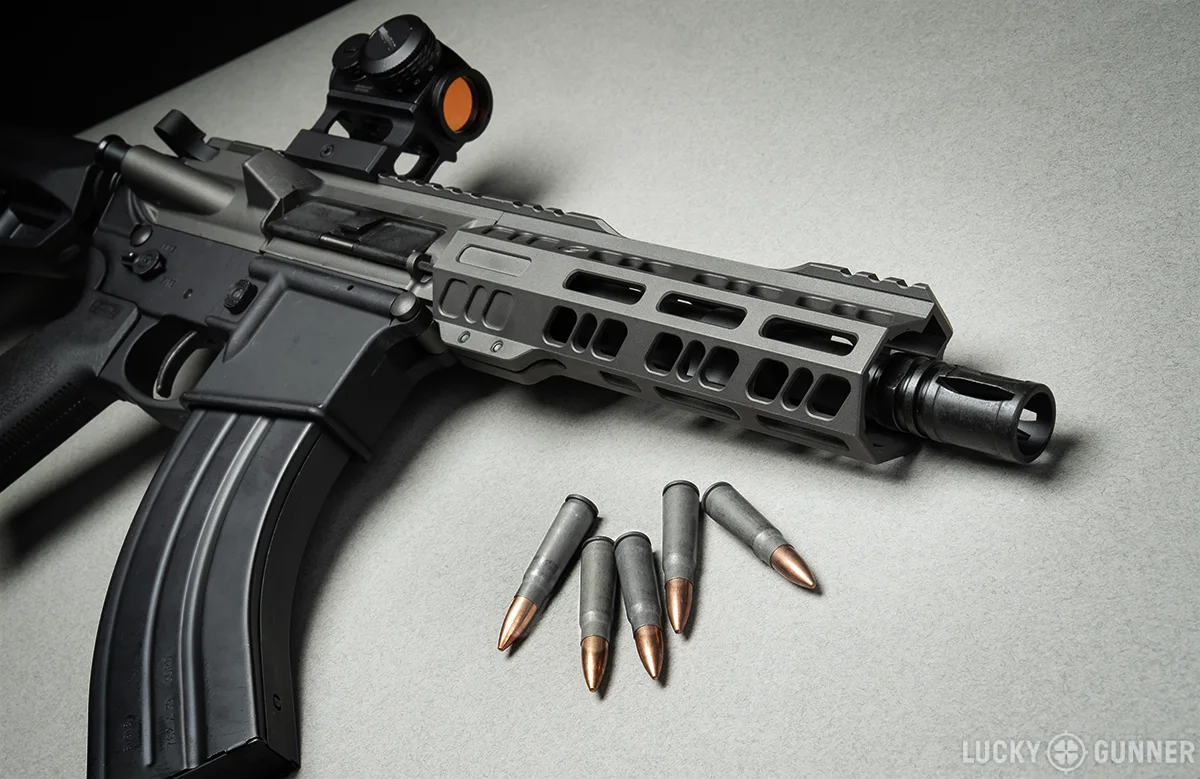
For our test barrels, we used an AK and two short barreled AR uppers:
- 7.5-inch, 1:10 twist (Grid Defense)
- 10.5-inch, 1:10 twist (Grid Defense)
- 16.5-inch, 1:9.44 twist (Arsenal)
We used the same method as our recent .223/5.56 and .300 Blackout velocity tests with a Garmin Xero C1 Pro at the muzzle and a five-shot average for each load/barrel combo.
Muzzle Velocity
The sortable chart below shows all our velocity data in feet per second. We’ve also provided the velocity claimed by the manufacturer as an additional reference point.
| Load | bullet weight | 7.5" | 10.5" | 16.5" | Factory |
|---|---|---|---|---|---|
| Hornady Subsonic 7.62x39 255 gr Sub-X | 255 | 960 | 1047 | 1016 | 1050 |
| Prvi Partizan Subsonic Line 182 gr FMJ BT | 182 | 954 | 1020 | 995 | 1033 |
| MAXXTech 7.62x39 123 gr FMJ | 123 | 1923 | 2157 | 2316 | 2330 |
| Nosler 7.62x39 123 gr Ballistic Tip | 123 | 1904 | 2133 | 2309 | 2350 |
| Belom 7.62x39 123 gr FMJ | 123 | 1928 | 2169 | 2273 | 2350 |
| Hornady Black 7.62x39 123 gr SST | 123 | 1927 | 2146 | 2302 | 2350 |
| Wolf 7.62x39 122 gr FMJ | 122 | 2057 | 2285 | 2374 | 2362 |
| TelaAmmo 7.62x39 124 gr FMJ | 124 | 2043 | 2273 | 2437 | 2354 |
| Sellier & Bellot 124 gr FMJ | 123 | 1978 | 2159 | 2312 | 2350 |
| PMC 7.62x39 123 gr FMJ | 123 | 1934 | 2181 | 2330 | 2350 |
| Fiocchi 7.62x39 123 gr FMJ | 123 | 1896 | 2147 | 2261 | 2375 |
| Federal Power Shok 7.62x39 123 gr JSP | 123 | 1932 | 2154 | 2281 | 2350 |
| Underwood Controlled Chaos 123 gr SCHP | 123 | 1969 | 2180 | 2298 | 2450 |
Muzzle Energy
When we know the velocity and bullet weight, we can also calculate the approximate energy the bullet has. This gives us a rough means of comparing bullets of different weights, but it should not be taken as a direct correlation to each load’s effectiveness. There are many other factors involved in terminal ballistics, especially bullet design and construction. The calculations below are in foot-pounds.
| Load | bullet weight | 7.5" | 10.5" | 16.5" |
|---|---|---|---|---|
| Hornady Subsonic 7.62x39 255 gr Sub-X | 255 | 522 | 620 | 585 |
| Prvi Partizan Subsonic Line 182 gr FMJ BT | 182 | 368 | 420 | 400 |
| MAXXTech 7.62x39 123 gr FMJ | 123 | 1010 | 1271 | 1465 |
| Nosler 7.62x39 123 gr Ballistic Tip | 123 | 991 | 1243 | 1457 |
| Belom 7.62x39 123 gr FMJ | 123 | 1015 | 1285 | 1411 |
| Hornady Black 7.62x39 123 gr SST | 123 | 1014 | 1258 | 1447 |
| Wolf 7.62x39 122 gr FMJ | 122 | 1146 | 1414 | 1527 |
| TelaAmmo 7.62x39 124 gr FMJ | 124 | 1150 | 1423 | 1636 |
| Sellier & Bellot 124 gr FMJ | 123 | 1069 | 1273 | 1461 |
| PMC 7.62x39 123 gr FMJ | 123 | 1021 | 1299 | 1483 |
| Fiocchi 7.62x39 123 gr FMJ | 123 | 982 | 1259 | 1396 |
| Federal Power Shok 7.62x39 123 gr JSP | 123 | 1019 | 1267 | 1422 |
| Underwood Controlled Chaos 123 gr SCHP | 123 | 1059 | 1298 | 1442 |
What You’re Giving Up
Both of our subsonic loads remained firmly in subsonic territory (roughly under 1126 fps) with all three barrels. That’s a good thing. Subsonic rifle loads sometimes go supersonic when fired through 16-inch barrels, giving you the noise of a supersonic load with the compromised ballistics of a subsonic load. Fortunately, that was not the case here.
But the bigger question is how barrel length affects the supersonic loads. On average, they lost 137 fps between the 16.5 and 10.5-inch barrels. Going down to a 7.5-inch barrel, the velocity loss grew to 364 fps, or about 16%.
For comparison, the .223 Rem/5.56 loads we tested lost an average of 25% of their velocity between 7 and 16-inch barrels and .300 Blackout lost only 11% (supersonic loads only).
Oftentimes, a cartridge’s performance varies widely from one load to the next. But since all of our supersonic 7.62×39 loads are right around 123 grains and fall within a similar velocity window for each barrel length, we can make some generalizations. With a 7.5-inch barrel, expect typical velocities in the 1900s. With a 10.5-inch barrel, somewhere in the 2100s. And with a full size 16-inch AK, around 2300. Exceptions exist: Wolf and TelaAmmo are both loaded a bit hotter, for example, but these numbers will get you in the ballpark.
A 123-grain FMJ leaving a 16.5-inch barrel at roughly 2300 fps has already dropped to about 1800 fps by the time it reaches 200 yards. That’s close to the same velocity you get straight out of the muzzle of a 7.5-inch barrel. As velocity drops below 1800 fps, I’d expect expect terminal effectiveness to become increasingly weaker. So pistol-length barrels are probably best reserved for close-range applications.
Factory Velocity vs. Reality
Unlike a lot of cartridges, the factory velocities here are actually pretty close to what we got out of the 16-inch AK – within 100 fps for all but two loads. My guess is that’s because many factory velocities are measured with an unholy long 28-inch test barrel or some such nonsense. But for this caliber, longer barrels are almost unheard of, so ammo makers use more real-world test barrels. If you’re using a full-size AK, you can probably rely on the factory velocity to be at least somewhat close to the ballpark of what your rifle will do more so than you might with other calibers.
Limited Load Selection
Flexibility is not a strong point for this cartridge. Most other intermediate rifle cartridges offer a far broader range of bullet designs and weights, each tailored to a variety of different use cases.
I don’t believe there’s any technical reason why 7.62×39 couldn’t get the same treatment. The lack of variety probably has a lot to do with market inertia. For decades, the primary appeal of this cartridge for the average shooter was its low cost. Nobody was really looking too closely at bullet design when they were getting a case of ammo for $80. FMJ would get the job done for basic self-defense or stocking up for your favorite Red Dawn scenario. The segment of shooters looking for premium loads with bullets optimized for hunting or precision was comparatively small.
Today, 7.62×39 is still more affordable than most other rifle ammo, but it’s no longer the bargain bin cost leader it once was (basic range ammo is generally about 50% more than .223/5.56). Shooters now want more out of this cartridge than just a cheap price tag. We have a few modern loads from companies like Hornady and Nosler, and hopefully more will follow. But for the time being, 123-grain FMJ (and sometimes basic soft points) are the default offering from most ammo makers.
The Bottom Line
None of this makes 7.62×39 a bad pick for a short-barreled build. A 15-20% velocity loss is a known, predictable tradeoff. The bigger limitation is what’s actually loaded for this cartridge. If the existing loads do what you need them to do, that’s not an issue. Otherwise, until more companies decide the R&D is worthwhile, your choices remain thin compared to what’s out there for other intermediate rifle cartridges.