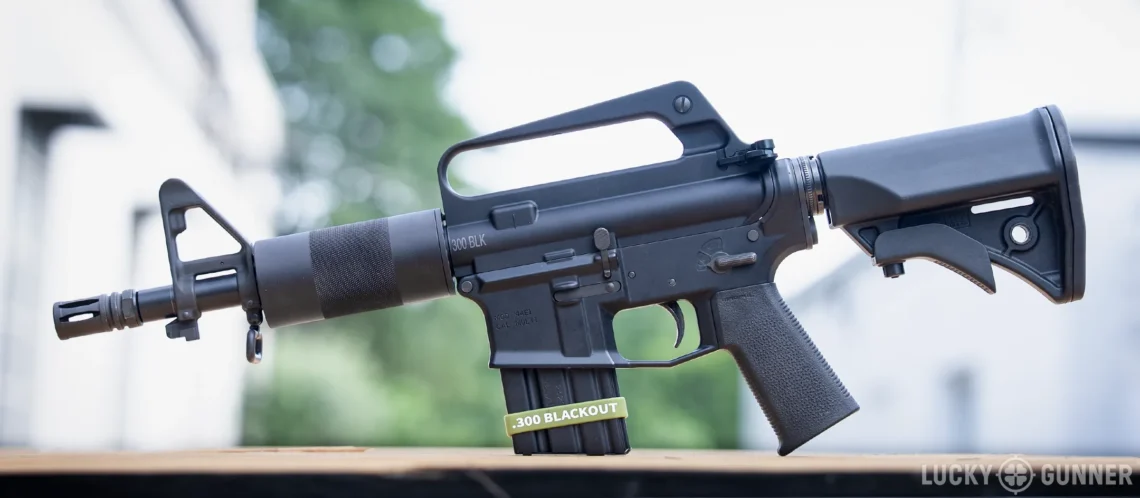

.300 Blackout has been called “efficient” so often that the word has almost lost its meaning. So we measured it.
Usually, efficient just means the powder burns quickly enough to get the bullet close to full velocity, even from a short barrel. And what pairs well with short barrels? Suppressors. So it’s no coincidence that .300 Blackout was also designed with both subsonic and supersonic loads in mind.
But that still leaves us with some questions. Is there any velocity advantage with longer .300 Blackout barrels? How short is too short? How does a .300 Blackout short barrel performance compare to other cartridges? Let’s look at the numbers.
What We Did to Test
We tested 13 different 300 Blackout ammo options across three barrel lengths. Five of those loads were subsonic, and eight were supersonic. Mixing bullet weights that far apart usually doesn’t make for a clean comparison, but with .300 Blackout, that’s kind of the point. You can swap between supersonic and subsonic ammo depending on the application, knowing that you’re sacrificing ballistic performance for a reduced sound signature.
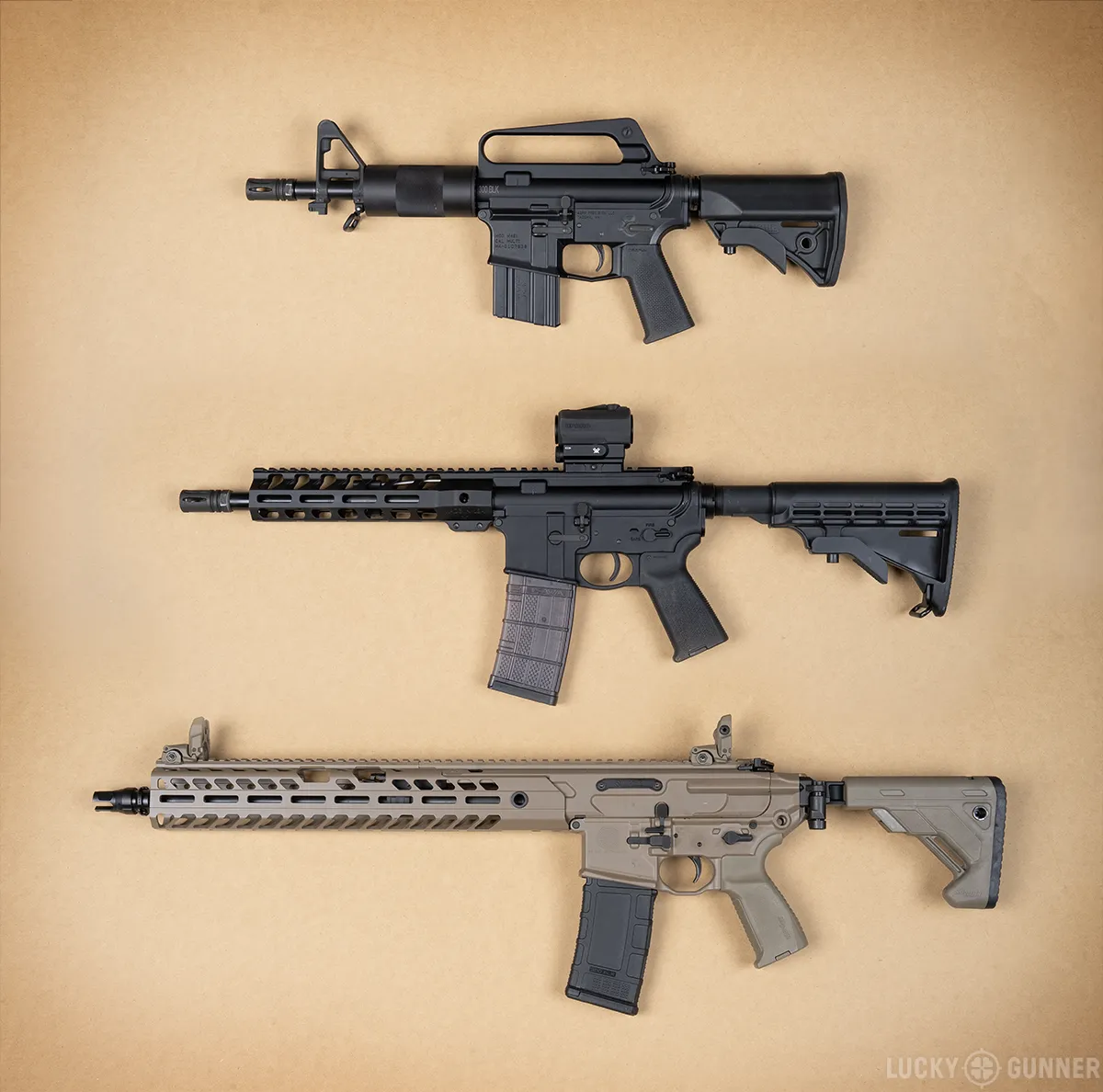
Our three test barrels were:
- 7.5-inch, 1:7 twist (DPMS)
- 10.5-inch, 1:7 twist (PSA)
- 16.5-inch, 1:6 twist (Sig)
We used the same method as our recent .223/5.56 velocity test – Garmin Xero C1 Pro at the muzzle, five-shot average for each load/barrel combo.
Muzzle Velocity
Here’s the velocity data, in feet per second. We also included the manufacturer’s advertised velocity for each load so you can see how it compares to what we actually measured out of these three barrels.
| Load | bullet weight | 7.5" | 10.5" | 16.5" | Factory |
|---|---|---|---|---|---|
| Winchester .300 BLK 200 gr Open Tip | 200 | 989 | 1048 | 1082 | 1060 |
| Hornady .300 BLK 190 gr Sub-X | 190 | 1028 | 1082 | 1107 | 1050 |
| Magtech .300 BLK 200 gr FMJ | 200 | 1017 | 1097 | 1139 | 1050 |
| Hornady Frontier .300 BLK 208 gr FMJ | 208 | 1047 | 1082 | 1099 | 1025 |
| Sellier & Bellot .300 BLK 200 gr FMJ | 200 | 988 | 1034 | 1087 | 1060 |
| American Quality Ammo .300 BLK 147 gr FMJ | 147 | 1679 | 1785 | 1880 | 2000 |
| Winchester .300 BLK 147 gr FMJ | 147 | 1747 | 1847 | 1949 | 1920 |
| Hornady .300 BLK 110 gr V-Max | 110 | 2055 | 2229 | 2376 | 2375 |
| Sellier & Bellot .300 BLK 147 gr FMJ | 147 | 1846 | 1971 | 2088 | 2077 |
| Federal American Eagle .300 BLK 150 gr FMJ | 150 | 1680 | 1813 | 1910 | 1900 |
| Federal Fusion .300 BLK 150 gr SP | 150 | 1713 | 1853 | 1958 | 1900 |
| Barnes VOR-TX .300 BLK 120 gr TAC-XT | 120 | 1920 | 2026 | 2135 | 2100 |
| Barnes VOR-TX .300 BLK 110 gr TAC-XT | 110 | 2052 | 2189 | 2297 | 2350 |
Muzzle Energy
Velocity alone doesn’t tell you much about a cartridge like .300 Blackout, especially when you’re comparing a 110 grain bullet to a 220 grain bullet. So we also calculated muzzle energy for each load and barrel. Muzzle energy is just a function of bullet weight and velocity, so it gives us a rough way to compare loads of different weights on more even footing. The calculations below are in foot-pounds.
| Load | bullet weight | 7.5" | 10.5" | 16.5" |
|---|---|---|---|---|
| Winchester .300 BLK 200 gr Open Tip | 200 | 435 | 488 | 520 |
| Hornady .300 BLK 190 gr Sub-X | 190 | 446 | 494 | 517 |
| Magtech .300 BLK 200 gr FMJ | 200 | 459 | 535 | 576 |
| Hornady Frontier .300 BLK 208 gr FMJ | 208 | 506 | 540 | 558 |
| Sellier & Bellot .300 BLK 200 gr FMJ | 200 | 434 | 475 | 525 |
| American Quality Ammo .300 BLK 147 gr FMJ | 147 | 921 | 1040 | 1154 |
| Winchester .300 BLK 147 gr FMJ | 147 | 996 | 1114 | 1240 |
| Hornady .300 BLK 110 gr V-Max | 110 | 1032 | 1214 | 1380 |
| Sellier & Bellot .300 BLK 147 gr FMJ | 147 | 1113 | 1269 | 1424 |
| Federal American Eagle .300 BLK 150 gr FMJ | 150 | 940 | 1095 | 1216 |
| Federal Fusion .300 BLK 150 gr SP | 150 | 977 | 1144 | 1278 |
| Barnes VOR-TX .300 BLK 120 gr TAC-XT | 120 | 983 | 1094 | 1215 |
| Barnes VOR-TX .300 BLK 110 gr TAC-XT | 110 | 1029 | 1170 | 1289 |
The Curve Is Flat
If you read the .223 velocity article, you already know that cartridge sees huge velocity gains going from a 7-inch to a 10.5-inch barrel, then flattens out fast after that. .300 Blackout never gets that early jump. It’s flat the whole way.
That’s exactly what we want with subsonic loads. If they gain too much velocity, they’ll break the supersonic threshold (around 1100-1125 fps), which defeats the purpose of those loads entirely. In fact, that’s exactly what happened with the Magtech 200 gr and Hornady 190 Sub-X loads out of the 16.5” barrel.
Our eight supersonic loads also had modest velocity gains. On average, going from a 7.5-inch barrel to a 16.5-inch barrel only added an extra 238 fps (a 13% increase in velocity). Compare that to 5.56, where the average gain from 7 inches to 16 inches was around 700 fps — nearly three times as much.
Efficient
The muzzle energy numbers really showcase .300 Blackout’s reputation for efficiency. With a 7.5-inch barrel, our eight supersonic .300 Blackout loads averaged 999 ft-lbs. For comparison, 5.56 out of a 7-inch barrel averaged 628 ft-lbs. It needs a 14.5-inch barrel to catch up to .300 BLK’s 7.5-inch number.
Muzzle energy isn’t a great stand-in for terminal effectiveness, and 37% more muzzle energy doesn’t mean it’s 37% more effective on a target. But it’s the kind of gap that’s hard to ignore, and it goes a long way toward explaining why a lot of hunters prefer .300 BLK over 5.56 for medium-sized game inside 150 yards or so.
What the Numbers Don’t Show
None of this means .300 Blackout is winning any awards for long range performance. Even with supersonic loads, velocity falls off fast with distance. What looks like a respectable number at the muzzle doesn’t stay that way for long. Trajectory is rough too, closer to 7.62×39 or .30-30 than anything resembling .223. Other intermediate cartridges like 6.5 Grendel and 6mm ARC will outperform .300 BLK in most measures of both terminal and external ballistics, and probably by a wide margin.
The real advantage of .300 Blackout is flexibility rather than raw ballistics. You get solid performance inside 150 yards, it’s easy to run in a suppressed, short barreled rifle, easy to switch between subsonic and supersonic ammo without changing anything else about the gun, and there’s no shortage of factory loads for either.
Final Thoughts
A short barrel doesn’t cost you much with .300 Blackout. The velocity curve is flat almost from the start, and the energy numbers make a real case for why this cartridge earned its reputation for short barrel, suppressed use. Just don’t expect it to do much for you at distance.
That short barrel, suppressed use case also just got a lot more accessible. Now that SBR and suppressor tax stamps are $0, building the kind of compact, quiet .300 Blackout setup this cartridge was made for is easier than ever before. We could be entering a real golden age for .300 Blackout.