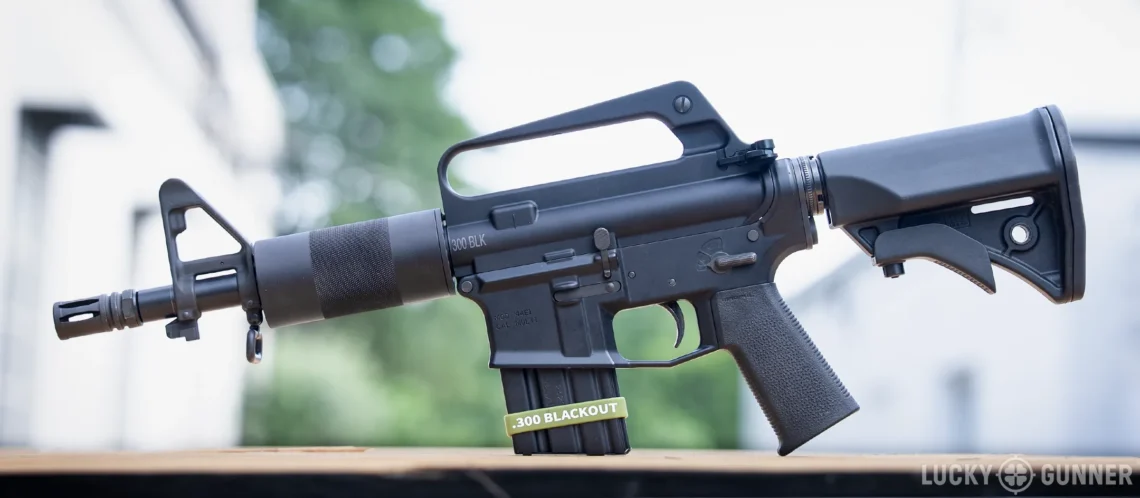

.300 Blackout has been called “efficient” so often that the word has almost lost its meaning. So we measured it.
Usually, efficient just means the powder burns quickly enough to get the bullet close to full velocity, even from a short barrel. And what pairs well with short barrels? Suppressors. So it’s no coincidence that .300 Blackout was also designed with both subsonic and supersonic loads in mind.
But that still leaves us with some questions. Is there any velocity advantage with longer .300 Blackout barrels? How short is too short? How does a .300 Blackout short barrel performance compare to other cartridges? Let’s look at the numbers.
What We Did to Test
We tested 13 different 300 Blackout ammo options across three barrel lengths. Five of those loads were subsonic, and eight were supersonic. Mixing bullet weights that far apart usually doesn’t make for a clean comparison, but with .300 Blackout, that’s kind of the point. You can swap between supersonic and subsonic ammo depending on the application, knowing that you’re sacrificing ballistic performance for a reduced sound signature.
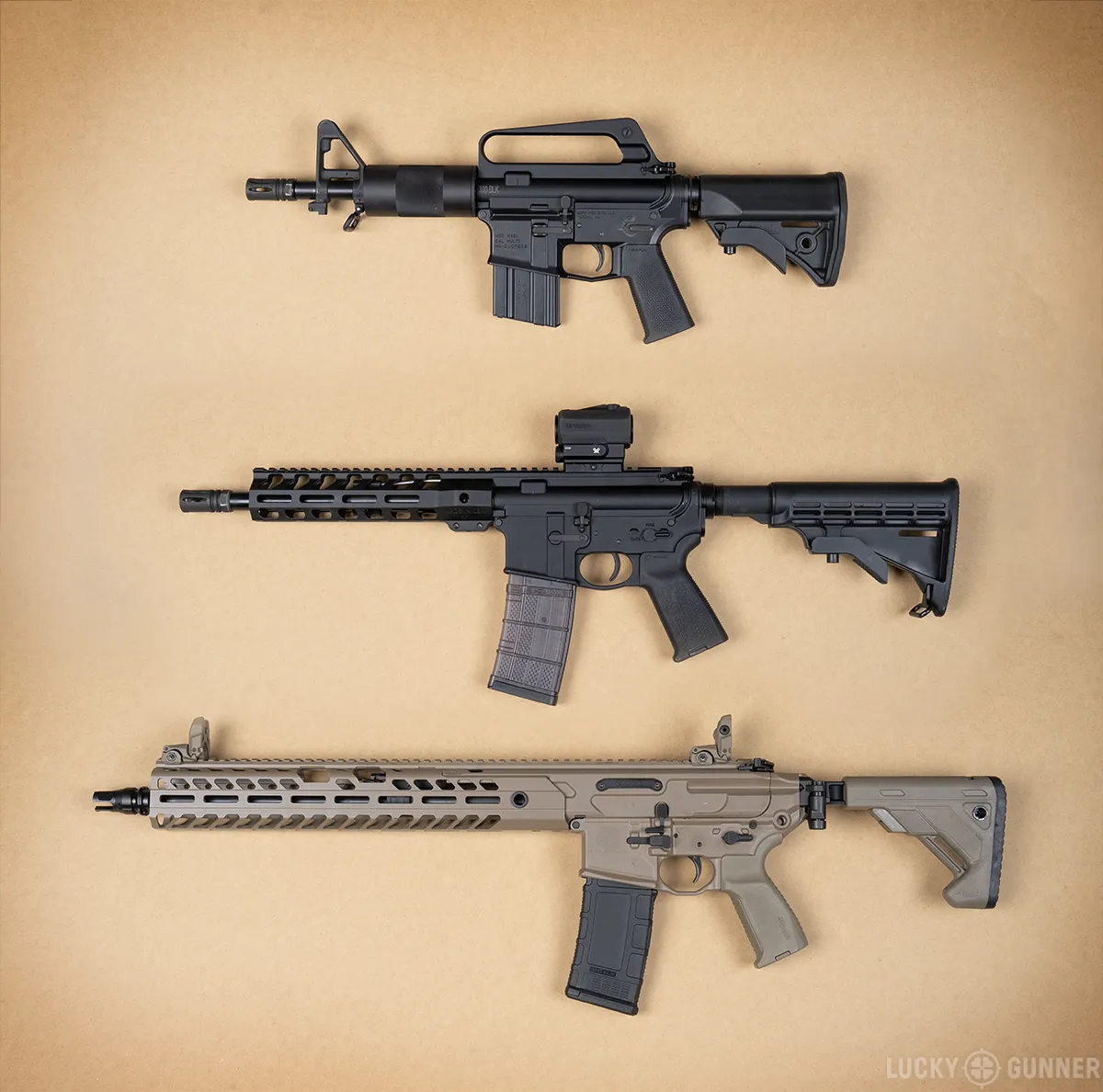
Our three test barrels were:
- 7.5-inch, 1:7 twist (DPMS)
- 10.5-inch, 1:7 twist (PSA)
- 16.5-inch, 1:6 twist (Sig)
We used the same method as our recent .223/5.56 velocity test – Garmin Xero C1 Pro at the muzzle, five-shot average for each load/barrel combo.
Muzzle Velocity
Here’s the velocity data, in feet per second. We also included the manufacturer’s advertised velocity for each load so you can see how it compares to what we actually measured out of these three barrels.
| Load | bullet weight | 7.5" | 10.5" | 16.5" | Factory |
|---|---|---|---|---|---|
| Winchester .300 BLK 200 gr Open Tip | 200 | 989 | 1048 | 1082 | 1060 |
| Hornady .300 BLK 190 gr Sub-X | 190 | 1028 | 1082 | 1107 | 1050 |
| Magtech .300 BLK 200 gr FMJ | 200 | 1017 | 1097 | 1139 | 1050 |
| Hornady Frontier .300 BLK 208 gr FMJ | 208 | 1047 | 1082 | 1099 | 1025 |
| Sellier & Bellot .300 BLK 200 gr FMJ | 200 | 988 | 1034 | 1087 | 1060 |
| American Quality Ammo .300 BLK 147 gr FMJ | 147 | 1679 | 1785 | 1880 | 2000 |
| Winchester .300 BLK 147 gr FMJ | 147 | 1747 | 1847 | 1949 | 1920 |
| Hornady .300 BLK 110 gr V-Max | 110 | 2055 | 2229 | 2376 | 2375 |
| Sellier & Bellot .300 BLK 147 gr FMJ | 147 | 1846 | 1971 | 2088 | 2077 |
| Federal American Eagle .300 BLK 150 gr FMJ | 150 | 1680 | 1813 | 1910 | 1900 |
| Federal Fusion .300 BLK 150 gr SP | 150 | 1713 | 1853 | 1958 | 1900 |
| Barnes VOR-TX .300 BLK 120 gr TAC-XT | 120 | 1920 | 2026 | 2135 | 2100 |
| Barnes VOR-TX .300 BLK 110 gr TAC-XT | 110 | 2052 | 2189 | 2297 | 2350 |
Muzzle Energy
Velocity alone doesn’t tell you much about a cartridge like .300 Blackout, especially when you’re comparing a 110 grain bullet to a 220 grain bullet. So we also calculated muzzle energy for each load and barrel. Muzzle energy is just a function of bullet weight and velocity, so it gives us a rough way to compare loads of different weights on more even footing. The calculations below are in foot-pounds.
| Load | bullet weight | 7.5" | 10.5" | 16.5" |
|---|---|---|---|---|
| Winchester .300 BLK 200 gr Open Tip | 200 | 435 | 488 | 520 |
| Hornady .300 BLK 190 gr Sub-X | 190 | 446 | 494 | 517 |
| Magtech .300 BLK 200 gr FMJ | 200 | 459 | 535 | 576 |
| Hornady Frontier .300 BLK 208 gr FMJ | 208 | 506 | 540 | 558 |
| Sellier & Bellot .300 BLK 200 gr FMJ | 200 | 434 | 475 | 525 |
| American Quality Ammo .300 BLK 147 gr FMJ | 147 | 921 | 1040 | 1154 |
| Winchester .300 BLK 147 gr FMJ | 147 | 996 | 1114 | 1240 |
| Hornady .300 BLK 110 gr V-Max | 110 | 1032 | 1214 | 1380 |
| Sellier & Bellot .300 BLK 147 gr FMJ | 147 | 1113 | 1269 | 1424 |
| Federal American Eagle .300 BLK 150 gr FMJ | 150 | 940 | 1095 | 1216 |
| Federal Fusion .300 BLK 150 gr SP | 150 | 977 | 1144 | 1278 |
| Barnes VOR-TX .300 BLK 120 gr TAC-XT | 120 | 983 | 1094 | 1215 |
| Barnes VOR-TX .300 BLK 110 gr TAC-XT | 110 | 1029 | 1170 | 1289 |
The Curve Is Flat
If you read the .223 velocity article, you already know that cartridge sees huge velocity gains going from a 7-inch to a 10.5-inch barrel, then flattens out fast after that. .300 Blackout never gets that early jump. It’s flat the whole way.
That’s exactly what we want with subsonic loads. If they gain too much velocity, they’ll break the supersonic threshold (around 1100-1125 fps), which defeats the purpose of those loads entirely. In fact, that’s exactly what happened with the Magtech 200 gr and Hornady 190 Sub-X loads out of the 16.5” barrel.
Our eight supersonic loads also had modest velocity gains. On average, going from a 7.5-inch barrel to a 16.5-inch barrel only added an extra 238 fps (a 13% increase in velocity). Compare that to 5.56, where the average gain from 7 inches to 16 inches was around 700 fps — nearly three times as much.
Efficient
The muzzle energy numbers really showcase .300 Blackout’s reputation for efficiency. With a 7.5-inch barrel, our eight supersonic .300 Blackout loads averaged 999 ft-lbs. For comparison, 5.56 out of a 7-inch barrel averaged 628 ft-lbs. It needs a 14.5-inch barrel to catch up to .300 BLK’s 7.5-inch number.
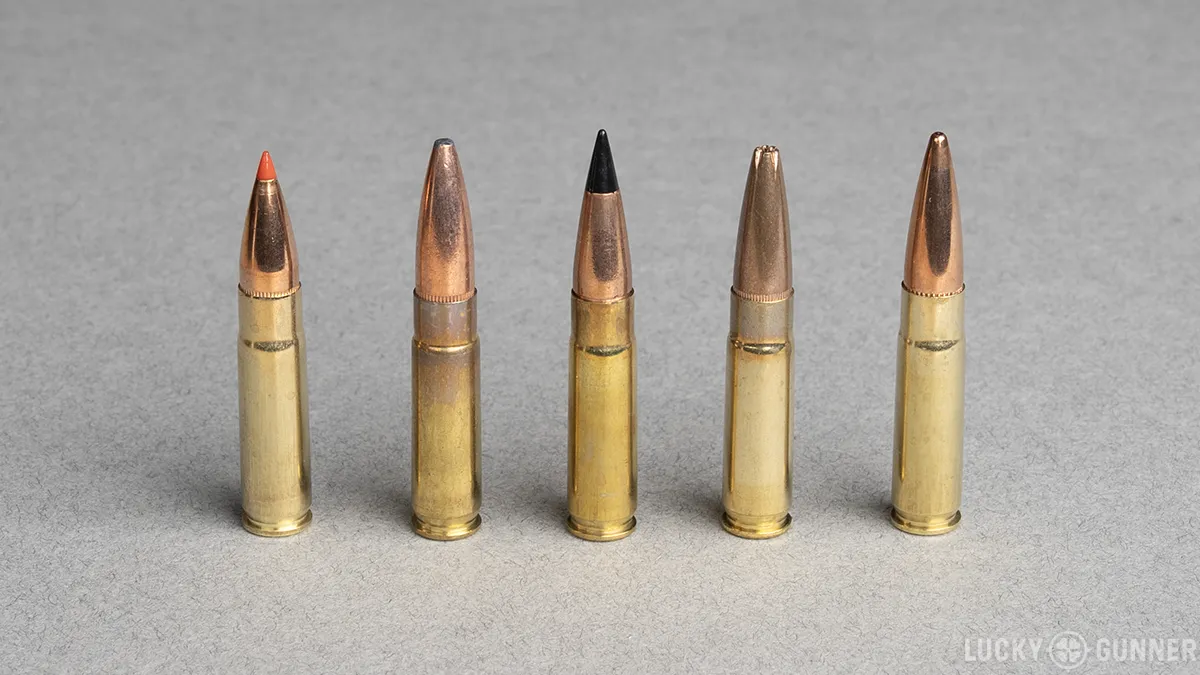
Muzzle energy isn’t a great stand-in for terminal effectiveness, and 37% more muzzle energy doesn’t mean it’s 37% more effective on a target. But it’s the kind of gap that’s hard to ignore, and it goes a long way toward explaining why a lot of hunters prefer .300 BLK over 5.56 for medium-sized game inside 150 yards or so.
What the Numbers Don’t Show
None of this means .300 Blackout is winning any awards for long range performance. Even with supersonic loads, velocity falls off fast with distance. What looks like a respectable number at the muzzle doesn’t stay that way for long. Trajectory is rough too, closer to 7.62×39 or .30-30 than anything resembling .223. Other intermediate cartridges like 6.5 Grendel and 6mm ARC will outperform .300 BLK in most measures of both terminal and external ballistics, and probably by a wide margin.
The real advantage of .300 Blackout is flexibility rather than raw ballistics. You get solid performance inside 150 yards, it’s easy to run in a suppressed, short barreled rifle, easy to switch between subsonic and supersonic ammo without changing anything else about the gun, and there’s no shortage of factory loads for either.
Final Thoughts
A short barrel doesn’t cost you much with .300 Blackout. The velocity curve is flat almost from the start, and the energy numbers make a real case for why this cartridge earned its reputation for short barrel, suppressed use. Just don’t expect it to do much for you at distance.
That short barrel, suppressed use case also just got a lot more accessible. Now that SBR and suppressor tax stamps are $0, building the kind of compact, quiet .300 Blackout setup this cartridge was made for is easier than ever before. We could be entering a real golden age for .300 Blackout.


My Anderson ‘Pistol’ with 10.5″ barrel chronos average of 2240 fps with Vmax 110s. The WW2 M1 Carbine would barely make 2000 fps from a 18″ barrel. And the Carbine had a round nose slug profile.. not a spitzer! Makes my ‘Pistol’ a real PDW! Thank God I live in Texas… no qualms about having it as a car/truck gun!
i have a 300bo with 7 1/2″ barrel, and about to get another with 10″ barrel, they make great for personal defense(with the right ammo) and truck guns
First , I enjoy the information you provide.this is by no means a criticism of the posting. You hit on three loads that I use regularly and you were on target with two of the barrel lengths. For years the only quality subsonic 300 BLK loads were both from Remington and both 220 grain. I used both in my 8in CMMG upper from (at least ,probably longer)ten years ago. I started using the AAC black tip 220 grain and it was fantastic.My latest 300 is an AERO PRECISION 10 in upper that I’m using Hornady 190 SUBX and S&B 200 gr which amazingly hit to the same point of aim. It would have been nice to see those 220 grain loads included but I understand the limitations. All my 300 BLK shooting is subsonic with either a Gemtech Sandstorm or a Silencerco Omega 300.
Thanks for the suggestion, Rick. We may add more loads to the list sometime in the future.
very good information, i have learned a lot from your ballistic info across all platforms, i currently carry an 8 inch 300bo unsuppressed, and use either hornady black, or tap ammo, or aac sabre black tip as back up ammo, and for a 100yds or so suites me fine, if i need to reach out and touch something at a distance i will grab my 5.56. thanks and keep up the good work
Thank you for tackling the sub and super data set for the blackout.
Have you considered evaluating the optimal twist rate by bullet weight for subs and supers, and what the optimal twist and bullet combination is for accuracy in the sub/super platform. Where the operator will be switching between the subs and supers?
I found that my 1:10 twist barrel is very accurate with 110 grains but is concerningly inaccurate using 220’s.
Additionally, terminal effect evaluation of slower yet heavier pill vs the lighter faster. Does going suppressed subsonic turn the rifle into a pistol? I’ve read in other places those slow heavy pills act more like a field tip arrow.
It stands to reason that heavy/slow will only mushroom(create hydraulic effect) if pill construction allows. I’ve heard that as the supers slow they struggle to operate since they where designed to operate above ~1200fps.
Is there a bullet designed to operate between 2000 and 500fps? Can we use it in a length and twist that provides sub 2MOA suppressed and not?
Thanks again if you got this far.
One interesting facet of .300 BO history is that it even predates the .300 WHISPER that AAC copied and then had Remington sponsor for SAMMI certification. JDJ was developing it thru the 90s as a suppressed round for hunting, but in those days suppressors were a rare privilege to own, unlike now.
That the early development was going on in the late 70s is even less known, and yet I witnessed it early on at an invitational 3 Gun match at Chapman’s Range in Columbia, MO. As we were observing the “Battle Rifle” portion of the match, a competitor who had been removed from the shooting list was advertising the reason why to all and sundry who passed by. He held up a .30 cal cartridge – in a necked out 5.56 case – and explained even tho it was Match legal under the rules, the course officials would not allow it as he was going to shoot it in an AR15. It was a wildcat .30 in a AR case. We politely listened, then moved on.
I kept hearing about how AAC had literally designed the .300 BO for the job, knowing that JDJ had worked on the Whisper when it finally came to me I knew better. A lot of AR fans were attempting to get around the mandated .30 caliber rule in 3 Gun at the time, knowing and later being proved right – the AR could take a match, and even dominate (which is still does today) over .30 cal “battle rifles” simply thru less recoil and faster subsequent on target shooting – accurately. It was proven very quickly in Service Rifle matches using military issue weapons – which is why the .30 only crowd was being so recalcitrant. They knew they would be deposed and shunted to runner up as soon as the AR was allowed.
That is exactly the historic record. Yet, as JDJ suffered, the .30 in a 5.56 case wasn’t rapidly adopted, all because in taking the AR as an allowed rifle in 3 Gun, 5.56 came with it. Nobody wanted to reload ammo especially for a competition rifle, and in light of the incredibly cheap cost of surplus 5.56, it was a significant factor, especially if you were an intense trainer who fired 10k rounds a year. So, the wildcat puttered along until AAC saw it as an adjunct round well fitted for suppressed use, and a competitive alternative to 6.5 Grendel or 6.8 SPC. Those were some intense internet wars in the day, with the .300 BO fans usually running out of argument compared to the reams of data 6.5 fans would publish, or the volumes of pics of game taken with the 6.8 – which the Army Marksmanship Unit had created to increase power by 50% compared to the 5.56. Now, those are considered the odd cartridges and .300 BO has taken the forefront.
Im not about to rebarrel my 6.8, we all enjoy our results. One thing remains, alternative cartridges won’t ever be surplus cheap – that is a limitation that cannot be overcome. Living with commercial prices for most ammo leaves 5.56 still ahead in this race until the next new issue cartridge comes along, and it will take decades for it to establish itself in the market. The new military 6.8 isn’t the same thing – it runs much higher pressure in a larger case – it remains to be seen how things will work out.